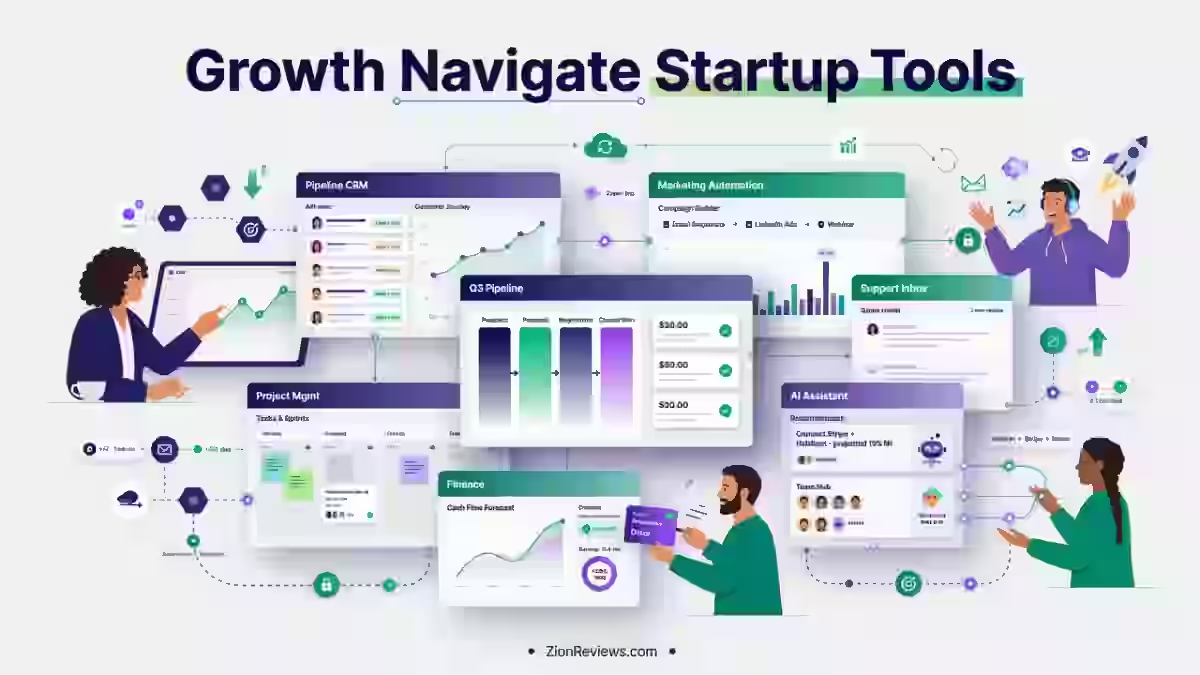
TL;DR: Growth navigate startup tools cover CRM, sales, marketing automation, project management and financial planning software that early-stage companies use to acquire customers and manage cash.
The main takeaway: pick tools by the metric they move, not by feature count and connect them so your team has one single source of truth for customer data.
This guide is for founders, small teams and marketers trying to build an effective software stack without overspending.
Quick Answer: What Are the Core Growth Navigate Startup Tools Most Startups Need?
Here’s a direct answer before we go deeper.
- CRM platform: Manages contact management, customer data, your sales pipeline, and the customer journey. HubSpot (free tier, up to 2 users) or Pipedrive ($14 to $59/user/month) are the most common starting points.
- Project management tool: Handles task tracking, team collaboration, and internal communication. Notion, Linear or Trello depending on your team’s workflow.
- Marketing automation tool: Runs email campaigns, automated sequences, and lead scoring to support customer acquisition. Mailchimp (free up to 250 contacts) or HubSpot’s paid tiers.
- Outreach and lead generation tool: Supports B2B sales, LinkedIn outreach, and cold email at scale. Apollo.io or Clay depending on your technical capability and budget.
- Analytics and reporting dashboards: Tracks user behavior, traffic sources, and conversion data to inform your go-to-market strategy. Google Analytics (free) is the baseline.
- Workflow automation: Connects tools and removes repetitive manual work from your team’s day. Zapier or Make.
- Knowledge base and documentation: Creates a single source of truth for processes, customer data, and team documentation. Notion or Confluence.
- Financial planning tool: Tracks monthly recurring revenue, burn rate, runway management and customer acquisition cost. Paddle, Baremetrics or a spreadsheet at pre-seed.
What Are Growth Navigate Startup Tools (And Why Your Stack Choice Matters)
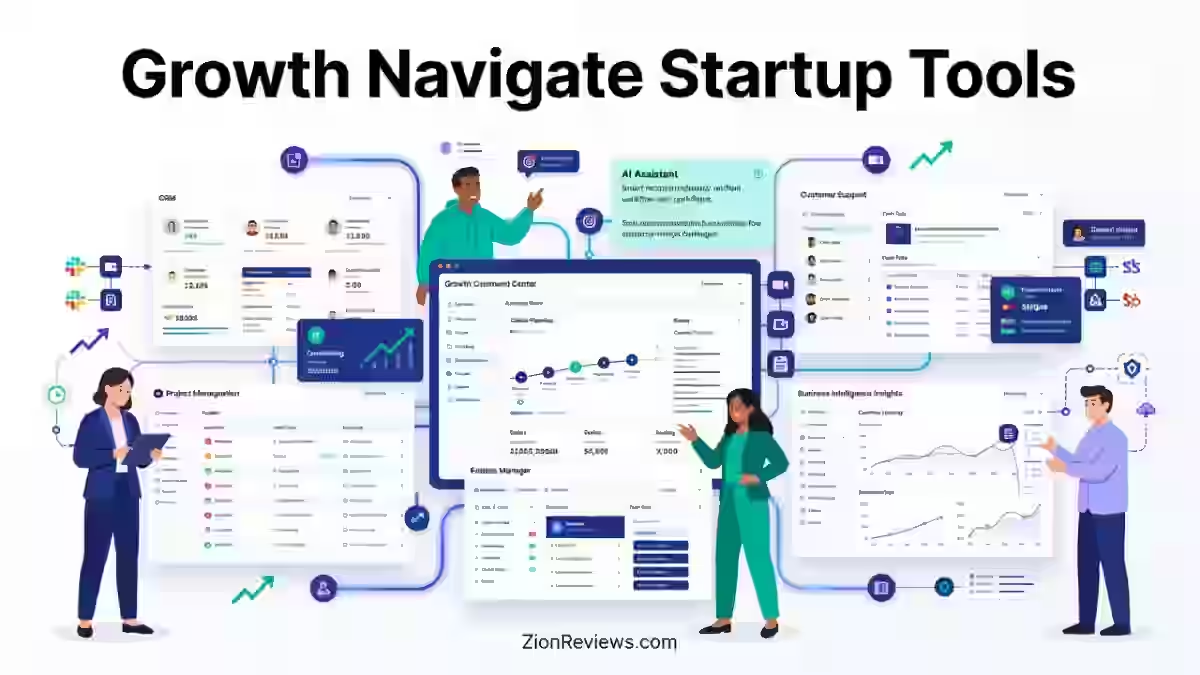
Growth navigate startup tools are software platforms you choose deliberately to help your team acquire customers, track performance, manage projects, automate repetitive work and make data-driven decisions without burning through runway
If you’ve ever opened your company’s billing dashboard and felt a quiet panic about how many SaaS subscriptions are running, you’re not alone.
Most early-stage failures advisors audit run too many tools, not too few.
The problem isn’t a lack of options. It’s that founders tend to add tools reactively, one problem at a time, until the stack becomes a disorganized mess of overlapping features and forgotten logins.
The word “growth” here doesn’t mean hockey-stick promises. It means picking tools that serve a real function at your current stage and can scale as your needs change.
Growth navigate startup tools are specifically chosen to help early-stage companies grow faster, operate leaner and make better decisions with limited resources.
A growing startup is constantly making decisions with incomplete information which channel to invest in, which customers to prioritize, which processes to automate first.
The right tools give you the data and systems to make those decisions confidently instead of guessing.
I’ve tested tools across CRM platforms, project management software, outreach automation and marketing automation for different client setups.
The clearest pattern: teams that commit to fewer, better-integrated tools consistently outperform teams running a scattered toolset.
How Much Should a Startup Actually Spend on Tools?
Before reviewing individual tools, let’s talk money because this is where most founders get it wrong.
Lean seed-stage startups typically spend $400 to $500 per month on software, which covers basic tools like email, communication, and project management before they scale their tech stack.
That’s the full stack, not just one category.
The rule of thumb is to spend less than 5% of your MRR on growth tools at seed stage.
If you’re burning 80K/month and making 20K MRR, your growth tool budget should be around 1K/month, not 4K.
Companies shifted from expansion to optimization, reducing average software counts from 371 apps per company in 2023 to 220 in 2024, driven by tighter tech budgets and a focus on cost control.
Startups are cutting redundant tools aggressively. The winning strategy is to pick fewer tools with broader functionality.
Audit your stack at least twice a year. Remove what nobody uses, consolidate overlapping features, and keep an eye on how much of your burn goes to software instead of people and distribution.
CRM Platform: Managing Your Sales Pipeline and Customer Relationship Management
Every startup building a sales and marketing function needs a CRM before it needs almost anything else.
At the earliest stage, founders often track leads in a spreadsheet. That can work for a while.
However, spreadsheets crack once multiple people start selling, marketing campaigns generate more leads, or follow-up timing becomes important. A CRM becomes useful when leads start slipping through the cracks.
HubSpot CRM
HubSpot is the most common starting CRM for early-stage startups, and for good reason.
HubSpot CRM remains a go-to because of its free core CRM features and a HubSpot for Startups program, which offers discounts up to 90%.
HubSpot’s free Sales Hub supports up to 2 users and includes basic pipeline management, contact tracking, and Gmail/Outlook integration at $0.
The limitation becomes clear when you start scaling. HubSpot isn’t highly customizable, which may be a problem for certain startups. HubSpot’s free CRM is extremely limited.
As startups grow, they may need to upgrade to a paid plan or an entirely different service, which can be a hassle.
Pipedrive
Pipedrive is purpose-built for sales-led teams that want clear pipeline visibility without the feature bloat of an all-in-one suite.
Pipedrive stands out among sales-focused CRMs for its simplicity. Founders who want a straightforward way to overview their pipeline and don’t need a full suite of marketing or support tools often gravitate here.
The current plan lineup is Lite, Growth, Premium, and Ultimate. Lite is the cheapest at $14/seat/month on annual billing, or $24 on monthly billing.
It is genuinely basic: no email sync, no sequences, and no automation. For a working sales team, the cheapest usable plan is Growth at $39.
The real cost warning: Pipedrive’s low entry price of $14/user/month sounds great. But the catch is that it doesn’t include the features most teams actually need.
Once you factor in add-ons, your bill grows fast, and suddenly that “simple CRM” can cost over $250/month for even small teams.
Pipedrive is focused on sales, so you won’t find built-in marketing automation or customer service features.
If your startup needs project management or wants to track more than just deals, you’ll need to connect third-party apps or look elsewhere.
CRM Platform Comparison Table
Tool | Free Tier | Starting Paid Price | Best For | Weakness |
|---|---|---|---|---|
HubSpot CRM | Yes (2 users) | $20/user/month (Sales Hub Starter) | Startups needing CRM + marketing in one | Customization limits; costs rise steeply |
Pipedrive | No (14-day trial) | $14/seat/month (Lite, annual) | Sales-first teams with a clear pipeline | No email sync on Lite; add-on costs add up |
Zoho CRM | Yes (3 users) | $14/user/month | Budget-conscious teams wanting breadth | Steeper learning curve than HubSpot |
Salesforce Starter | No | $25/user/month | Teams wanting structured CRM scalability | Overkill complexity at early stage |
Copper CRM | No | $23/user/month | Google Workspace-native teams | Limited outside the Google ecosystem |
Lead Generation, Data Enrichment and B2B Sales Outreach
Once you have your ideal customer profile defined and some product-market fit signals, outreach becomes the next priority.
Two tools dominate this space for startups running outbound: Apollo.io and Clay.
Apollo.io
Apollo is an all-in-one sales platform with a built-in B2B contact database of 275+ million contacts.
You can search for leads, find their contact information, and execute email sequences or cold calls directly from the platform.
Apollo combines prospecting, enrichment, and outreach in a single tool designed for speed and simplicity.
Apollo.io offers a more traditional per-user pricing model, starting with a free tier and moving into paid plans ranging from 59 to 149 per user per month.
This makes it an attractive, predictable option for lean teams that need a straightforward tool to manage their daily outreach.
Apollo is the right call when your team doesn’t have a dedicated RevOps person, you want one login, and your outreach volume is manageable.
You can sign up, filter for leads using multiple criteria, build a list, and launch an email sequence within 30 minutes. The learning curve is minimal if you’ve used any sales engagement platform.
The downside is data accuracy at scale. Apollo.io maintains massive US coverage and provides solid firmographic and technographic data, making it a reliable choice for high-volume outreach.
However, relying on a single database can occasionally lead to outdated information or gaps in specialized industrial niches.
Clay
Clay is a data enrichment and automation platform that functions like a programmable spreadsheet. It doesn’t have its own database.
Instead, it connects to 100+ data providers to pull real-time information about leads.
Clay specializes in building custom workflows with conditional logic, AI personalization, and waterfall enrichment to prepare hyper-targeted lead lists.
Clay is best for growth teams and RevOps professionals who want to build custom data enrichment and outreach workflows.
Pricing: Free (100 credits/month), Starter ($149/month), Explorer ($349/month), Pro ($800/month), Enterprise (custom).
Apollo wins for teams wanting everything in one login. Clay wins for teams prioritizing data accuracy and advanced personalization who already have outreach tools.
Clay’s credit-based model means costs can escalate. Clay uses a credit-based system that scales with your usage. While plans start around $149 per month, heavy use of its AI research agents and multiple data providers can quickly push costs to $500 or $1,000 per month.
For cold email sending itself, Clay doesn’t send cold emails. You need Smartlead, Instantly, or another tool to handle sending. Apollo sends natively.
For cold email capability alone, Apollo wins. If you need enrichment accuracy first, Clay plus a dedicated sender beats Apollo alone.
Outreach Tool Comparison
Tool | Pricing | Database | Sends Email | Best For |
|---|---|---|---|---|
Apollo.io | Free tier; $59–$149/user/month | 275M+ contacts | Yes (built-in sequences) | All-in-one outreach for lean teams |
Clay | Free (100 credits); from $149/month | 150+ providers (waterfall) | No (needs Instantly/Smartlead) | Data-heavy, personalized outreach |
Instantly | From $37/month | No (bring your own list) | Yes | High-volume cold email sending |
Project Management, Task Tracking and Team Collaboration
A startup’s internal communication and task tracking setup matters more than most founders admit. When these systems break down, so does execution.
The most flexible option for early-stage teams is Notion, which handles project planning, documentation, and team wikis in one place.
Trello works for simple kanban-style task tracking. Linear is the best choice for product and engineering teams that need structured sprint planning.
Notion offers a free tier suited for solopreneurs and early teams, with business upgrades starting at just $10/user/month.
For a genuinely lean minimum viable stack, HubSpot CRM (free for 2 seats), Notion (free workspace), and Linear (free with a 250-issue cap) are among the tools that work well together without spending anything upfront.
For teams that need a full project and work management suite with built-in CRM capability, monday.com’s CRM plans start at $29/user/month (billed annually) and include lead management, project management, advanced reports, and pre-built reporting dashboards.
The Professional plan at $49/user/month adds lead routing, workflow automation, and AI Copilot. The Enterprise plan at $99/user/month adds sandboxes, Products/Pricebooks/Quotes, and audit logging.
Marketing Automation: Running Email Campaigns and Lead Nurturing at Scale
Marketing automation sits at the intersection of revenue generation and efficiency. Done well, it lets a two-person team run the email campaigns and customer journey touchpoints of a much larger organization.
The challenge for early-stage startups is choosing automation tools that match their current volume without locking them into expensive contracts before they’ve found repeatable acquisition.
Email marketing generates an average return of $36 for every $1 spent, a 3,600% return on investment confirmed by the Litmus research data
That makes it worth investing in properly, even at an early stage.
For startups focused on B2B sales and inbound lead scoring, HubSpot’s marketing automation features in paid tiers cover email campaigns, behavioral triggers, and lead qualification workflows in one platform.
For teams that want more flexibility in their workflows without the HubSpot price tag, EngageBay is worth testing.
EngageBay is an all-in-one CRM platform for startups and small businesses that combines sales pipeline management, contact management, marketing automation, and a built-in helpdesk and live chat in a single suite.
It is well-suited for early-stage startups and small teams that need a full sales, marketing, and support stack without managing multiple separate tools.
The visual workflow builder lets you chain actions and Yes/No conditions to score a lead when they visit a key page, then drop them into a drip campaign once they hit a threshold.
Workflow Automation: Connecting Your Stack
No startup tool stack works in isolation. Workflow automation tools like Zapier and Make act as the connective tissue between your CRM, outreach tools, email campaigns, and internal communication channels.
Automation tools connect your other tools together and eliminate the repetitive tasks that eat founder time.
When a new lead fills out a form, automation adds them to your CRM, sends a Slack notification, and triggers a welcome email without you touching anything.
Every hour saved through automation is an hour redirected toward growth.
Pipedrive supports over 400 integrations with tools like Slack, Zoom, Trello, Google Workspace, and more. However, advanced workflows often require third-party services like Zapier or Make.
Zapier’s free plan allows up to 100 tasks/month across 2-step Zaps. The Starter plan is $19.99/month for up to 750 tasks.
For more complex multi-step workflows, Make (formerly Integromat) starts at $9/month for 10,000 operations.
For most early-stage startups, Zapier’s free plan combined with the native integrations of HubSpot or Pipedrive is enough to cover basic workflow automation needs before scaling teams require something more custom.
Financial Planning, Burn Rate and Runway Management
Knowing your financial position isn’t just for investors. It informs every tool decision you make, including which subscriptions are actually earning their place.
For startups that are pre-revenue or very early stage, a well-structured Google Sheets model or Airtable base is often all you need to track burn rate, runway management, and customer acquisition cost.
Purpose-built financial planning tools like Baremetrics ($108/month for startups) and Paddle become worth it once you have monthly recurring revenue to track and lifetime value trends to monitor.
The average SaaS spend per employee is $4,830 per year. For a 10-person startup, that’s $48,000 annually, or $4,000/month across all tools.
Tracking software spend as a line item in your financial model helps you make rational decisions about which tools to keep and which to cut at each funding stage.
What a Lean Startup Tool Stack Actually Looks Like
Here’s a practical breakdown by stage, based on how I’ve seen lean stacks evolve:
Pre-Seed / Pre-Revenue (Target Budget: Under $100/month)
Category | Tool | Cost |
|---|---|---|
CRM | HubSpot Free | $0 |
Project management | Notion Free | $0 |
Email marketing | Mailchimp Free (up to 250 contacts) | $0 |
Analytics | Google Analytics | $0 |
Communication | Slack Free | $0 |
Automation | Zapier Free (100 tasks/month) | $0 |
Task tracking | Trello Free | $0 |
Total | $0–$50 |
Seed Stage / Early Revenue (Target Budget: $300–$600/month)
Category | Tool | Cost |
|---|---|---|
CRM | Pipedrive Growth or HubSpot Starter | $39–$50/user/month |
Outreach | Apollo.io Basic | $59/user/month |
Marketing automation | HubSpot Marketing Starter | $20/month |
Project management | Notion Plus | $10/user/month |
Workflow automation | Zapier Starter | $19.99/month |
Analytics | Google Analytics + Search Console | $0 |
Documentation | Notion | Included above |
Series A+ / Scaling Teams (Tool Spend: $1,000–$3,000+/month)
At this stage, tools like Clay ($149–$800/month), dedicated cold email infrastructure, a proper knowledge base, Salesforce or HubSpot Professional, and revenue intelligence tools start making economic sense against the team size.
Common Mistakes Startups Make When Building Their Tool Stack
Based on both personal testing and watching founder workflows across multiple categories, these are the patterns I see repeated most often:
- Over-customizing the CRM too early: Lost reasons are especially underrated. If 20 deals close-lost because of pricing, that tells one story. If 20 deals close-lost because the product lacks a key integration, that tells another. A CRM gives those patterns a home. Don’t customize the CRM too early.
- Stacking tools that overlap: When your CRM does email, your marketing automation tool does email, and your cold email tool does email, you’re paying for the same function three times and getting inconsistent customer data across all three.
- Adding automation before the process is defined: Automating a broken workflow makes that broken workflow run faster. Define your sales funnel and customer acquisition process manually first. Automate only what’s proven to work.
- Ignoring scalability and flexibility when choosing tools: As you add tools, favor clear upgrade paths, open integration capabilities, and pricing that will not punish you for success.
- Not auditing the stack regularly: Audit your stack at least twice a year. Remove what nobody uses, consolidate overlapping features, and keep an eye on how much of your burn goes to software instead of people and distribution.
Key Metrics Your Startup Tool Stack Should Help You Track
No matter which individual tools you choose, your combined stack should give you clear visibility into these numbers:
Metric | What It Tells You | Tool Category |
|---|---|---|
Monthly recurring revenue (MRR) | Revenue health and growth rate | Financial planning / CRM |
Burn rate | How fast you’re spending cash | Financial planning |
Customer acquisition cost (CAC) | Cost efficiency of your GTM strategy | CRM + Analytics |
Lifetime value (LTV) | Long-term value of each customer | CRM / Revenue tools |
Sales pipeline value | Potential revenue in active deals | CRM |
Lead qualification rate | Quality of your ideal customer profile targeting | CRM + Marketing automation |
Email open and reply rates | Effectiveness of outreach and email campaigns | Outreach tools |
Runway | Months of operating budget remaining | Financial planning |
Growth Navigate Startup Tools: Category-by-Category Summary
Category | Top Tools | Starting Price | Best Fit |
|---|---|---|---|
CRM platform | HubSpot, Pipedrive, Zoho | $0–$59/user/month | All startups |
Lead generation / data enrichment | Apollo.io, Clay | Free–$800/month | B2B sales and outreach teams |
Marketing automation | HubSpot, EngageBay, Mailchimp | $0–$50/month | Teams with email-driven acquisition |
Project management | Notion, Linear, Trello | $0–$10/user/month | Any team needing task tracking |
Workflow automation | Zapier, Make | $0–$20/month | Teams connecting multiple tools |
Analytics | Google Analytics, Mixpanel | $0–varies | All startups |
Financial planning | Baremetrics, Paddle, Google Sheets | $0–$108/month | Post-revenue startups |
Knowledge base | Notion, Confluence | $0–$10/user/month | Teams needing a single source of truth |
Final Thoughts: Building a Tool Stack That Serves Your Stage
The best growth navigate startup tools are the ones your team actually uses, that fit your current stage, and that don’t drain runway before you’ve earned the right to spend more.
Start with free tiers across CRM, project management, analytics, and email. Add paid tools only when a free tier is genuinely limiting your revenue or your team’s ability to execute.
Audit the stack every six months and cut anything that isn’t earning its place.
No tool will figure out your go-to-market strategy, define your ideal customer profile, or close deals for you. Software works best when it supports human judgment, not when it’s expected to replace it.
If you’re building your first startup stack, start with HubSpot’s free CRM, Google Analytics, Notion, Mailchimp, and Zapier. That’s a $0/month foundation that covers CRM, analytics, documentation, email marketing, and basic automation.
Add Apollo.io ($59/user/month) when outbound B2B sales becomes a priority, and upgrade your CRM when your pipeline complexity outgrows the free tier.
Have you tested any of these tools in your own workflow? What’s worked, what’s been a waste of budget and what’s missing from your current stack? Share your experience in the comments below.
Frequently Asked Questions
1. What are growth navigate startup tools?
Growth navigate startup tools are software platforms that startups use to acquire customers, track performance, automate workflows, and make better decisions at every stage of growth. They are a deliberate system built in the right order, for the right stage, that helps your startup acquire customers, track performance, automate work, and grow without burning cash on tools you do not use.
2. How many tools does an early-stage startup actually need?
Most startups don’t need dozens of apps. They need a tight stack built around clear jobs. A pre-seed startup can operate well on five to seven free or low-cost tools covering CRM, project management, analytics, email, and communication.
3. What is the best CRM for an early-stage startup?
HubSpot’s free Sales Hub supports up to 2 users and includes basic pipeline management, contact tracking, and Gmail/Outlook integration at 0. Pipedrive’s Lite plan costs 14/seat/month and doesn’t include email sync. For a team just getting started that wants to validate its process before paying anything, HubSpot free is the stronger starting point.
3. Is Apollo.io better than Clay for B2B outreach?
It depends on your team’s technical capacity and deal size. Apollo’s value proposition is real: one login, one bill, one place to manage prospecting and outreach for a team that doesn’t have a GTM engineer yet. Clay is better when data accuracy and personalization matter more than speed of setup.
4. What is a single source of truth in a startup tool stack?
A single source of truth is a centralized system, typically a CRM or documentation tool like Notion, where all customer data, deal status, process documentation, and team knowledge lives in one place. A CRM system helps startups manage customer data, track interactions, and streamline sales processes. Unlike spreadsheets, a modern CRM system centralizes everything, from leads and deals to emails and follow-ups.
5. How should a startup budget for software tools?
Spend less than 5% of your MRR on growth tools at seed stage. If you’re burning 80K/month and making 20K MRR, your growth tool budget should be around 1K/month, not 4K. Start with free tiers and upgrade only when you hit a limit that’s genuinely slowing revenue.
6. What is the difference between CRM and marketing automation?
A CRM platform manages your sales pipeline, contact management, and sales and marketing alignment. Marketing automation handles the execution layer: email campaigns, automated sequences, lead scoring, and nurturing workflows. Many tools like HubSpot combine both, but they serve different purposes. Some platforms unify CRM, marketing automation, helpdesk, and live chat in one place, with automation workflows and segmentation available on core plans, giving all teams a unified view of customer activity.
7. When does a startup need workflow automation tools?
Automation tools connect your other tools together and eliminate the repetitive tasks that eat founder time. When a new lead fills out a form, automation adds them to your CRM, sends a Slack notification, and triggers a welcome email without you touching anything. Most startups benefit from basic Zapier automations as soon as they’re running more than two or three tools simultaneously.

He is the founder of ZionReviews, where he helps businesses, marketers and creators make informed decisions about software through detailed reviews, comparisons and hands-on analysis.
Aboah specializes in testing SEO tools, AI writing platforms and autoblogging software, focusing on real-world performance, features, usability, pricing, and overall value.
His review process combines practical testing, industry research, and SEO expertise to provide unbiased insights for readers looking for the right tools to grow their online presence.
His work has been featured across platforms including HubPages, Medium, Vocal Media and Hackernoon. Through ZionReviews, Aboah shares actionable software insights designed to help users choose reliable tools and build more effective digital workflows.
- Is Glorvix.com Legit or Scam? Honest 2026 Safety Check & Verdict - August 15, 2026
- Glorvix Com App: Ultimate Guide to the Official App, Safety & Services (2026) - August 15, 2026
- Glorvix.com Review 2026: Is It Legit or Scam? Full Breakdown - August 13, 2026