TL;DR: AI strategic visibility is the practice of making a brand discoverable, mentioned and cited inside AI-generated answers from tools like ChatGPT, Google AI Overviews, Perplexity, Claude and Copilot. This guide explains what influences AI visibility, how it differs from traditional SEO, how to measure it and which tools and workflows actually help, based on verified documentation and independent research rather than vendor promises.
Introduction
A first-page Google ranking used to be the clearest signal that a brand existed online. That signal is no longer complete. Pew Research Center pulled the browsing records of 900 U.S. adults and looked at 68,879 real Google searches in March 2025, finding that an AI Overview sat at the top of the page in 18% of those searches.
That shift is why AI strategic visibility has become a working term in SEO and marketing teams. It describes whether a brand actually shows up, gets named, or gets cited when someone asks an AI system a question related to that brand’s category. This article explains what the term means, how it works technically, what factors influence it, how to measure it, and which tools can help you track it, based on verifiable documentation and independent testing data rather than marketing claims.
You will learn how AI strategic visibility differs from (and overlaps with) traditional SEO, Generative Engine Optimization (GEO), and Answer Engine Optimization (AEO). You will also get a practical framework, a 30-day action plan, and an honest comparison of the tools currently used to track AI visibility.
What Is AI Strategic Visibility?
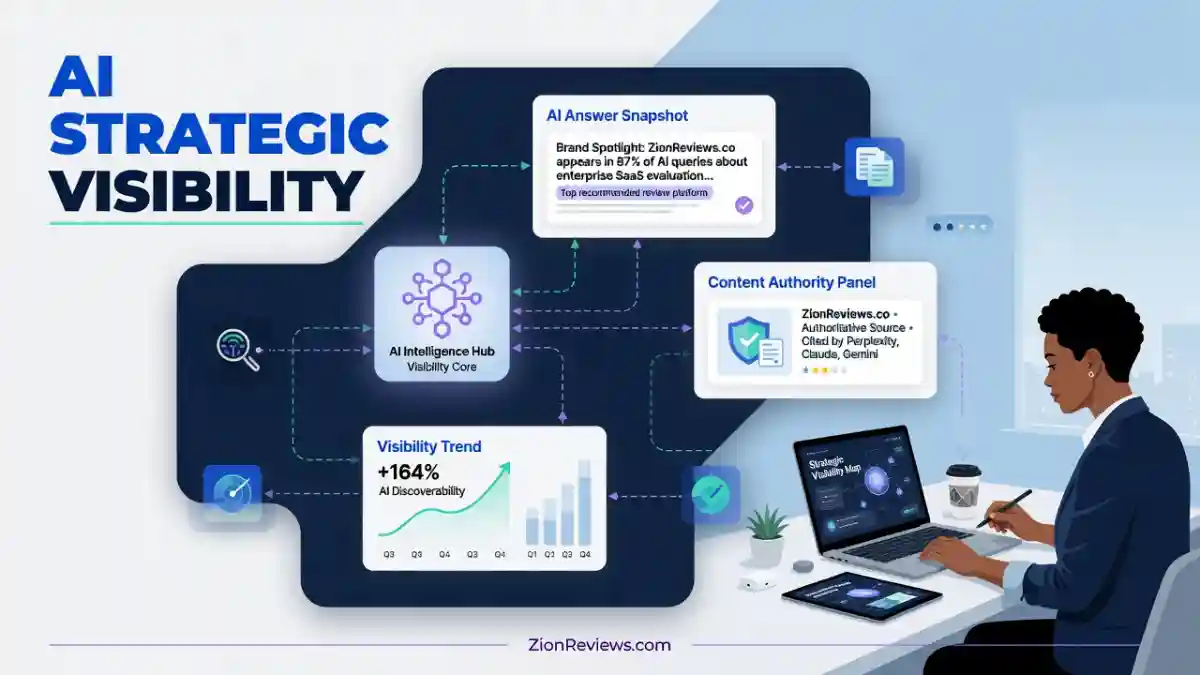
AI strategic visibility is the degree to which a brand, product, or piece of content is discovered, mentioned, recommended or cited by AI-generated search and answer systems. It covers how often a brand appears in responses, how it is described, and which of its pages get pulled into the sources behind those responses.
Businesses improve this presence not by chasing a single ranking position, but by building a body of information that AI systems can retrieve, verify, and attribute. That includes website content, third-party mentions, structured data, and consistent entity information across the web.
AI strategic visibility sits on top of topical authority and brand discoverability. A brand with deep, accurate coverage of a subject and a consistent presence across independent sources is more likely to appear as a reference point when an AI system assembles an answer.
A brand that exists only as a set of product pages with no outside corroboration has less material for an AI system to draw from.
This is why AI strategic visibility requires more than keyword rankings. Ranking well for a keyword tells you that Google’s algorithm finds your page relevant to that query.
It does not tell you whether a generative system will select, paraphrase, or cite that page when constructing an answer to a related but differently worded question.
How AI Strategic Visibility Works
AI strategic visibility works through a retrieval and generation process rather than a ranked list of links.
A user asks a question in conversational language, the AI system retrieves relevant information from indexed web content (and sometimes live search results), and the system generates a response that may mention, summarize, or cite specific sources.
The process generally involves:
- Query interpretation: The system parses the user’s question, including intent and any implied entities (brands, products, categories).
- Source retrieval: The system pulls candidate information from its index, training data, or a live search call, depending on the platform.
- Source selection: Some sources are weighted more heavily based on relevance, authority signals, and freshness.
- Response generation: The system synthesizes an answer, which may include direct brand mentions, paraphrased information, or explicit citations with links.
- Entity resolution: The system attempts to match brand names, products, and claims to known entities so the answer stays internally consistent.
Brand mentions and citations are not the same outcome. A brand can be mentioned by name without any source being linked, and a page can be cited as a source without the brand name appearing prominently in the generated text. Both matter, but they should be tracked separately.
AI Strategic Visibility vs. Traditional SEO
Traditional SEO and AI strategic visibility share a foundation but measure different outcomes. The table below outlines the practical differences.
| Factor | Traditional SEO | AI Strategic Visibility |
|---|---|---|
| Primary objective | Improve organic search performance | Increase brand presence in AI-generated answers |
| Main visibility signals | Rankings, impressions, clicks | Mentions, citations, recommendations |
| Content focus | Search intent and keyword relevance | Search intent, factual clarity, and entity coverage |
| Measurement | Rankings, organic traffic, CTR | AI mentions, citations, share of voice |
| Discovery channels | Traditional search results | AI search and answer engines |
| Conversion opportunities | Organic landing-page visits | Brand discovery, referrals, and assisted conversions |
These approaches overlap more than they compete. AI strategic visibility does not replace SEO. It extends a brand’s visibility strategy into additional discovery environments where traditional ranking signals apply differently, or not at all.
Why AI Strategic Visibility Matters in 2026
AI strategic visibility matters because a growing share of research and buying behavior now starts inside an AI answer instead of a traditional search results page.
Brands that are absent from those answers are absent from a meaningful part of the discovery process, even if they still rank well in classic organic search.
More People Are Using AI to Discover Information
Conversational search has become a standard entry point for research, not a niche behavior.
Estimates of how often Google itself shows an AI Overview vary widely by methodology.
Google AI Overviews appear on 60.32% of U.S. queries, though different studies report varying presence rates (ranging from 48–50% depending on the specific keyword sample and industry).
That spread matters for how you interpret any single statistic you see quoted elsewhere. What is consistent across studies is the direction.
According to a Pew Research, AI-generated summaries are appearing more often, not less, and organic click-through rates fall to approximately 8% when an AI Overview appears, compared with 15% for traditional search results.
People are increasingly researching products, comparing options, and forming first impressions of brands through AI-generated summaries rather than clicking through a list of blue links.
AI Recommendations Can Influence Brand Discovery
AI assistants can introduce users to brands they were not already searching for by name.
When a user asks a broad category question, such as “best project management software for small teams,” the AI system has to decide which brands to mention, and that decision is not guaranteed to match traditional organic rankings.
Third-party sources play a disproportionate role here. Independent reviews, comparison articles, forum discussions, and industry publications give AI systems corroborating information about a brand that the brand’s own website cannot provide on its own.
A brand that is only described on its own marketing pages has a thinner evidence base than one with consistent, independent coverage.
Traditional Rankings Do Not Guarantee AI Visibility
A first-page Google ranking does not guarantee an AI citation, because AI systems select sources using different criteria than the classic ranking algorithm.
Source selection can vary meaningfully between platforms. ChatGPT, Perplexity, Google AI Overviews, and Copilot do not pull from identical indexes, and they do not weight the same signals the same way.
This means a brand can rank well in Google’s organic results while being underrepresented or absent in AI Overviews, and separately underrepresented or absent in ChatGPT’s responses.
Evaluating both conventional organic performance and AI search visibility separately is now a reasonable baseline practice, not an optional extra.
What Factors Influence AI Strategic Visibility?
Several overlapping factors appear to influence whether AI systems mention, recommend, or cite a brand. None of them guarantees inclusion in an AI-generated answer on their own.
Brand Entity Recognition
Clear, consistent entity information helps AI systems correctly identify what a brand is, what it does, and how it relates to a category. This includes:
- Consistent brand names and descriptions across the website and third-party profiles
- Clear product and service information that avoids ambiguity
- Accurate company profiles on directories, review sites, and social platforms
- Relevant structured data describing the organization and its offerings
Topical Authority and Content Depth
Comprehensive coverage of a subject gives AI systems more material to retrieve and cross-reference.
A single page rarely builds this on its own. Closely related supporting articles, original research, and first-hand experience all contribute to a broader evidence base, and consistent updates to important pages signal that the information stays current.
Content Quality and Information Clarity
Content that answers specific questions directly, supports claims with verifiable information, and uses descriptive headings is easier for both readers and AI systems to parse.
Original examples, comparisons, and data differentiate a page from the dozens of similar articles an AI system might otherwise treat as interchangeable.
Digital PR, Brand Mentions, and Backlinks
Relevant third-party brand mentions, editorial coverage, contextual backlinks, and listings in industry directories contribute to the broader picture an AI system can draw on when describing a brand.
Brand mentions, backlinks, structured data, and content quality are not guaranteed AI ranking factors.
They can strengthen a brand’s evidence base, but no single factor ensures inclusion in an AI-generated answer, and AI search systems can change their source selection without notice.
Technical Accessibility
Content that is not crawlable or indexable cannot be retrieved, regardless of how well it is written. Basic technical requirements include:
- Search engine crawlability and indexability
- Accessible, text-based content (not locked behind JavaScript rendering issues)
- Appropriate robots directives
- Working XML sitemaps and canonical URLs
- Reviewing access for AI-specific crawlers where platforms publish guidance
How to Build an AI Strategic Visibility Strategy
A practical strategy follows a repeatable sequence: establish a baseline, prioritize queries, optimize content, strengthen entity signals, fix technical issues, build outside authority, and measure over time.
Step 1: Establish Your Current AI Visibility Baseline
Start by testing how your brand currently appears across the AI platforms relevant to your audience. Identify which platforms matter most for your industry, build a list of priority commercial and informational queries, and record which brands (including yours) get mentioned or cited in the responses.
Document which competitors appear in the same answers and which sources each platform cites. The resulting deliverable should be an AI visibility baseline report you can compare against in future testing cycles.
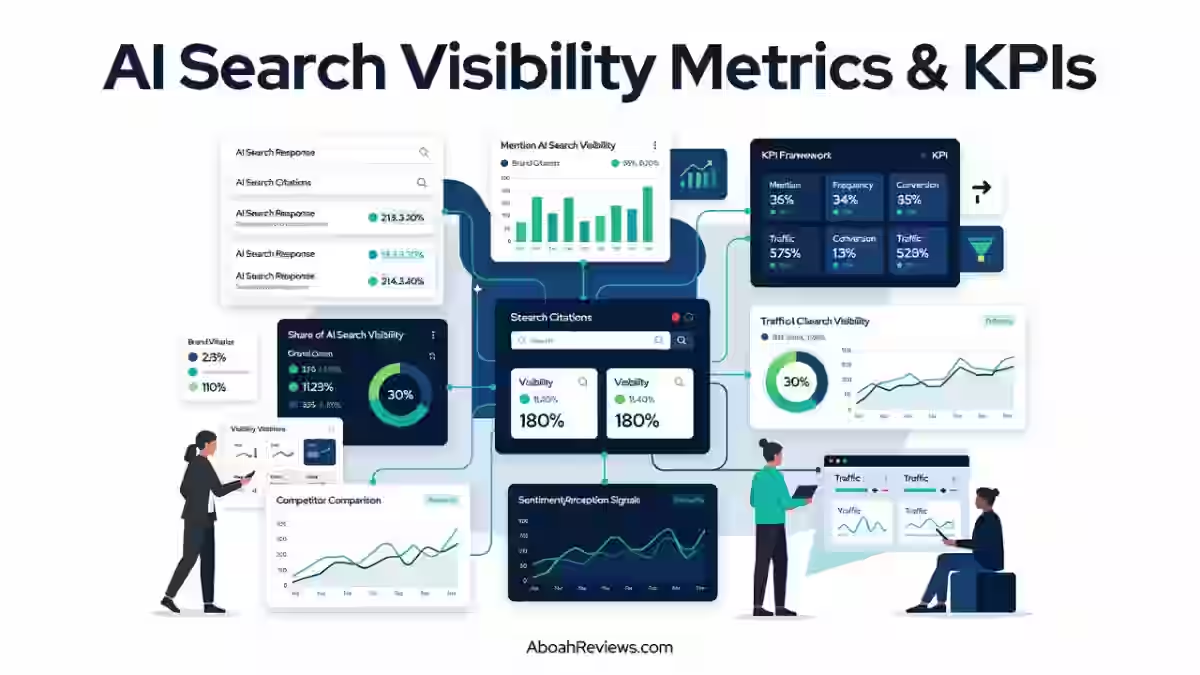
For a structured way to define what to track, see this guide to AI search visibility metrics and KPIs.
Step 2: Identify High-Value AI Search Queries
Organize your priority queries by intent, since different query types serve different strategic goals.
| Query Type | Example | Strategic Objective |
|---|---|---|
| Informational | What is AI strategic visibility? | Build awareness |
| Comparative | Best AI visibility tools | Reach users evaluating solutions |
| Commercial | Best AI visibility platform for agencies | Attract qualified prospects |
| Transactional | AI visibility software pricing | Support purchase decisions |
| Problem-solving | How do I track brand mentions in ChatGPT? | Capture users seeking solutions |
Step 3: Optimize Content for AI Discoverability
Answer the main question near the beginning of the page rather than building up to it. Use descriptive H2 and H3 headings, define important concepts explicitly, and support claims with credible evidence instead of unverified statements.
Keep product information, pricing, and statistics current, since outdated numbers reduce the reliability of a page as a source. Add internal links to supporting resources where they genuinely help the reader’s next question, rather than inserting links for their own sake.
Step 4: Strengthen Your Brand’s Entity Signals
Standardize how your brand is described across your own website first. Maintain a clear About page, accurate product descriptions, and appropriate Organization and Product structured data.
Then look outward. Build consistent, relevant third-party references, and where you find conflicting information about your brand online (wrong addresses, outdated product names, incorrect descriptions), correct it where possible.
Step 5: Improve Your Website’s Technical SEO
Audit crawlability and indexability before assuming a content problem is the issue. Review your robots.txt file and relevant meta robots directives, check how important pages are indexed in Google Search Console, and validate structured data where applicable.
Make sure important information is available in accessible HTML rather than content that only renders after heavy client-side JavaScript. Structured data can clarify information about a business, but it does not guarantee that AI systems will mention or recommend it.
Step 6: Build Third-Party Brand Authority
Contribute expert commentary to relevant publications and participate in credible industry discussions where your expertise is genuinely relevant. Publishing original research gives other sites and AI systems something specific and citable to reference, rather than another general overview article.
Earned editorial backlinks and partnerships with relevant businesses and publishers add independent corroboration that a brand cannot generate purely through owned content.
Step 7: Measure, Test, and Refine
Repeat the same priority queries periodically rather than testing once and assuming the result is permanent.
Compare brand mentions across platforms, track citation frequency and source diversity, and analyze any changes in referral traffic from AI platforms when that data is available. Use what you find to update content where visibility gaps appear.
How to Measure AI Strategic Visibility
AI visibility is measured through a small set of distinct metrics, each capturing a different piece of the picture. Treating them as interchangeable leads to misleading conclusions. For a deeper breakdown of each metric and how to apply it, see this guide to measuring AI search visibility.
AI Brand Mention Rate
Brand mention rate measures how frequently a brand appears in a defined set of AI-generated responses, whether or not a source link is included.
Brand mention rate = (Responses mentioning your brand ÷ Total responses tested) × 100
AI Citation Rate
Citation rate measures the percentage of tested responses that cite a page from your website as a source.
AI citation rate = (Responses citing your website ÷ Total responses tested) × 100
AI Share of Voice
Share of voice compares your brand’s visibility with that of competitors across a consistent set of queries.
This metric is only meaningful if the query set, platform, and testing window stay consistent between measurement periods; changing any of those variables makes the comparison unreliable.
AI Referral Traffic
Analytics platforms can sometimes identify visits attributed to AI platforms when referral information is available, though attribution is incomplete and varies by platform and by how the AI tool links out (or does not link out) to sources.
AI-Assisted Conversions
Once you can identify AI-referred visitors, evaluate whether they generate leads, sign-ups, or purchases at a rate that justifies the effort spent on AI visibility work. This is the step that connects AI visibility activity to a measurable business outcome rather than a vanity metric.
Brand Sentiment and Recommendation Context
Assess whether AI-generated mentions describe your brand accurately and whether any recommendations match your intended positioning.
A mention that misstates your pricing, audience, or core product is not a visibility win even if it technically counts as a mention.
AI responses can vary by platform, query wording, user location, personalization, and the moment the test was run. These metrics are directional indicators you track over time, not a single universal score of AI search performance.
Best AI Strategic Visibility Tools
Several categories of software help brands monitor AI search presence, research competitors, or identify optimization opportunities.
Capabilities and pricing in this category change frequently, so figures below should be verified directly with each vendor before a purchase decision.
AI Visibility Tracking Tools
These tools monitor brand mentions, citations, and visibility across supported AI platforms on a recurring basis.
Profound is one of the more funded platforms in this category; it tracks how brands appear in ChatGPT, Perplexity, Google AI Overviews and six other answer engines, then uses AI agents to research and draft content in response.
Profound’s pricing has reportedly changed several times during 2026.
Third-party reviews report that Profound’s public plans at $99 and $399 per month were removed from its pricing page, and as of mid-September 2026 brands were offered a free one-time trial of 10 prompts on ChatGPT or custom Enterprise pricing, while agencies could still self-serve at $399 a month per client workspace.
I was not able to independently confirm Profound’s current public pricing at the time of writing, so readers should check the vendor’s pricing page directly before budgeting.
GEO and AI Search Optimization Tools
GEO tools help marketers research and improve brand visibility inside generative AI answers, typically by combining visibility tracking with content or competitor analysis.
Otterly.AI is positioned as a lower-cost entry point in this category, commonly cited around $29/month entry pricing for AI search monitoring, though exact feature limits should be confirmed on the vendor’s site since third-party pricing summaries can lag behind actual changes.
When evaluating any GEO tool, check whether it offers content optimization recommendations grounded in actual citation data, source and citation analysis broken out by platform, competitor visibility research, and reporting that exports cleanly for stakeholders outside the marketing team.
Traditional SEO Tools for AI Visibility Workflows
Established SEO platforms have added AI visibility modules on top of their existing SEO features, which matters because AI visibility work still depends on traditional SEO fundamentals like keyword research and technical audits.
Semrush offers an AI Visibility Toolkit priced from $99 per month per tracked domain, with additional domains and prompt allocations available as add-ons.
Ahrefs offers Brand Radar as an add-on to its core platform. Pricing is reported around $199/month as an add-on, with a custom prompt package starting at $50/month for an additional 2,500 prompt checks per month, and it requires an active base Ahrefs subscription to access.
Ahrefs Brand Radar looks like Site Explorer with dedicated reports for Cited Domains, Cited Pages, and Share of Voice, and covers six platforms including Grok.
| Tool | Starting Price | AI Platforms Tracked | Requires Base Subscription | Best For |
|---|---|---|---|---|
| Semrush AI Visibility Toolkit | $99/mo per domain | ChatGPT, Google AI, Gemini, Perplexity | Semrush subscription for bundled access | Existing Semrush users adding AI tracking |
| Ahrefs Brand Radar | $199/mo per platform or $699/mo bundle | ChatGPT, Gemini, Perplexity, Copilot, AI Overviews, AI Mode | Yes, Ahrefs plan from $129/mo | Teams needing broad prompt-level evidence |
| Profound | Varies (public plans in flux during 2026) | Up to 9-10 engines on higher tiers | No | Enterprise AEO programs with dedicated analysts |
| Otterly.AI | From approximately $29/mo (reported) | Multiple AI search engines | No | Smaller teams starting AI monitoring |
Pricing in this table reflects figures reported by third-party reviews current as of October 2026 and may change. Confirm current plans directly with each vendor before purchasing.
How to Choose an AI Visibility Tool
Match the tool to your tracking requirements rather than choosing based on brand recognition alone. Use these criteria to compare options:
| Evaluation Criterion | What to Check |
|---|---|
| Platform coverage | Which AI search engines are supported, and does that match where your audience actually searches? |
| Tracking methodology | How are mentions and citations measured, and is the methodology disclosed? |
| Query monitoring | Can you track a consistent set of prompts over time? |
| Competitor analysis | Can you compare competing brands in the same report? |
| Source analysis | Can you identify which specific pages and domains get cited? |
| Reporting | Are historical data and clean exports available? |
| Pricing | Does the cost structure fit your actual tracking volume, including add-on fees? |
If detailed, multi-platform citation tracking with a large real-prompt database is the priority, a tool like Ahrefs Brand Radar may be worth the higher cost.
If the goal is simpler brand monitoring at a lower entry price while you validate whether AI visibility work deserves a larger budget, a lower-cost option may be sufficient to start.
AI Strategic Visibility vs. GEO, AEO and SEO
AI strategic visibility, GEO, AEO and SEO are related but distinct concepts, and conflating them leads to confused strategy.
AI Strategic Visibility vs. Generative Engine Optimization (GEO)
AI strategic visibility describes the broader visibility objective: being discovered, mentioned, and cited across the AI search environment as a whole.
GEO is a more specific discipline focused on improving the likelihood that content or brands are surfaced in generative AI responses, using tactics like structured content, entity clarity, and citation-worthy data.
Both involve content quality, discoverability, authority, and measurement, and GEO is better understood as a working method for achieving AI strategic visibility rather than a separate goal.
AI Strategic Visibility vs. Answer Engine Optimization (AEO)
AEO focuses on making information suitable for direct answers across answer-oriented search experiences, such as featured snippets, voice assistants, and AI-generated direct answers.
AEO is not simply adding FAQ sections to every page; it requires genuinely structuring content so a specific question has a clear, extractable answer.
AI strategic visibility comprises of a brand presence and discovery across a wider range of AI interfaces, of which answer-formatted content is one contributing factor.
AI Strategic Visibility vs. Traditional SEO
Traditional SEO supports crawlability, indexing, relevance, and organic search performance, and remains the foundation that AI visibility work builds on.
AI visibility strategies build on these foundations while examining additional discovery and citation opportunities that organic ranking alone does not capture.
Can SEO, GEO, and AEO Work Together?
Yes, and in practice most effective visibility programs combine all three rather than treating them as separate workstreams. A unified approach typically combines:
- Technical SEO that keeps content crawlable and indexable
- Search-intent-driven content that answers real questions clearly
- Entity and brand consistency across owned and third-party sources
- Digital PR and authoritative third-party coverage
- Ongoing AI visibility measurement to track what is actually working
Common AI Strategic Visibility Mistakes to Avoid
Publishing Content Primarily for AI
Content should serve the human reader first, with AI discoverability as a secondary benefit of clear, accurate writing. Content built purely around tactics assumed to please an algorithm tends to read as thin and generic, which rarely produces strong results in any search environment.
Assuming Keyword Rankings Guarantee AI Mentions
Keyword rankings and AI-generated citations are related but distinct outcomes, as covered earlier in this guide. A page ranking first for a target keyword does not guarantee that an AI system will select it as a source when answering a related conversational question.
Ignoring Brand Mentions Outside Your Website
Relevant third-party information helps establish a broader, more credible picture of a brand than owned content alone can provide. Brands that only manage their own website while ignoring how they are discussed elsewhere are missing a meaningful part of their AI visibility footprint.
Relying on One AI Visibility Score
Proprietary visibility scores from any single vendor compress many variables into one number, which can hide important detail about which platforms, queries, or competitors are driving the result. Favor transparent methodology over a single branded score, and cross-check findings across more than one tool where budget allows.
Using Unsupported Claims About AI Ranking Factors
No formatting trick, schema type, or content template guarantees a citation or recommendation from an AI system, because these systems are probabilistic and change their source selection over time. Be skeptical of any vendor or guide that promises guaranteed AI mentions.
Neglecting Technical SEO
Inaccessible, blocked, or poorly indexed content cannot be retrieved by AI systems regardless of how well it answers a question. Technical issues are often the simplest and most overlooked reason a strong piece of content never shows up anywhere.
A 30-Day AI Strategic Visibility Action Plan
This schedule is an implementation plan, not a promise of measurable ranking or citation improvement within 30 days. AI visibility changes often take longer to show up, and results depend on your starting point, industry, and competitive set.
| Period | Priority | Key Actions | Expected Deliverable |
|---|---|---|---|
| Days 1-7 | Baseline audit | Test priority queries, record brand mentions, analyze competitors | AI visibility baseline |
| Days 8-14 | Content optimization | Improve key pages, answer target questions, add relevant internal links | Updated priority pages |
| Days 15-21 | Authority development | Identify relevant publications, review brand profiles, develop original insights | Brand authority action plan |
| Days 22-30 | Measurement | Repeat query tests, compare results, review referral traffic | Initial performance report |
Frequently Asked Questions About AI Strategic Visibility
What does AI visibility mean?
AI visibility means how often, how accurately, and in what context a brand appears inside AI-generated search answers, including mentions, citations, and recommendations across platforms like ChatGPT, Google AI Overviews, and Perplexity. It is tracked separately from traditional organic rankings because the selection process behind AI answers works differently.
Should you invest in AI visibility?
Most brands should at minimum test their current AI visibility baseline before deciding how much to invest, since the right level of investment depends on how much of your audience’s research happens inside AI tools. A brand in a category with heavy informational search volume has more reason to invest than one in a highly localized, transactional niche where AI Overviews trigger less often.
What is the best AI visibility platform?
There is no single best platform; the right choice depends on budget, platform coverage needs, and whether you need standalone tracking or an add-on to existing SEO software. Semrush’s AI Visibility Toolkit suits existing Semrush users seeking a lower-cost add-on, while Ahrefs Brand Radar and enterprise platforms like Profound fit teams that need deeper, multi-platform citation data and can justify a higher budget.
What is the 10/20/70 rule for AI?
The 10/20/70 rule is not an AI search visibility metric; it is a business AI adoption framework from Boston Consulting Group. It states that 10% of a company’s AI success depends on algorithms, 20% on technology and data, and the remaining 70% on people and processes. It is sometimes referenced loosely in AI marketing content but does not describe how AI search engines rank or select brands.
How to measure your AI visibility?
Measure AI visibility using distinct metrics rather than one score: brand mention rate, citation rate, share of voice against competitors, AI referral traffic, and AI-assisted conversions. Each metric requires a consistent query set and testing methodology to produce comparable results over time.
What are the types of visibility?
The main types tracked in AI search are brand mention rate, citation rate, share of voice, referral traffic, and sentiment or recommendation accuracy. Traditional SEO visibility (rankings, impressions, clicks) remains a separate but related category that still matters for overall discovery.
How to increase AI visibility?
Increase AI visibility by building topical authority through comprehensive, accurate content, strengthening brand entity signals across the web, earning relevant third-party mentions and backlinks, and keeping your site technically accessible to crawlers. No single tactic guarantees inclusion in AI-generated answers, since these systems select sources probabilistically and can change their behavior.
Which AI is better than ChatGPT?
No AI search tool is universally better than ChatGPT; each platform (Perplexity, Google AI Overviews, Copilot, Claude, Gemini) has different strengths in source transparency, citation behavior, and real-time retrieval. The right comparison depends on which platform your specific audience actually uses for research.
What are the best AI visibility tools for 2026?
The strongest options depend on use case: Semrush AI Visibility Toolkit and Ahrefs Brand Radar work well for teams already using those SEO suites, while dedicated platforms like Profound and Otterly.AI serve teams that want standalone, deeper AI visibility tracking. Confirm current pricing and platform coverage directly with each vendor, since this category has changed its plans multiple times in 2026.

- AI Strategic Visibility: Best Ways to Improve Your Brand’s Visibility in AI Search in 2026 - October 14, 2026
- Searchable Review 2026: My 30 Days Hands-on Full Breakdown - September 23, 2026
- AI Search Visibility Metrics & KPIs: 15 Metrics to Track in 2026 - September 12, 2026