
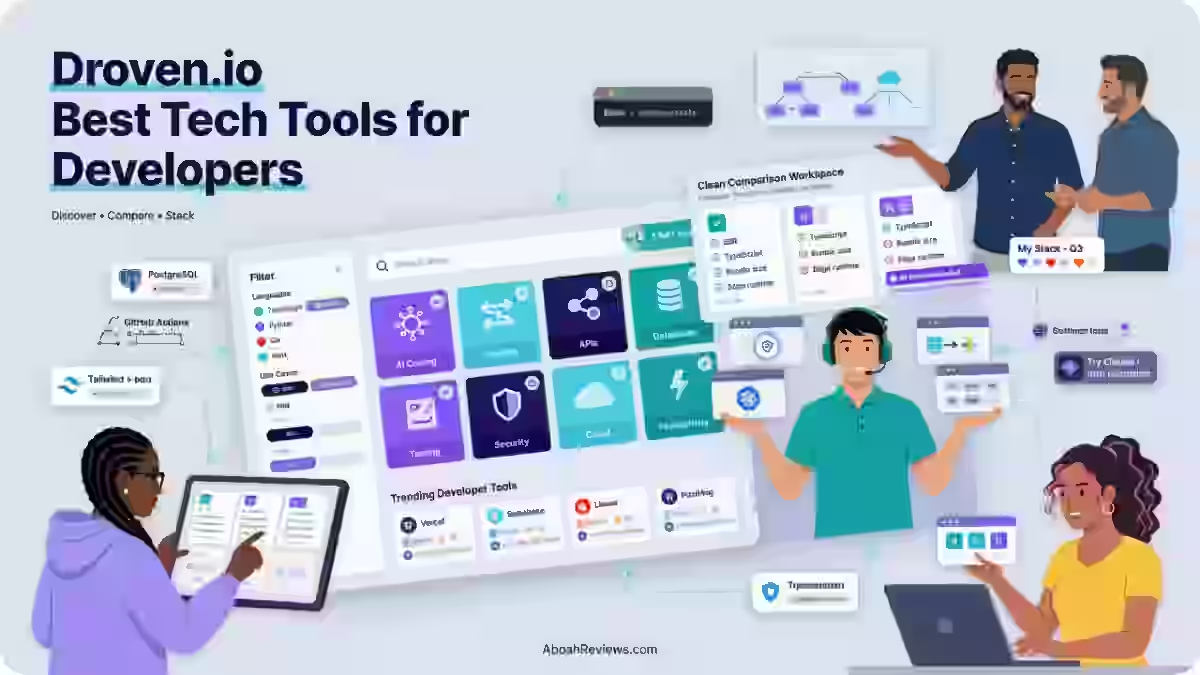
TL;DR: Droven.io functions as a technology discovery and editorial platform where developers can research software categories like AI coding assistants, cloud tools, and automation platforms before making a purchase decision. It’s useful for early research, not for final technical evaluation.
For more information about AI automation tools and developer productivity, check out my guide on Droven io AI automation tools.
Introduction to Droven io Best Tech Tools for Developers
If you’ve searched for droven io best tech tools for developers, you’re probably trying to figure out whether this platform is worth your time or just another content site cashing in on developer search traffic.
I spent time going through what Droven.io publishes, cross-checked it against other tool discovery platforms I’ve used over the years, and tested a handful of the categories it covers, from AI coding assistants to workflow automation tools.
Developers don’t have a shortage of software anymore; they have a shortage of time to figure out which tool actually solves their problem instead of adding another tab to an already crowded browser window.
That’s exactly why platforms built around tool discovery, comparison, and category breakdowns have become part of how technical teams shop for software in 2026.
Based on what I found across multiple sources, Droven.io is a technology discovery platform that helps developers explore software tools, services, and resources across multiple development-related categories, functioning as a resource hub rather than a development environment itself.
Some coverage of the site also positions it more as an editorial knowledge hub, an editorial knowledge platform for artificial intelligence, automation, and emerging technology rather than a tool marketplace or vendor demo funnel.
Either way, the practical takeaway for developers is the same: use it to learn what’s out there, then run your own hands-on test before committing budget or migrating a workflow.
Quick Answer on Droven io Best Tech Tools for Developers
Here’s the direct answer if you’re short on time:
- Droven.io is a discovery and editorial resource, not an IDE, not a CI/CD platform, and not something you install into your stack.
- It’s best used for research, not for final technical decisions like security scanning tools or production infrastructure.
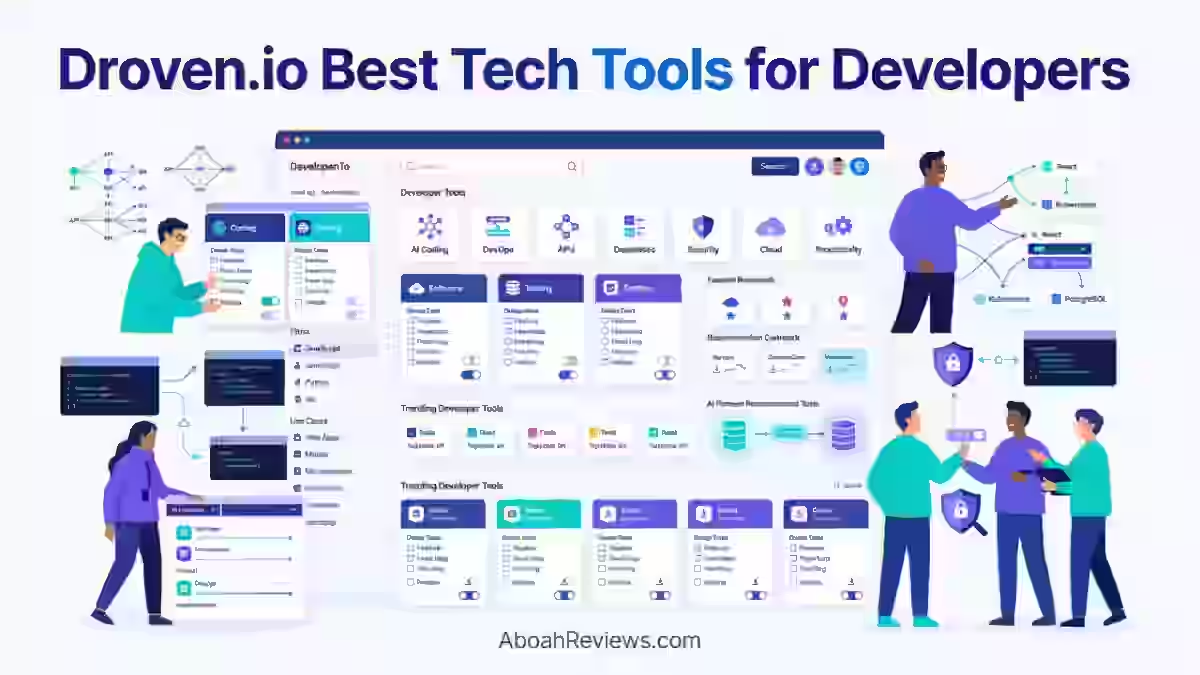
- The strongest categories to explore through it are AI coding assistants, cloud/DevOps tools, API tools, automation platforms, and productivity software.
- You still need to test tools yourself using free trials, documentation, and small-scale pilots before rolling anything into a production workflow.
- It works better as a starting point alongside sites like Product Hunt, GitHub Marketplace, AlternativeTo, and StackShare, not as your only source
What Is Droven.io?
Droven.io is a free, editorially independent AI and technology knowledge platform that explains AI, machine learning, cybersecurity, and cloud computing without selling software or pushing affiliate products.
The platform helps developers and technical professionals understand emerging technologies before committing budget or development resources.
Unlike tool marketplaces or software directories, Droven.io focuses on education rather than product listings.
I find this approach helpful when researching categories I’m unfamiliar with, though I still test every tool independently before adding it to production workflows.
How Droven.io Works
The droven.io website serves as a digital platform that showcases information related to technology innovation, AI applications, business transformation, and automation strategies.
It is associated with emerging technology solutions designed to help businesses improve operational efficiency, streamline workflows, and adopt intelligent systems.
The platform publishes guides and articles that explain technical concepts in plain language.
Developers can browse content on topics including AI automation tools, cloud infrastructure, DevSecOps practices, machine learning models, and implementation frameworks.
The content helps readers understand what different technologies do, where they fit into development workflows, and what tradeoffs exist.
The platform does not offer software trials, pricing comparisons, or affiliate links to products.
Who Is Droven.io For?
Droven.io targets readers who need to understand technology concepts before making purchasing or implementation decisions:
- Software developers looking for explanations of AI coding assistants, version control workflows, and deployment automation
- Web developers researching frontend deployment, serverless computing, and API integration patterns
- Mobile developers exploring cross-platform frameworks, push notification services, and mobile backend systems
- Startup founders evaluating technology stacks, cost reduction strategies, and ROI timelines for automation
- Indie hackers learning about no-code workflow builders, webhook integrations, and automated testing
- Engineering teams implementing DevSecOps, secrets management, container orchestration, and log management
- Technical professionals staying current with conversational AI, custom AI agents, and intelligent workflow platforms
I’ve used similar educational platforms when researching categories outside my primary expertise.
They reduce the time I spend reading vendor documentation that’s often too promotional or technical papers that assume advanced knowledge.
Don’t forget to read my roundup of the best growth navigate tools for startups.
Best Developer Tool Categories to Explore on Droven.io
Developers need different tools depending on their programming language, project requirements, deployment environment, and team size.
Here are the categories worth exploring when building or improving a development workflow in 2026.
AI Coding Tools for Developers
AI coding assistants have changed how developers write, review, and refactor code.
The treatment group, with access to the AI pair programmer, completed the task 55.8% faster than the control group.
That research from 2023 showed early productivity gains, and tools have improved significantly since then.
Adopting GitHub Copilot led to a 10.6% increase in pull requests and a 3.5-hour reduction in cycle time, significantly enhancing developer productivity and collaboration.
I’ve tested GitHub Copilot, Cursor, and Claude for coding tasks over the past year, and each tool handles different workflows better than others.
- GitHub Copilot works inside Visual Studio Code and other supported editors. Developers reported that GitHub Copilot helped them stay in the flow (73%) and preserve mental effort during repetitive tasks (87%). It generates code completions, suggests entire functions, and helps with documentation. Pricing starts at $10/month for individuals and $19/user/month for business plans.
- Cursor is an AI-first code editor built on VS Code. It offers inline code generation, codebase-aware chat, and multi-file editing. I’ve found it particularly useful for refactoring large sections of code across multiple files. Pricing includes a free tier with limited requests and a $20/month pro plan.
- Claude from Anthropic works as a conversational AI that can analyze code, suggest improvements, explain complex logic, and generate new implementations. I use it when I need explanations of unfamiliar codebases or help designing system architecture. Access is available through claude.ai or the API with usage-based pricing.
- Codeium provides free AI code completion for individual developers with support for 70+ programming languages. It integrates with most popular editors and offers features similar to Copilot without the subscription cost.
AI coding assistants improve productivity for repetitive tasks, boilerplate generation, and learning new frameworks.
They struggle with complex business logic, maintaining consistency across large projects, and understanding domain-specific requirements that aren’t well-documented in training data.
I tested three different AI coding tools by building the same REST API endpoint in each environment. The tool that generated the most accurate code on the first attempt wasn’t the most expensive option.
The mid-tier assistant required fewer manual corrections because it followed the coding patterns already present in my codebase.
Developer Productivity Tools
Project management, documentation, and team collaboration tools help developers organize work, share knowledge, and reduce coordination overhead.
These tools don’t write code, but they prevent wasted time on unclear requirements, duplicated work, and context switching.
- Linear is a project tracking and issue tracking system designed for software teams. It offers keyboard shortcuts, automatic status updates based on git activity, and integration with GitHub, GitLab, and other development platforms. Pricing starts at $8/user/month with a free plan for small teams.
- Notion provides documentation, knowledge bases, and project wikis in one workspace. Development teams use it for technical specifications, API documentation, onboarding guides, and meeting notes. Individual plans are free, with team plans starting at $8/user/month.
- Slack and Discord handle team communication and replace constant email threads. Both integrate with CI/CD pipelines, error tracking, and deployment tools to send automated notifications when builds fail or deployments complete. Slack starts at $7.25/user/month. Discord is free with paid features for larger communities.
- Loom records video explanations of code reviews, bug reproductions, and feature walkthroughs. I use it when written explanations would take longer than showing the problem directly. Free plans include 25 videos with 5-minute limits. Paid plans start at $12.50/user/month.
The best productivity tools integrate with your existing workflow instead of creating new places to check. I’ve abandoned tools that required manual updates or existed in isolation from where actual development work happens.
Cloud Development and DevOps Tools
Cloud platforms, deployment automation, and infrastructure management tools determine how quickly you can ship code and how reliably it runs in production.
The developer toolchain in 2026 looks nothing like it did two years ago as AI assistants now write code, review pull requests, and handle background work that used to burn half a day.
- Vercel deploys frontend applications with automatic preview deployments for every git commit and pull request. It supports Next.js, React, Vue, and static sites with built-in CDN, serverless functions, and edge computing. Free plans include unlimited preview deployments. Pro plans start at $20/month.
- Railway offers backend deployment with support for databases, Docker containers, and monorepo applications. It handles environment variables, secrets management, and automatic HTTPS. Pricing is usage-based with $5/month minimum.
- Supabase provides a database toolkit including PostgreSQL databases, authentication, storage, and real-time subscriptions. It competes with Firebase while giving developers direct database access. Free tier includes 500MB database and 1GB file storage. Pro plans start at $25/month per project.
- GitHub Actions automates CI/CD pipelines directly inside GitHub repositories. You can run automated testing, build Docker images, deploy to cloud platforms, and execute custom workflows on every push or pull request. Free tier includes 2,000 minutes/month for private repositories.
- Docker and Kubernetes handle container orchestration for teams deploying complex applications across multiple environments. Docker packages applications with dependencies. Kubernetes manages container deployment, scaling, and networking in production.
I’ve moved most projects to platforms that offer preview deployments because they eliminate “works on my machine” problems and make code review faster.
Seeing the deployed version of every pull request catches issues that unit tests miss.
API Development and Testing Tools
Modern applications connect through REST APIs, GraphQL endpoints, and webhook integrations.
Developers need tools that test API behavior, document endpoints, monitor performance, and simulate complex integration scenarios.
- Postman creates, tests, and documents APIs with support for REST, GraphQL, SOAP, and WebSocket protocols. Teams use it to build automated API testing workflows and share endpoint collections. Free plans support basic testing. Paid plans start at $12/user/month with team collaboration features.
- Insomnia provides similar functionality with a simpler interface focused on REST and GraphQL testing. It offers environment variables, code generation, and plugin support. Free for individual use with team plans at $5/user/month.
- Hoppscotch is an open-source API testing tool with a web interface and self-hosted option. It supports WebSocket, GraphQL, and real-time connections with no installation required.
- Swagger/OpenAPI creates interactive API documentation from code annotations. Developers can test endpoints directly from documentation pages and generate client libraries automatically.
- ngrok exposes local development servers to the internet for testing webhooks, mobile app connections, and third-party integrations. Free tier allows temporary tunnels. Paid plans start at $8/month with custom domains and reserved URLs.
I use Postman for complex API workflows with multiple authentication methods and environment configurations.
For simpler testing during development, I prefer tools like Insomnia or HTTPie that reduce setup time.
Database and Backend Development Tools
Database management, backend frameworks, and data storage decisions affect application performance, scalability, and development speed.
The right database choice depends on data structure, query patterns, and consistency requirements.
- PostgreSQL remains the most popular open-source relational database with support for JSON fields, full-text search, and geographic data. It’s free and works well for applications requiring complex queries and transactions.
- MongoDB handles document-based data with flexible schemas. It’s useful for content management, product catalogs, and applications where data structure changes frequently. Free tier includes 512MB storage on MongoDB Atlas.
- Redis provides in-memory data storage for caching, session management, and real-time analytics. It dramatically improves application performance for frequently accessed data.
- Prisma generates type-safe database clients for Node.js and TypeScript applications. It replaces manual SQL queries with an intuitive API and handles migrations automatically.
- Hasura adds instant GraphQL APIs on top of PostgreSQL databases with real-time subscriptions and role-based access control. It eliminates boilerplate backend code for CRUD operations.
During one project, I switched from a NoSQL database to PostgreSQL after realizing that 80% of my queries needed joins and transactions that document databases handle poorly.
The migration took three days but reduced query complexity and improved data consistency.
Automation Tools for Developer Workflows
Workflow automation reduces repetitive tasks including deployment processes, code formatting, dependency updates, and notification management.
These tools eliminate repetitive business tasks, automate lead capture, power AI chatbots, and integrate live data across CRMs, ecommerce platforms, and communication channels.
- GitHub Actions automates testing, building, and deployment triggered by git events. I use it to run tests on every pull request, deploy to staging on merges to main, and publish packages when creating release tags.
- n8n workflow is a self-hosted automation platform connecting 400+ services through visual workflow builders. It supports webhooks, API integration, and custom code execution. Free to self-host or cloud plans starting at $20/month.
- Zapier AI connects thousands of apps with pre-built integrations and AI-powered automation suggestions. It’s easier to set up than n8n but more expensive at scale. Free tier includes 100 tasks/month. Paid plans start at $19.99/month.
- Make (formerly Integromat) offers visual workflow automation with more complex logic than Zapier at lower prices. Free tier includes 1,000 operations/month. Paid plans start at $9/month.
- GoHighLevel combines CRM integration, lead automation, and marketing automation for agencies and service businesses. It includes workflow builders, AI chatbots, and client management. Pricing starts at $97/month.
I built an n8n workflow that monitors GitHub issues, sends Slack notifications for critical bugs, creates Linear tickets automatically, and updates a tracking spreadsheet.
The entire workflow runs on a $5/month server and saves approximately 30 minutes of manual work daily.
Why Developers Use Platforms Like Droven.io to Find Technology Tools
1. Discover New Software Faster
Technology discovery platforms reduce research time by organizing tools into categories and explaining concepts in plain language.
They struggle because they have too many options and not enough neutral context, and a platform like Droven.io is useful when it helps readers slow down, understand the category, and make a better next decision.
Instead of reading dozens of vendor websites, developers can understand entire categories including AI automation tools, workflow orchestration platforms, and intelligent workflow platforms through educational content.
This helps identify promising tools for deeper evaluation.
Knowledge platforms also introduce emerging technologies before they reach mainstream adoption.
I’ve found several useful developer tools by reading about new approaches to deployment automation, error tracking, and performance testing before they appeared in search results.
2. Find Tools for Specific Development Challenges
Developers search for tools when facing specific problems:
Slow coding speed leads to research on AI coding assistants like GitHub Copilot, Cursor, or Codeium
Manual deployment processes trigger investigation of CI/CD pipelines, preview deployments, and continuous deployment systems
Complex API integrations require tools supporting REST API testing, webhook management, and workflow builder interfaces
Poor team collaboration drives adoption of issue tracking, code review workflows, and project management platforms
Security concerns lead to DevSecOps tools, security scanning, secrets management, and dependency analysis
Discovery platforms help developers understand which tool category solves their specific problem before comparing individual products. This prevents wasting time testing solutions designed for different use cases.
3. Stay Updated With Developer Technology Trends
The developer tooling market changes rapidly. Developers using AI coding assistants like GitHub Copilot and cursor-based code generators are building APIs faster than ever, as an endpoint that used to take a day to scaffold can now be generated in minutes.
However, that speed is valuable and it creates a documentation and governance gap because APIs are being created faster than teams can register, secure, and monitor them.
Educational platforms track developments in:
- AI development including GPT-4o models, LLM pipelines, and machine learning models
- Automation including robotic process automation, workflow automation, and operational efficiency improvements
- Infrastructure including infrastructure as code, container orchestration, and serverless computing
- Security including type-safe data, end-to-end testing, and security scanning
- Integration including API integration, webhook support, and integration architecture
I check developer-focused content platforms monthly to learn about tools I haven’t tested yet.
Most don’t replace tools I currently use, but understanding new approaches helps me recognize when my current workflow has limitations.
Key Features to Look For When Evaluating Developer Tools on Droven.io
1. Integration Options
Developer tools should connect to existing systems without requiring complete workflow changes. Look for:
- API access that allows custom integrations and automation
- Webhook support for real-time notifications and triggering external workflows
- Git platform integrations with GitHub, GitLab, and Bitbucket for code review workflows
- CI/CD pipeline connections to run automated testing and deployment automation
- CRM integration for teams connecting development work to customer feedback and support tickets
I’ve abandoned tools that claimed to “integrate with everything” but only offered manual CSV exports or required maintaining duplicate data across systems. Real integrations sync automatically and work both directions.
2. Developer Experience (DX)
If code discovery is the problem, evaluate code search tools, and if service ownership is the challenge, look at developer portals.
Good developer tools prioritize ease of setup, clear documentation, and minimal learning curve.
- Documentation quality determines how quickly developers can implement features. Look for code examples, API references, troubleshooting guides, and migration instructions. The best documentation includes copy-paste examples that actually work.
- Ease of setup affects adoption. Tools requiring extensive configuration, manual infrastructure setup, or custom implementations slow down testing and deployment.
- User interface should match developer workflows. Command-line tools suit automation. Visual interfaces work better for exploring features and monitoring systems.
- Community support provides faster answers than waiting for vendor responses. Check for active GitHub discussions, Stack Overflow questions, Discord servers, or community forums.
The same principle applies to developer tools. AI-powered features improve productivity, but they work best alongside human review, testing, and workflow optimization.
3. Security and Reliability
Production systems require tools that protect data, maintain uptime, and follow security best practices:
- Data protection including encryption at rest and in transit, compliance certifications, and access controls
- Privacy policies that clearly explain data collection, storage, and third-party sharing
- Uptime guarantees with service level agreements, status pages, and incident communication
- Vendor reputation measured by company history, funding status, customer count, and public security audits
I check security documentation before adding tools that access code repositories, customer data, or production infrastructure. Tools without published security practices don’t make it past initial evaluation.
4. Pricing and Scalability
Businesses deploying the right AI automation stack reduce operational costs by 30-40% within the first 90 days of production deployment. But pricing models vary significantly across developer tools:
- Free tiers let you test before committing budget. Check usage limits, feature restrictions, and whether free plans work for small production applications.
- Startup pricing often offers discounts for early-stage companies. GitHub, AWS, and GCP provide credit programs. Some tools offer free access for open-source projects.
- Enterprise requirements including team management, SSO authentication, audit logs, and dedicated support typically require business or enterprise plans.
- Long-term costs compound as usage grows. Tools charging per API call, per user, or per execution can become expensive at scale. Calculate projected costs at 10x current usage.
Expensive platforms sometimes offer features you’ll never use while missing capabilities that matter for your specific workflow.
Droven.io Developer Tools Categories Compared
Tool Category | Best For | Main Benefit |
|---|---|---|
AI Coding Tools | Developers writing code | Faster development with code completion and generation |
Cloud Tools | Deployment teams | Scalable infrastructure with preview deployments |
API Tools | Backend developers | Easier integrations with testing and documentation |
Automation Tools | Engineering teams | Reduced repetitive work through workflow automation |
Productivity Tools | Development teams | Better collaboration through project and issue tracking |
Database Tools | Backend engineers | Reliable data storage with type-safe queries |
Security Tools | DevSecOps teams | Improved security with scanning and secrets management |
Monitoring Tools | Platform teams | Better observability through log management and error tracking |
Pros and Cons of Using Droven.io for Developer Tool Discovery
Advantages
- Educational focus helps developers understand categories before comparing specific products
- Technology trends coverage introduces emerging tools including AI agents, conversational AI, and workflow orchestration
- No affiliate pressure because the platform doesn’t sell tools or earn commissions on recommendations
- Plain language explanations make complex topics including infrastructure as code, container orchestration, and LLM pipelines accessible
- Time savings from reading organized content instead of browsing dozens of vendor websites
- Implementation guidance for topics including DevSecOps, continuous integration, and deployment automation
Limitations
- Tool listings may require independent testing because no platform can verify every product claim
- Not every tool matches every workflow and discovery platforms can’t predict your specific requirements
- Developers still need technical evaluation of security, performance, integration quality, and code quality
- Reviews and popularity should not replace hands-on testing because your use case differs from average users
- No pricing comparisons or feature tables comparing competing tools
- Limited depth on advanced topics that require consulting official documentation
I use educational platforms to understand categories I’m unfamiliar with, but I always test tools independently before adding them to production workflows.
Reading about a tool is different from integrating it with your codebase, team processes, and infrastructure.
How to Choose the Right Developer Tool
Step 1: Identify Your Development Problem
Start with the specific problem affecting your workflow:
- Need faster coding? Evaluate AI coding assistants, code completion tools, and AI pair programming options
- Need better deployment? Research CI/CD pipelines, preview deployments, continuous deployment platforms, and frontend deployment tools
- Need API testing? Compare REST API testing tools, webhook debugging, and API integration platforms
- Need workflow automation? Test workflow builders, n8n workflow, Zapier AI, and robotic process automation platforms
- Need better collaboration? Investigate issue tracking, code review workflows, and team collaboration software
- Need improved security? Implement security scanning, secrets management, and DevSecOps practices
Avoid browsing tools without clear requirements. I’ve wasted hours testing impressive-sounding products that solved problems I didn’t have.
Step 2: Check Technical Requirements
Evaluate whether tools work with your existing technology stack:
- Programming language support for your primary languages and frameworks
- Framework compatibility with React, Vue, Next.js, Django, Laravel, or whatever you use
- Integration options including APIs, webhooks, git platforms, and CI/CD systems
- Security requirements including compliance certifications, data residency, and access controls
- Scalability to handle your current usage and projected growth
I once spent two days integrating a deployment platform before discovering it didn’t support monorepo applications. Checking technical requirements first prevents wasted implementation time.
Step 3: Test Before Adopting
Run a pilot with a real team by giving 10-15 engineers access for 30 days and measure both quantitative outcomes (cycle time changes) and qualitative feedback (do engineers actually like using it?). Small-scale testing reveals issues that product demos hide.
- Free trials let you test with real code instead of vendor examples
- Documentation review shows whether you can implement features without constant support requests
- Developer community feedback on GitHub, Reddit, Stack Overflow, or Discord reveals common problems
- Small-scale testing using the tool for one project or feature before company-wide rollout
I maintain a testing checklist for developer tools including setup time, documentation quality, integration difficulty, performance under realistic conditions.
And whether the tool actually improves my workflow. Most tools fail at least one criterion during testing.
Droven.io Alternatives for Discovering Developer Tools
Several platforms help developers discover tools, but they serve different purposes:
1. Product Hunt
When it comes to promoting your developer tool in 2026, focus on platforms where developers naturally go to discover and engage with tools, with two key areas to target being developer content feeds and community-driven platforms, and platforms like daily.dev are incredibly effective for organic discovery.
Product Hunt showcases new technology products across all categories.
Best for: Discovering newly launched tools, tracking startup releases, and seeing what’s trending in technology
Strengths: Daily featured products, community voting, founder interviews, and early access opportunities
Weaknesses: Focus on new launches rather than established tools, short-term hype can outweigh long-term quality, limited technical depth
Pricing: Free to browse and submit products
I check Product Hunt weekly to learn about new developer tools, but I ignore upvote counts and focus on whether the tool solves problems I actually have.
2. GitHub Marketplace
GitHub Marketplace lists developer integrations, GitHub Actions workflows, and tools that connect directly to repositories.
Best for: Finding tools that integrate with GitHub repositories, CI/CD workflows, code review processes, and pull requests
Strengths: Verified integration quality, installed directly from GitHub, pricing transparency, user reviews from actual developers
Weaknesses: Limited to GitHub-compatible tools, missing platforms that work with GitLab or Bitbucket, focuses on integrations rather than standalone tools
Pricing: Free and paid apps with pricing listed clearly
I install most development workflow automation through GitHub Marketplace because the integrations are tested and reviewed by developers using similar workflows.
3. AlternativeTo
AlternativeTo helps find software replacements by showing alternatives to popular tools organized by platform, license, and features.
Best for: Finding open-source alternatives, replacing expensive subscriptions, discovering tools similar to products you already know
Strengths: Community recommendations, filters by pricing and platform, comparison features, user reviews
Weaknesses: Coverage varies by category, user reviews aren’t always from developers, limited information about newer tools
Pricing: Free with optional premium features
When I need to replace a tool due to pricing changes or feature limitations, AlternativeTo provides starting points for finding alternatives in the same category.
4. StackShare
StackShare shows technology stacks used by companies and tracks which tools developers are adopting.
Best for: Exploring technology stacks used by successful companies, understanding how tools work together, finding alternatives to current tools
Strengths: Real company usage data, shows tool combinations and integration architecture, developer reviews, job listings using specific technologies
Weaknesses: Incomplete data for smaller companies, self-reported technology choices, dated information if teams don’t update profiles
Pricing: Free for basic browsing
I use StackShare when researching how companies similar to my projects combine tools into complete technology stacks. Seeing the entire infrastructure helps understand how individual tools integrate.
Final Verdict on Droven io Best Tech Tools for Developers
Best For:
- Developers exploring new tool categories who need plain-language explanations before testing specific products
- Startups researching software solutions to understand available options before committing budget
- Teams improving workflows through automation, AI tools, and better collaboration systems
- Technical professionals staying current with emerging technologies including AI agents, workflow orchestration, and intelligent workflow platforms
- Developers learning new domains including DevSecOps, infrastructure as code, serverless computing, and machine learning models
Not Ideal For:
- Developers who already know exactly what tools they need and just want pricing comparisons or feature lists
- Teams requiring enterprise-level software evaluation including vendor assessments, security audits, and contract negotiations
- Developers seeking hands-on tutorials rather than conceptual explanations
- Organizations needing tool implementation consulting beyond educational content
Frequently Asked Questions About Droven io Best Tech Tools for Developers
1. What is Droven.io used for?
Droven.io is an educational AI and automation knowledge platform, not a tool marketplace or vendor demo funnel, with its value being in helping business owners, operators, developers, and learners understand AI, automation, RPA, cloud, cybersecurity, and machine learning before they commit budget to tools or implementation. Developers can use similar platforms to research tool categories, learn about emerging technologies, and understand concepts before testing specific products.
2. Does Droven.io have AI tools for developers?
Droven.io publishes educational content about AI coding assistants, automation tools, and AI productivity software. It explains how tools like GitHub Copilot, conversational AI, custom AI agents, and AI chatbots work in development workflows. The platform provides knowledge rather than offering downloadable tools or software products.
3. What are the best developer tools in 2026?
The best tools depend on your specific workflow, but popular categories include AI coding assistants like GitHub Copilot and Cursor for code generation, cloud platforms like Vercel and Railway for deployment automation, API tools like Postman for REST API testing, automation platforms like n8n workflow and Zapier AI for workflow automation, and collaboration software like Linear for issue tracking.
4. Is Droven.io free to use?
Droven.io is a free AI and technology knowledge platform not a tool, not a course site. The content is accessible without subscriptions, registration, or payment. The platform does not charge for accessing articles, guides, or educational content.
5. Is Droven.io useful for beginner developers?
Droven.io explains complex technical concepts in plain language, which helps beginner developers understand categories like DevSecOps, infrastructure as code, and container orchestration. The platform covers beginner-friendly tools alongside advanced developer solutions. New developers benefit from understanding tool categories before testing specific products, though hands-on practice remains more important than reading.
6. How do developers improve productivity with technology tools?
Developers improve productivity through workflow automation that reduces manual tasks, AI assistance for code completion and generation, better workflows including preview deployments and automated testing, and collaboration systems for issue tracking and code review. Tools work best when integrated into existing processes rather than adding new systems to manage.

He is the founder of ZionReviews, where he helps businesses, marketers and creators make informed decisions about software through detailed reviews, comparisons and hands-on analysis.
Aboah specializes in testing SEO tools, AI writing platforms and autoblogging software, focusing on real-world performance, features, usability, pricing, and overall value.
His review process combines practical testing, industry research, and SEO expertise to provide unbiased insights for readers looking for the right tools to grow their online presence.
His work has been featured across platforms including HubPages, Medium, Vocal Media and Hackernoon. Through ZionReviews, Aboah shares actionable software insights designed to help users choose reliable tools and build more effective digital workflows.
- Is Glorvix.com Legit or Scam? Honest 2026 Safety Check & Verdict - August 15, 2026
- Glorvix Com App: Ultimate Guide to the Official App, Safety & Services (2026) - August 15, 2026
- Glorvix.com Review 2026: Is It Legit or Scam? Full Breakdown - August 13, 2026