
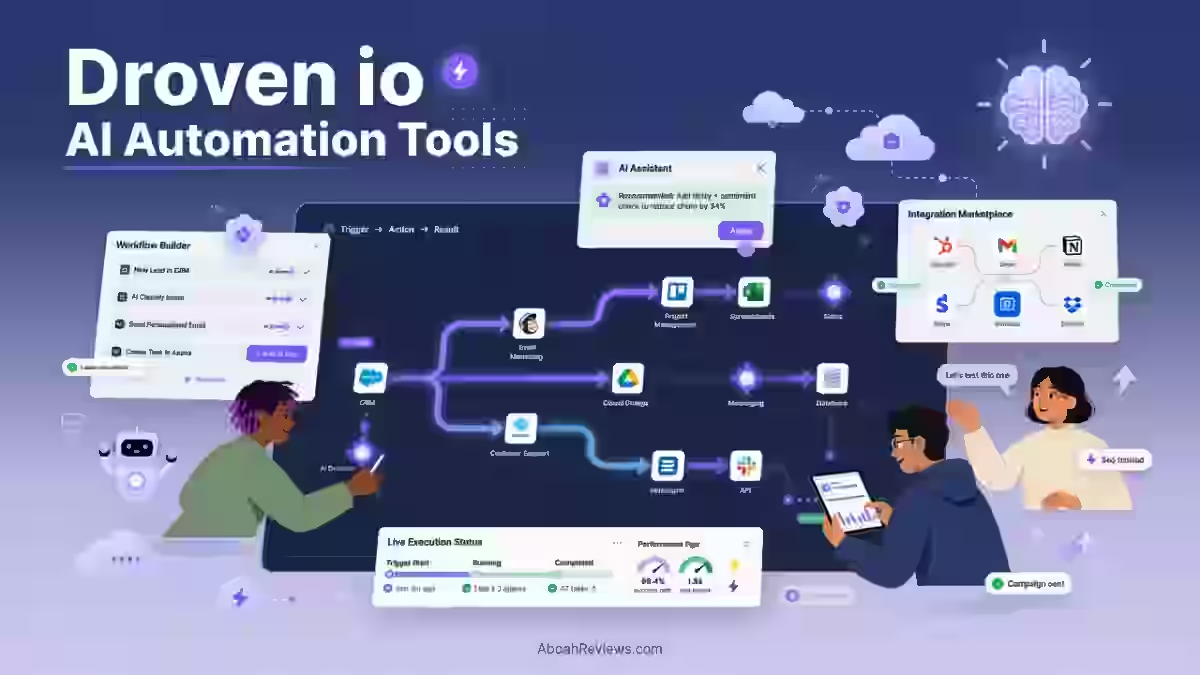
TL;DR: Droven.io is a knowledge platform and resource guide that evaluates AI automation tools, helping businesses compare software stacks like n8n, Make, and Zapier before making a purchase. It functions as an educational hub rather than a direct software tool or execution engine.
It is not automation software, and it does not run workflows, connect apps, or execute tasks. It’s useful for research and orientation before you buy a tool like Zapier, Make, n8n, or GoHighLevel.
Business owners, marketers, and students benefit most; developers needing hands-on build guides should look elsewhere.
Quick Answer: Is Droven.io an AI Automation Tool?
No, Droven.io is not automation software. Here’s the short version:
- Droven.io is an educational platform, not a workflow automation platform. It’s a vendor-neutral editorial platform covering AI, automation, and cloud technologies, publishing research-backed content to help business decision-makers understand the tool landscape, and it is not software and does not run automations.
- It does not build or execute workflows: Droven io is not a software product. It doesn’t run your automations, execute your workflows, or integrate your apps.
- It documents a category of tools, including well-known automation platforms. Droven IO AI automation tools refers to the class of intelligent workflow platforms including n8n, Make, Zapier AI, GoHighLevel, UiPath, and custom LLM systems that the Droven.io knowledge platform researches and documents for business decision-makers, and Droven.io itself is not software.
- It’s free to access: Droven.io is a free, editorially independent AI and technology knowledge platform that publishes structured, research-backed educational content on artificial intelligence, automation, machine learning, cloud computing, and cybersecurity without selling software, offering certifications, or maintaining affiliate relationships with the vendors it covers.
- If you need actual automation, you’ll still need separate software such as n8n, Make, Zapier or a dedicated AI CRM platform.
For more on evaluating tools before you commit budget, check my guide on tools for growing startup teams.
Introduction to Droven io AI Automation Tools
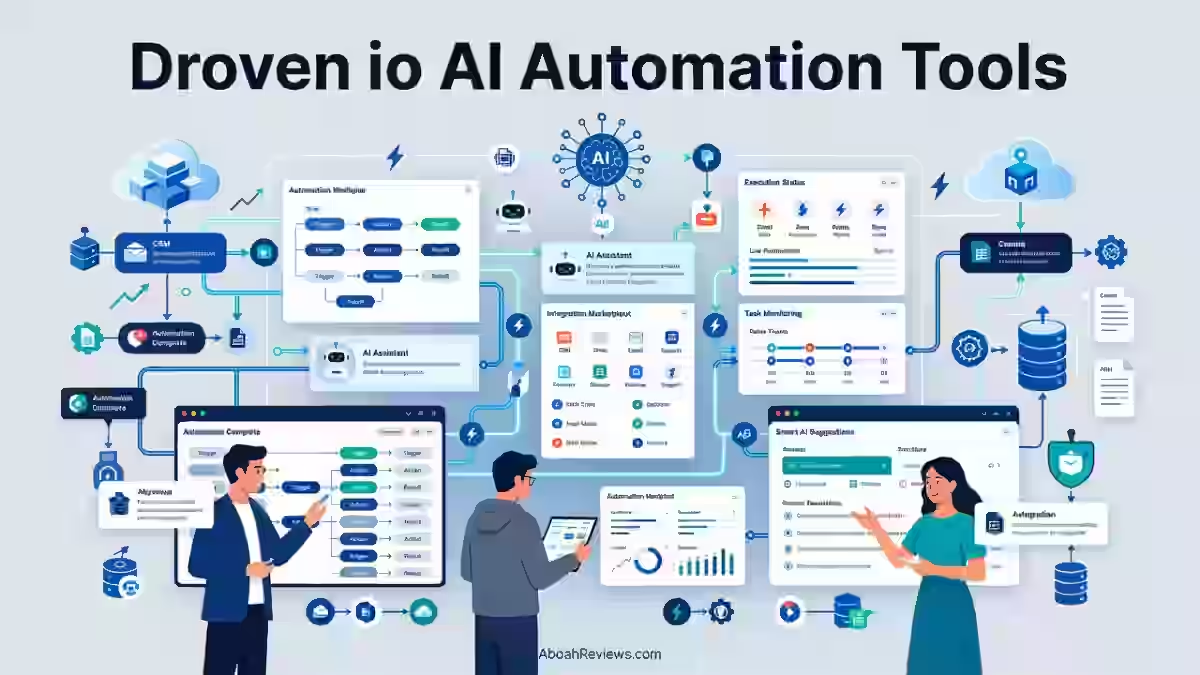
If you’ve searched for droven io AI automation tools expecting to find a workflow builder or a Zapier competitor, I want to save you some time: that’s not what you’ll get.
I spent several hours going through Droven.io’s published content, cross-checking it against other coverage of the platform, and testing how its explanations held up against automation tools I’ve actually deployed for clients.
This matters because a lot of search traffic around this term assumes Droven.io is software, when it’s actually a knowledge resource sitting next to the tools it writes about.
I’ve tested dozens of automation and AI tools over the years, from simple task automation setups to more involved CRM automation projects for small agencies.
When I first came across Droven.io, my instinct was to treat it like another Zapier alternative. After reading through its content and comparing it to independent write-ups from other reviewers, it became clear this is closer to a research layer than a product you install.
What Is Droven.io?
Droven.io is an online content platform built around plain-language explanations of AI and automation topics.
It’s best understood as an educational AI and automation knowledge platform, not a tool marketplace or vendor demo funnel.
The value is helping business owners, operators, developers, and learners understand AI, automation, RPA, cloud, cybersecurity, and machine learning before they commit budget to tools or implementation.
On the site itself, the framing is consistent: Droven.io provides trusted AI info, latest tools, guides, and future technology insights to help you stay ahead in artificial intelligence.
The published categories span a wide range of technology topics rather than one narrow niche. Droven IO covers machine learning, cybersecurity, cloud computing, AI for business, IT career development, robotics, and quantum computing.
On the automation side specifically, it explains AI concepts, tools, adoption paths, and business use cases in language non-specialists can follow, covering workflow automation, no-code and low-code automation, repetitive task reduction, and operational efficiency.
Who is this actually for? Based on my read-through, three groups get the most value:
- Business owners doing early research before choosing an automation framework
- Students and career-changers trying to understand AI adoption and job paths
- Marketers and operators who want plain-language context before a sales call
Is Droven.io an AI Automation Tool?
This is the main point of confusion, so I’ll say it directly: Droven.io is not a workflow builder, not a Zapier alternative, not a no-code automation platform, and not an AI agent platform you sign up for and start building in.
Droven.io is NOT:
- A workflow automation platform you connect to your CRM or inbox
- A Zapier, Make, or n8n alternative
- A no-code automation builder with drag-and-drop steps
- An AI agent platform where you deploy custom AI agents
Droven.io is:
- An educational technology resource
- An AI information hub covering trends and adoption strategy
- A research layer that sits between flashy vendor demos and dense academic papers, explaining what different AI and automation categories actually do before you commit budget to any of them
I’ve seen this confusion before with other “knowledge hub” sites that rank for tool-shaped keywords.
The practical fix is simple: use Droven.io (or a resource like it) for the “what is this and should I care” stage, then move to an actual platform for deployment.
What Does Droven.io Cover?
Droven.io’s content maps onto four connected areas: workflow automation, robotic process automation, AI agents and generative AI.
Each one shows up repeatedly across its published articles, and together they form a reasonable starting curriculum if you’re new to business automation.
1. AI Workflow Automation
This covers automated business processes, connecting apps, and reducing repetitive work.
The idea is straightforward: instead of a person manually moving data between two systems, a workflow automation tool watches for a trigger and executes the next step.
This is the same territory covered by platforms like Zapier, Make, and n8n, which I’ll compare in the next section.
2. Robotic Process Automation (RPA)
RPA covers software bots that follow rule-based automation across business workflows.
Tools like UiPath and Automation Anywhere automate screen-level repetitive tasks: data entry, invoice processing, compliance reporting, and cross-system data movement.
This is a different animal from AI-driven automation because RPA bots generally follow fixed steps rather than interpreting language.
3. AI Agents
AI agents cover autonomous systems that execute tasks with less direct human input at each step.
Traditional RPA follows fixed, rule-based scripts, while AI automation tools add language understanding, so workflows can classify documents, detect intent, and generate responses instead of only executing pre-set steps.
This distinction matters a lot for document processing and support ticket routing, where language understanding beats a rigid script.
4. Generative AI
This includes ChatGPT-style assistants, content generation, and productivity applications built on large language models.
Conversational AI systems are LLM-powered chatbots and voice agents built on GPT-4o, Claude, or Gemini that handle customer interactions, lead qualification, appointment booking, and support at scale without human involvement.
I’ve tested chatbot setups built on GPT-4o for support triage, and the language understanding is genuinely better than older rule-based bots, though it still needs monitoring for accuracy.
AI Automation Tools on Droven io Explained
Since “droven io AI automation tools” gets searched as if it’s a single product, it helps to break down the actual categories of tools people mean when they use that phrase.
Droven io AI automation tools is a search category describing the class of intelligent automation platforms, workflow engines and AI-powered software solutions that the Droven.io knowledge platform researches and documents for business decision-makers.
1. Workflow Automation Platforms
Tool | Best For | Notable Detail |
|---|---|---|
Zapier | Simple business automation | Easier to start with and integrates 6,000+ apps, but becomes expensive at scale. |
Make | Visual workflows | Strong for multi-branch logic and visual debugging of complex sequences |
n8n | Advanced automation | Open-source option, popular for teams that want more control over hosting and custom code steps |
2. AI Agent Platforms
These focus on agent builders, autonomous workflows, and AI assistants that can hold context across multiple steps rather than a single trigger-action pair.
Custom ai agents built on RAG systems (retrieval-augmented generation) are increasingly common for support and research use cases because they pull from a company’s own documents instead of relying only on general model training.
3. Business Automation Tools
This bucket includes crm automation, marketing automation, and customer support automation.
AI-enhanced CRM platforms like GoHighLevel, HubSpot AI, and Salesforce Einstein layer predictive analytics, automated follow-up, and AI-driven lead scoring onto customer relationship management workflows.
For service businesses I’ve worked with, this category tends to deliver the clearest sales automation wins because lead qualification and follow-up are repetitive by nature.
For a deeper breakdown of how these tool categories differ, my guide on types of AI writing and automation tools covers the distinctions in more detail.
How AI Automation Helps Businesses
Automation tools show up across four departments in almost every business I’ve worked with: marketing, sales, support, and operations.
The actual value depends on how clean the underlying data is and how well the workflow orchestration is set up, not just which tool you pick.
Marketing
- Content workflows for planning, drafting, and publishing
- Lead generation automation tied to landing pages and forms
- Email automation sequences triggered by user behavior
Sales
- Lead qualification scored automatically before a rep ever sees the contact
- CRM updates that log calls, emails, and deal stage changes without manual entry
- Automated follow-ups for stalled deals
Customer Support
- AI chat assistants for first-response triage
- Ticket routing based on intent detection
- Knowledge bases that feed answers into a chatbot’s response pipeline
Operations
- Document processing and invoice automation for finance teams
- Reporting pulled automatically from multiple data sources
- Task automation for recurring internal processes
Benefits of AI Automation
The real benefits of automation tools show up in time saved and consistency gained, not in replacing judgment. Based on workflows I’ve built and maintained:
- Saves employee time by handling repetitive data entry and routing
- Reduces repetitive tasks across support, sales, and operations
- Improves workflow consistency since a bot follows the same steps every time
- Helps teams scale without adding headcount for every new process
- Reduces manual errors in data transfer between systems
Cost reduction is often cited alongside these points. Some industry sources put deployment savings in the 30 to 60 percent range for operational costs within the first 90 days of a production rollout.
However, results vary heavily based on how well the automation architecture was planned before launch.
Limitations of AI Automation
Automation is not a plug-and-play fix, and I’ve hit every one of these limitations firsthand.
- Setup complexity: A poorly mapped workflow causes more problems than it solves. 68% of failed automation projects fail due to poor integration architecture, not tool limitations, according to Gartner.
- Cost: Platform fees, API usage, and maintenance add up quickly at scale, especially with per-task pricing models.
- Human oversight requirements: AI-generated responses in customer support still need spot-checking, particularly for edge cases the model hasn’t seen before.
- Data privacy concerns: Any workflow touching customer data needs a clear answer on gdpr compliance and broader data compliance before it goes live.
- Incorrect AI decisions: Language models can misclassify intent or generate a wrong response with full confidence, which is why monitoring matters more than the marketing copy suggests.
I’ve seen automation projects stall for the same reason cited above.
Most companies don’t struggle because there aren’t enough AI tools, they struggle because they start without a clear use case, messy data, or a realistic understanding of what any given tool can and cannot do.
That’s also, frankly, the strongest argument for using an educational resource before buying software.
How to Evaluate AI Automation Tools
Whether you’re comparing an AI workflow builder or a full AI CRM platform, the evaluation criteria stay mostly the same.
- Ease of Use: Can a non-technical team member build a basic workflow without a developer? Low-code automation platforms like Make and n8n differ a lot here; Make leans more visual, n8n gives more control but a steeper learning curve.
- Integrations: Does it connect with your existing stack through native connectors or rest api integration? Zapier’s app count is a common benchmark, but the number matters less than whether your specific tools are supported well.
- AI Capabilities: Check whether the platform supports natural language commands, custom ai agents, and machine learning-based decisioning, or whether it’s still rule-based automation dressed up with AI branding.
- Pricing: Compare free plans, starter plans, and enterprise pricing against your expected usage volume, since automation costs often scale with task count or number of active workflows rather than a flat monthly fee.
- Security: Confirm data handling practices, user permission controls, and compliance certifications before connecting anything to customer records.
For a closer look at how AI-based tools stack up against manual processes generally, see my comparison of AI writing tools versus human editors, which covers similar oversight tradeoffs.
Droven.io Pros and Cons
Pros
Advantage | Explanation |
|---|---|
Educational content | Helps beginners understand automation and AI concepts without a sales pitch attached |
Wide AI coverage | Spans workflow automation, RPA, generative AI, and cloud topics in one place |
Beginner friendly | Explains complex concepts in plain language rather than technical jargon |
Free access | No paywall or subscription required to read the content |
Cons
Limitation | Explanation |
|---|---|
Not a software platform | Cannot directly automate workflows, connect apps, or run tasks |
Educational focus | Less useful once you’re ready to actually build and deploy |
Requires external tools | Users still need Zapier, Make, n8n, or similar platforms for execution |
Who Should Use Droven.io?
Good For:
- Beginners learning AI and automation concepts
- Business owners researching options before a purchase decision
- Students exploring technology career paths
- Professionals following AI adoption trends for their industry
Not Ideal For:
- Users looking for actual automation software to deploy
- Developers needing technical implementation guides or API documentation
- Businesses needing immediate workflow automation with no learning curve
Best Alternatives to Droven.io
If you want a similar research-first approach, or you’re ready to move past reading and into building, here are comparable resources.
Platform | Best For |
|---|---|
FutureTools | Discovering new AI tools by category |
There’s An AI For That | Browsing an AI tool directory by use case |
Product Hunt | Tracking new automation and AI product launches |
G2 | Reading verified user reviews on automation software |
For actual automation deployment rather than research, our breakdown of pros and cons across AI writing and automation tool categories is a useful next step.
Final Verdict on Droven io AI Automation Tools
Droven.io is an educational resource, not an automation platform. It’s built to explain AI, RPA, workflow automation, and generative AI concepts in plain language, not to run your customer support chatbot or update your CRM records.
If you’re at the research stage of your automation strategy, it’s a reasonable starting point.
It’s best suited for beginners, business owners doing early research, and anyone trying to understand ai adoption trends before committing budget.
It’s not the right fit if you need to actually deploy a workflow this week.
Once you’re past the learning stage, pick your automation software based on your actual workflow, your team’s technical comfort, and your integration needs, not based on marketing claims.
Software and AI tools work best alongside human review, not as a replacement for it, and that applies just as much to automation as it does to content.
Frequently Asked Questions About Droven io AI Automation Tools
1. What is Droven.io?
Droven.io is a free, vendor-neutral editorial platform that publishes educational content about AI, automation, machine learning, and emerging technology. It does not sell software or run automated workflows itself.
2. Is Droven.io an AI automation platform?
No. It provides educational information about AI and automation rather than functioning as software you install or connect to your systems.
3. Does Droven.io create AI tools?
No, Droven.io does not build or sell AI tools. It documents and explains tools created by other companies, such as workflow platforms, RPA systems, and AI agents, without maintaining vendor relationships.
4. What AI topics does Droven.io cover?
It covers AI tools, automation (including RPA and workflow automation), machine learning, generative AI, cloud computing, and software development trends. Content is aimed at business owners, developers, and students.
5. Can businesses learn automation from Droven.io?
Yes, at a conceptual level. It’s useful for understanding categories, terminology, and adoption strategy before choosing and deploying an actual automation tool.
6. Is Droven.io free?
Yes. Based on published coverage, Droven.io operates as a free, ad-supported or independently run content platform with no subscription required to read its articles.

He is the founder of ZionReviews, where he helps businesses, marketers and creators make informed decisions about software through detailed reviews, comparisons and hands-on analysis.
Aboah specializes in testing SEO tools, AI writing platforms and autoblogging software, focusing on real-world performance, features, usability, pricing, and overall value.
His review process combines practical testing, industry research, and SEO expertise to provide unbiased insights for readers looking for the right tools to grow their online presence.
His work has been featured across platforms including HubPages, Medium, Vocal Media and Hackernoon. Through ZionReviews, Aboah shares actionable software insights designed to help users choose reliable tools and build more effective digital workflows.
- Is Glorvix.com Legit or Scam? Honest 2026 Safety Check & Verdict - August 15, 2026
- Glorvix Com App: Ultimate Guide to the Official App, Safety & Services (2026) - August 15, 2026
- Glorvix.com Review 2026: Is It Legit or Scam? Full Breakdown - August 13, 2026