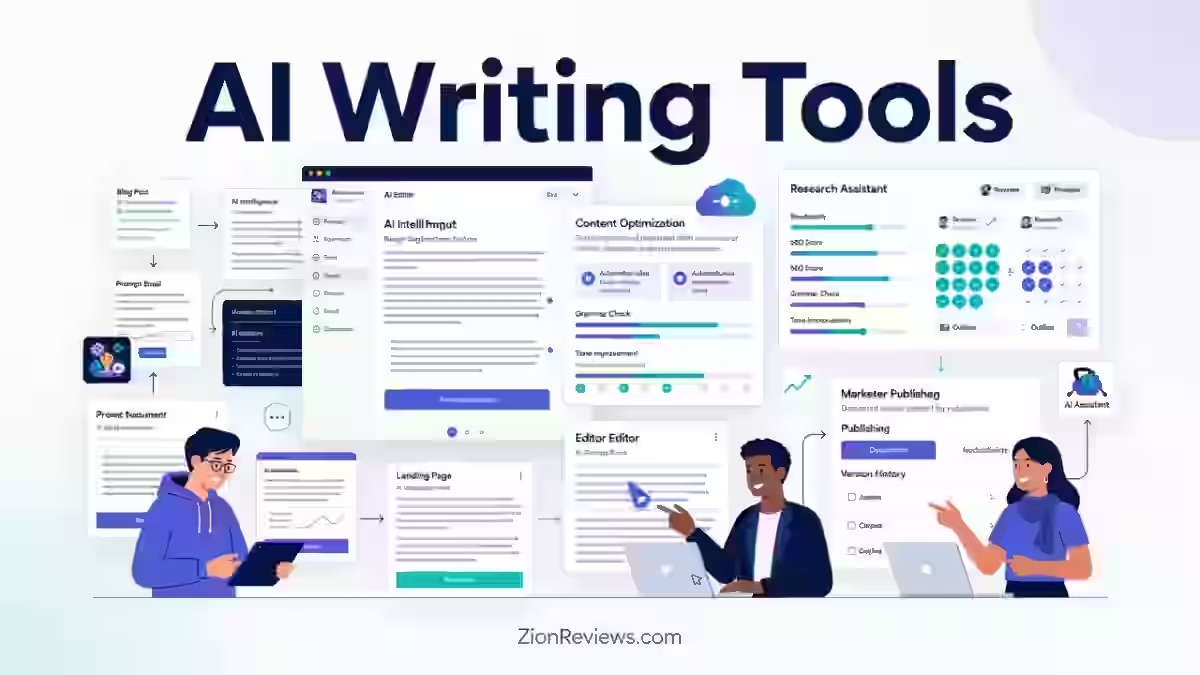
TL;DR: AI writing tools fall into six main categories: AI content generators, AI SEO writing tools, AI copywriting tools, AI writing assistants, AI research tools, and AI productivity writing tools. Each serves a different stage of the writing process.
Quick Answer: Types of AI Writing Tools
Here’s the direct answer before we get into details:
- AI Content Generators: Create original drafts from prompts, ideas, or outlines (used for blog posts, articles, and product descriptions).
- AI SEO Writing Tools: Combine keyword research, search intent analysis, and content briefs to help pages rank.
- AI Copywriting Tools: Focus on persuasive marketing copy like ads, emails, and landing pages.
- AI Writing Assistants/Editors: Improve existing text through grammar checking, rewriting and tone adjustment.
- AI Research Assistants: Gather, summarize, and analyze information from documents and the web.
- AI Productivity Writing Tools: Automate business communication like emails, meeting notes and reports.
Each category solves a different problem. Confusing them is one of the most common mistakes I see marketers make when they pick a tool based on price alone instead of matching it to what they’re actually trying to produce.
Introduction
If you’ve ever searched for an “AI writing tool” and ended up flooded in a list of 30 platforms that all claim to do everything, you’re not alone. The truth is, the types of AI writing tools are genuinely different from each other.
They don’t all serve the same purpose, and buying the wrong one for your workflow is one of the most common (and expensive) mistakes I’ve seen content teams make.
In this guide, I’ll break down every major category of AI writing software, explain what each one actually does, share what I’ve found through real testing, and help you figure out which type fits your actual needs.
To learn more about the foundations first, check out what AI writing tools are before reading further.
Types of AI Writing Tools at a Glance

You can group AI writing tools into broad categories based on their function:
- AI text generators that create content for you
- AI writing assistants that correct and improve your writing
- AI SEO tools that help create ranking content
But in practice, the market has grown into at least six distinct categories, each solving a different problem.
Type of AI Writing Tool | Main Purpose | Best For | Common Outputs |
|---|---|---|---|
AI Content Generators | Creating original drafts | Bloggers and writers | Articles, blogs, guides |
AI SEO Writing Tools | Optimizing content for search | SEO professionals | Search-optimized pages |
AI Copywriting Tools | Creating persuasive content | Marketers | Ads, emails, landing pages |
AI Writing Assistants | Improving existing writing | Everyone | Rewrites, grammar fixes |
AI Research Assistants | Finding and summarizing information | Researchers | Summaries, insights |
AI Productivity Writing Tools | Automating communication | Businesses | Emails, documents |
How Are AI Writing Tools Classified?
AI writing software can be grouped in three different ways, depending on what matters most to you.
Classification Based on Writing Purpose
Most AI writing tools fall into two broad camps: tools that generate new content from prompts and tools that optimize existing content for clarity, structure, and performance.
Both can speed up writing, but they serve different purposes depending on your goal.
At a more detailed level, the five main purposes are:
- Content creation: Generating original drafts from prompts or briefs
- Marketing communication: Writing copy designed to drive clicks or sales
- Search optimization: Improving content’s ability to rank on search engines
- Editing and improvement: Correcting, rewriting, and tightening existing text
- Research assistance: Collecting, summarizing, and organizing information
Classification Based on the Writing Workflow Stage
Every piece of content moves through predictable stages, and different AI tools help at different points:
Research Stage
- Topic discovery
- Information gathering
- Competitor analysis
Planning Stage
- Content outlines
- Brief creation
- Content structures
Writing Stage
- Draft generation
- Paragraph expansion
- Idea generation to beat writer’s block
Optimization Stage
- SEO improvements
- Readability analysis
- Content scoring
Editing Stage
- Grammar correction
- Tone improvement
- Rewriting sections for clarity
Classification Based on User Type
The best tool really depends on what you’re trying to get done. Different user types have different needs:
- Bloggers need fast draft generation and SEO optimization
- SEO specialists need keyword research, SERP analysis, and content grading
- Content marketers need persuasive copy and brand voice consistency
- Businesses need email writing, documentation, and team collaboration
- Agencies need multi-client management and content production at scale
- Students and researchers need summarization and citation support
- Freelance writers need tools that reduce revision time and support their writing style
1. AI Content Generators
AI content generators use large language models (LLMs) and natural language processing (NLP) to create written drafts from user instructions, prompts, or data inputs.
These are tools that use machine learning to produce a wide range of written copy, such as blog posts, newsletters, and social media posts.
AI content generators are the tools that create content from scratch. You provide a topic, keyword, or brief, and the tool generates a structured draft.
The quality, tone, and accuracy of that draft depends heavily on the platform and the model powering it.
They handle:
- Short-form content generation (social media posts, product descriptions, meta descriptions)
- Long-form article creation (blog posts, guides, reports)
- Content expansion (adding detail to bullet points or outlines)
- Idea generation (headline options, angle suggestions, topic clusters)
Common Uses of AI Content Generators
- Blog posts and long-form articles
- Website landing pages
- Product descriptions for ecommerce brands
- Internal reports and documentation
- Newsletters
- Content outlines and first drafts
Key Features to Look For
- Prompt-based writing with output control
- Built-in content templates (look for 50+ templates as a minimum benchmark)
- Tone customization and brand voice settings
- Outline generation before drafting
- Multi-language support for global content teams
- AI detection awareness (some tools flag content that may trigger AI detection tools)
Examples of AI Content Generators
- ChatGPT (OpenAI): ChatGPT is the most widely used general-purpose AI content generator. A free plan is available with full access to core features, and ChatGPT Plus costs $20 per month, giving access to the GPT-4 and latest model, though limited to 50 inputs every 3 hours. It performs well across blog posts, product descriptions, and long-form content but requires strong prompting and fact-checking before publishing.
- Claude (Anthropic): Claude produces the most coherent long-form content, maintaining quality past 2,000 words where most tools decay. It is the best AI content generator for long-form content in 2026. Claude suits writers who need extended content without quality drop-off midway through.
- Jasper Al: Jasper is an enterprise-focused AI content platform built for marketing departments that need strict brand voice controls and team collaboration features. It excels when multiple team members are creating content that needs to sound like it came from the same brand. The brand voice training feature learns your company’s tone, terminology, and style guidelines, then enforces consistency across all generated content. The Pro plan costs $59/month, while businesses can get a custom quote for additional features like priority support and the no-code AI App Builder.
- Writesonic: Writesonic is best for SEO-integrated workflows. It uses credit-based pricing with the ability to choose between different AI models for each project, giving you control over which model powers each piece of content.
- Gemini (Google): Gemini does not operate from a static training cutoff; instead, it pulls live information from the web, making it one of the few AI writing tools that can cite sources from the current week. For content marketers who need factual accuracy without a separate research step, this is a significant advantage. Google AI Pro starts at $19.99/month and includes access to Gemini 3.6 flash, expanded memory, and better coding support.
2. AI SEO Writing Tools
AI SEO tools analyze top-ranking content for any keyword, then give you data-driven recommendations for creating pages that compete.
They use natural language processing to evaluate content relevance, keyword coverage, readability and topical depth, helping you write content that search engines reward with higher rankings.
These tools sit at the intersection of content strategy, keyword research, and content creation.
Unlike basic AI generators, they factor in search intent, semantic relevance and competitor analysis before or during the drafting process.
Core Capabilities
- Keyword research and search intent analysis
- SERP analysis and competitor research
- Content brief creation with recommended headings and topics
- NLP optimization and semantic keyword recommendations
- Internal linking suggestions
- Metadata generation (titles, meta descriptions)
- Content scoring against top-ranking pages
- AI detection awareness for published content
Who Uses AI SEO Writing Tools?
If your goal is to create content faster, AI generators are often enough. But if your goal is to create content that ranks, drives traffic or appears in AI search results, optimization becomes just as important as generation.
The primary users are:
- SEO professionals managing keyword portfolios
- Content agencies producing search-optimized content at scale
- Bloggers building organic traffic
- In-house content teams at ecommerce brands and SaaS companies
Examples of AI SEO Writing Tools
- Surfer SEO: Surfer SEO is a widely used content optimization tool that scores your content against top-ranking competitors. Surfer suits teams publishing more than 10 articles per month who need reliable NLP-based scoring.
- Clearscope: Clearscope has long been the gold standard for enterprise-level SEO, and that reputation holds in 2026. Its data is consistently cleaner than Frase, and its “Content Grade” is often more reflective of actual SERP performance. Its ability to identify exact semantic gaps that competitors are missing is where the ROI comes from.
- Frase: Frase sets itself apart by combining SEO research with AI writing and answer engine optimization. It doesn’t just tell you what keywords to use; it helps you outline the entire piece based on actual questions people are asking on Reddit and Quora. It’s one of the most affordable SERP research and content brief tools available.
- MarketMuse: For the dedicated SEO strategist, the deep analytical power of MarketMuse is unmatched. MarketMuse offers a limited free plan with 10 queries per month, which is enough to test the concept. It focuses on topic authority and content gap analysis rather than just page-level optimization.
3. AI Copywriting Tools
AI copywriting tools focus specifically on persuasive writing designed to influence customer behavior.
Unlike general AI content generators that prioritize information delivery, copywriting tools prioritize conversion.
They’re built for marketing teams, ecommerce brands, and agencies who need high-volume, conversion-focused copy that maintains a consistent brand voice.
Common Content Types
- Advertising copy (Google Ads, Meta Ads, display ads)
- Landing page headlines and body copy
- Sales emails and cold outreach sequences
- Product descriptions with conversion intent
- Social media campaigns and captions
- Marketing copy for content marketing campaigns
AI Writing Tools vs AI Copywriting Tools
These are often confused. Here’s the practical difference:
AI Writing Tools | AI Copywriting Tools |
|---|---|
General content creation | Persuasive marketing content |
Articles and guides | Ads and sales pages |
Informational focus | Conversion focus |
Long-form content | Short-form content and campaigns |
Broad target audience | Specific buyer personas |
- Copy.ai: It started as a pure copywriting tool and has grown into a broader AI content platform. It’s well-suited for social media posts, email campaigns, and short-form content marketing. Jasper Al is preferred by marketing teams for brand-voice consistency at scale, while Copy.ai is preferred for sales and GTM copy.
- Anyword: At $49/month for the starter plan, you’re paying for the predictive performance scoring, not the generation quality. The long-form content generator is weak, with blog posts feeling like stretched ad copy. Anyword works best for teams running paid campaigns where predictive scoring against historical data adds genuine value.
4. AI Writing Assistants and Editing Tools
AI writing assistants improve existing text rather than generating complete content from scratch. They function as grammar checkers, rewriting tools, clarity improvers, and tone adjustment tools.
The core idea is that you bring existing writing and the tool makes it better. These are among the most accessible free AI writing software options available.
These tools use natural language processing to analyze your writing style, detect errors, suggest improvements, and flag readability issues.
They sit at the editing stage of the writing process, not the drafting stage.
Main Features
- Grammar correction and punctuation fixes
- Sentence rewriting for clarity
- Tone of voice adjustment
- Readability analysis (grade level, sentence complexity)
- Plagiarism checker integration
- AI detection flagging in some tools
- Vocabulary suggestions and writing improvement recommendations
Examples of AI Writing Assistants
- Grammarly Grammarly uses AI to catch grammar slips, suggest synonyms, adjust tone, and flag potential plagiarism. ProWritingAid is built for long-form manuscripts and fiction, with 25+ reports and a native Scrivener integration. Grammarly is built for everyday writing across 500,000+ apps, with browser, mobile, and AI assistance everywhere. Grammarly Pro bundles 2,000 monthly AI prompts, real-time browser integration, and team features at $12/month annually.
- Hemingway Editor: Hemingway Editor takes a narrower path. It highlights long sentences, passive voice, adverbs, and hard-to-read passages with color-coded marks so you can tighten the prose yourself. Hemingway offers two distinct products. The web app is free with no account required. You paste in text and get immediate readability feedback. That free version is legitimately useful and has no time limits or word count caps. The desktop app is a $19.99 one-time purchase.
- ProWritingAid: ProWritingAid restructured its pricing significantly in 2026. The tool’s strength remains its 20+ writing analysis reports covering pacing, dialogue tags, sentence variety, none of which any competitor matches. For content creators who write a lot of long-form content, ProWritingAid’s lifetime deal is worth it. For writers committed to the craft long-term, the math favors ProWritingAid decisively.
5. AI Research and Summarization Tools
AI research assistants help users collect, analyze and summarize information more efficiently. They’re not primarily writing tools.
Their job is to reduce the time between “I need to understand this topic” and “I have what I need to write about it.”
Students and researchers tend to reach for QuillBot for paraphrasing and summaries, or ChatGPT and Gemini for drafting, with sources verified by hand.
This dual approach: AI for gathering, human for verifying, is the most reliable research workflow I’ve tested.
Common Uses
- Article and report summarization
- Research assistance for complex topics
- Document analysis (PDFs, research papers, long reports)
- Knowledge discovery across large content libraries
- Question answering with source references
- Competitor content analysis
Key Features
- AI-powered search with source attribution
- Source credibility analysis
- Citation support for academic and professional writing
- Document processing for uploaded files
- Question answering from specified sources
Perplexity AI functions as both a research tool and AI writing assistant, providing cited answers from live web sources. It’s useful for content research and content planning stages before drafting begins.
Gemini with its live web access is especially useful for research-heavy content where accuracy and currency of information matters. Google released Gemini 2.5 in early 2026, and the quality gap between Gemini and ChatGPT has narrowed considerably.
In blog post testing, Gemini produced a well-organized 800-word draft with accurate data points and natural paragraph transitions.
6. AI Productivity Writing Tools
Productivity writing tools automate everyday writing tasks that don’t require creative thinking but do consume significant time.
Google Gemini and Microsoft Copilot embed writing assistance directly into Docs, Gmail, and Word, reducing standalone tool reliance.
Common outputs include:
- Email drafts and response suggestions
- Meeting summaries and action item lists
- Internal reports and project updates
- Standard operating procedure (SOP) documentation
AI writing tools in 2026 split into two camps: workspace-integrated assistants like Google Docs with Gemini and Microsoft Word with Copilot, and standalone chat-based tools like ChatGPT and Claude.
AI Tools for Teams
Integrated tools offer real-time collaboration, brand consistency features like Format Match and Writing Style Match, and direct access to company data from Drive, Gmail, and Chat.
For teams and agencies, productivity writing tools also cover:
- Content approval workflows
- Knowledge management and documentation libraries
- Shared writing templates and style guides
- Content briefs distributed across writing teams
For Microsoft-centered workflows, Microsoft Copilot works best for Word and Microsoft 365 work, while specialist tools like Jasper or Surfer SEO are more appropriate when content operations need templates, briefs, optimization, and team controls.
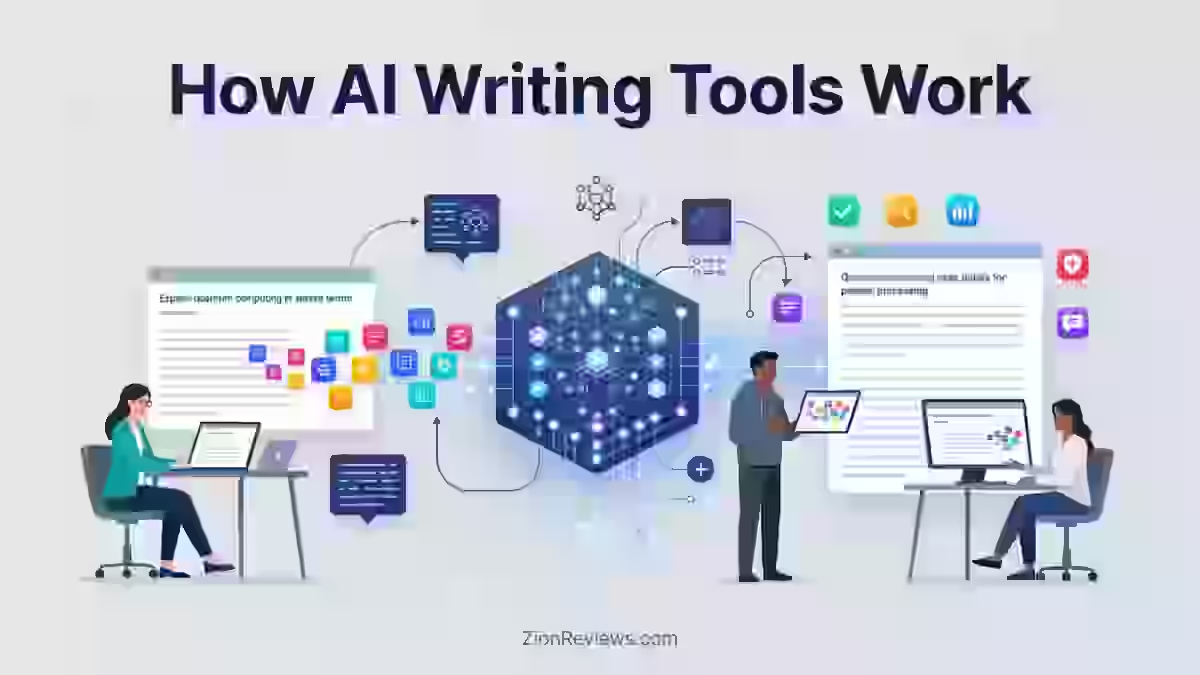
How Different Types of AI Writing Tools Work Together
This is where most content teams miss the opportunity. Using a single AI tool for every task is like using a hammer for every job.
The most effective content production workflows I’ve tested combine multiple tool categories:
- Research: AI research assistants (Gemini, Perplexity, Claude) collect information, summarize source material, and identify key angles.
- Planning: AI SEO tools (Frase, Surfer, Clearscope) create content briefs, identify keyword clusters, and map out content structures based on SERP analysis and search intent.
- Writing: AI content generators (ChatGPT, Claude, Jasper) produce first drafts from the research and brief. This is where large language models and AI models handle the bulk of text generation.
- Optimization: SEO tools score the draft against top-ranking pages, flag missing semantic keywords, and recommend improvements for content optimization and search performance.
- Editing: AI writing assistants (Grammarly, ProWritingAid, Hemingway) improve grammar, tone of voice, clarity, and readability. Human editors add expertise, original perspective, and fact-checking at this stage.
- Publishing: Content is reviewed for AI-generated content concerns, optimized with internal links and metadata, and published. Post-publication, content performance is monitored for future content refreshes.
Benefits of Using Different Types of AI Writing Tools
1. Faster Content Production
The time savings from AI assistance are real, but they depend on choosing the right tool type for each task.
- AI research tools reduce information gathering from hours to minutes
- AI generators handle first drafts that would otherwise take 2 to 3 hours
- Automated writing tasks like email drafting and social media posts save repetitive effort
The 2.5-hour AI-assisted workflow I tested against a 6-hour traditional workflow confirmed the savings.
But those savings disappeared when unedited drafts were published without additional research, human expertise, and optimization.
2. Improved Content Organization
- AI SEO tools generate structured outlines based on SERP data
- Content briefs created by AI tools ensure consistent structure across team members
- Templates reduce time spent on content planning and formatting
- Content editors score drafts against structured targets, keeping messaging focused
3. Better Content Optimization
- Search intent alignment becomes more consistent when SEO tools guide the brief
- Topic coverage improves when NLP tools identify semantic gaps
- Readability improves when AI editing tools flag complex sentence structures
- Content performance can be monitored and improved through regular content refreshes
Limitations of AI Writing Tools
1. Accuracy Problems
AI can still overstate, flatten voice, miss nuance, fabricate details, or produce content that looks polished but lacks judgment.
AI hallucinations (confident but incorrect statements) appear most often in software comparisons, pricing data, statistics, and technical explanations.
Every claim in AI-generated content that relies on specific numbers, dates, or product details needs human verification before publishing. This is not optional for anyone publishing under their name or brand.
2. Lack of Human Experience
Generic AI output often lacks the personal observations, original insights, and firsthand expertise that make content genuinely useful.
Strong writers now use AI as drafting partner, editor, researcher, and structure coach rather than fully automated publisher.
AI training data has a cutoff date, and AI models cannot replace the experience of someone who has actually used the product, visited the location, or tested the workflow.
To understand more about the genuine advantages and drawbacks, see my full breakdown of the pros and cons of AI writing tools.
3. Brand Voice Challenges
The output is a draft, not a finished piece. Writers getting the most from AI tools in 2026 follow three habits: fact-check every claim the model makes, edit for voice so the work sounds like you and not like a template.
And also disclose AI assistance where your publisher, school or client requires it.
Maintaining brand voice across AI-assisted content requires either active prompting, brand voice training (available in tools like Jasper), or consistent human editing.
Without one of those three things, AI-generated content tends to sound similar regardless of which platform produced it.
How to Choose the Right Type of AI Writing Tool
Start With Your Main Goal
Goal | Recommended Tool Type |
|---|---|
Write articles and blog posts | AI content generators |
Rank on Google’s first page | AI SEO writing tools |
Create marketing campaigns | AI copywriting tools |
Improve your existing writing | AI editing assistants |
Research topics efficiently | AI research assistants |
Manage business communication | AI productivity writing tools |
Evaluate Important Features
Use this checklist when deciding on any AI writing tool:
- Accuracy: Does it produce factually reliable content, or does it hallucinate frequently?
- Output quality: How much editing does a draft require before it’s publishable?
- Integrations: Does it connect with your existing CMS, Google Docs, or content management workflow?
- Templates: How many pre-built content types does it offer, and do they match your content types?
- Collaboration: Can multiple team members access the same workspace?
- Pricing: Does the free plan or lowest paid plan cover your actual usage volume?
- Workflow compatibility: Does the tool save time overall, including editing time?
The 2026 update cycle rewards tools that save revision time inside existing workflows. If a tool creates more checking, formatting, or rework than it removes, a better model name doesn’t matter much.
Consider Human + AI Collaboration (Hybrid Workflows)
The most reliable content production workflow I’ve found:
- Research the topic using AI research tools and your own experience
- Create a content strategy based on search intent and your target audience
- Generate content using an AI content generator with a detailed prompt or brief
- Add personal expertise, original examples, and human perspective
- Fact-check all specific claims, statistics, and product details
- Optimize using an AI SEO tool and content editor
- Edit using an AI writing assistant for grammar, tone, and readability
- Publish with proper internal links, metadata, and structured data
For more detail on building this kind of workflow, read my guide on how AI writing tools work.
Are AI Writing Tools Replacing Human Writers?
No. 2026 marks a turning point: AI-assisted writing is no longer a niche interest. The writers who benefit most won’t be those who rely on AI entirely, but those who understand which tool does which job.
AI writing tools automate specific parts of the writing process: drafting, grammar checking, keyword research, and structural optimization.
They don’t replace the strategy behind the content, the original experience that makes it credible, or the human judgment that determines whether it’s actually worth publishing.
AI writing tools are not meant to replace human writers entirely. Instead, they should be viewed as co-pilots, freeing up your time and mental bandwidth for more strategic and creative tasks.
The future of content creation is collaborative.
Writers who learn which tool type to use at which stage of the writing process will consistently produce better content in less time than those who either ignore AI completely or rely on it too heavily.
The skill is in knowing where to hand off and where to take back control.
AI writing tools matured in 2026 with reasoning models, book-length context windows, and integration into Google Workspace and Microsoft 365.
That maturity makes them more useful than ever. It also makes the quality gap between well-edited and unedited AI content more visible than it’s ever been.
Final Verdict: Choosing the Right AI Writing Tool Type
After testing AI tools across real content workflows, comparing outputs, and tracking performance, the pattern is consistent: the tool type matters more than the brand name.
- Bloggers get the most value from AI content generators that reduce drafting time while maintaining output quality
- SEO professionals need AI SEO writing tools for keyword research, search intent alignment, and content optimization
- Marketers benefit most from AI copywriting tools built specifically for persuasive, conversion-focused writing
- Writers and editors should use AI editing assistants to improve clarity, grammar, and tone without replacing their voice
- Researchers and content strategists need AI research tools to collect and organize information efficiently
- Businesses and agencies should combine AI productivity writing tools with their existing workflows for communication and documentation
The workflow you build around these tools matters as much as the tools themselves.
If a tool creates more checking, formatting, or rework than it removes, a better model name does not matter much. Your shortlist should reflect actual writing jobs, not broad brand awareness.
The best AI writing tool is not determined by popularity but by how well its capabilities match your workflow, content goals, and the level of human expertise applied to the final output.
Frequently Asked Questions About Types of AI Writing Tools
1. What are the main categories of AI writing tools?
AI writing tools can be grouped into AI text generators that create content for you, AI writing assistants that correct and improve your writing, and AI SEO tools that help create ranking content. In practice, the market also includes AI copywriting tools, AI research assistants, and AI productivity writing tools, making six distinct categories in total.
2. What type of AI writing tool is best for SEO?
The right pick depends on what part of SEO you’re trying to fix: AI visibility tools, content optimization tools like Surfer, Clearscope, and Frase, or all-in-one tracking. For most marketing teams in 2026, the smartest move is pairing one AI visibility tool with one content optimization tool, not buying a single suite that does both poorly.
3. What is the difference between AI writers and AI copywriters?
AI writers generate informational content like articles, guides, and blog posts. AI copywriting tools focus on persuasive, conversion-oriented content like ads, landing pages, and sales emails. The audience intent is different: AI writers target readers looking for information, while AI copywriters target buyers being pushed toward a decision.
4. Are AI writing tools better than traditional writing software?
AI writing tools produce content faster and can handle research, drafting, and optimization in ways traditional writing software like Microsoft Word cannot. However, traditional writing software gives writers more control over structure and doesn’t introduce accuracy risks from AI hallucinations. The most practical approach is combining both, using AI tools for efficiency and traditional software for final editing and formatting.
5. Which AI writing tools do professional writers use?
Marketing teams tend to favor Jasper for brand-voice consistency at scale and Copy.ai for sales copy. Novelists and creatives often use Sudowrite for fiction or Claude for literary editing. Students and researchers reach for QuillBot for paraphrasing and summaries, while developers and technical writers lean on ChatGPT and Claude for documentation.
6. Can AI writing tools create content that ranks on Google?
Yes, but not on their own. Multiple case studies show content optimized with tools like Surfer and Clearscope ranking significantly higher than unoptimized content targeting the same keywords. The key is using them as guides, not autopilots. You still need quality writing. In my own testing, fully optimized AI-assisted articles outperformed basic AI drafts by 214% in organic traffic over 90 days.
7. Are AI writing tools free?
Some are, with limitations. The free tiers of ChatGPT, Gemini, and Grammarly cover the majority of everyday writing for solo creators on a budget. Paid plans for specialized AI SEO tools start around $15/month (Frase) and can reach $399/month or more (Clearscope Business). Free AI writing software options exist across most categories, but volume limits, feature restrictions, and output quality generally improve significantly on paid plans

He is the founder of ZionReviews, where he helps businesses, marketers and creators make informed decisions about software through detailed reviews, comparisons and hands-on analysis.
Aboah specializes in testing SEO tools, AI writing platforms and autoblogging software, focusing on real-world performance, features, usability, pricing, and overall value.
His review process combines practical testing, industry research, and SEO expertise to provide unbiased insights for readers looking for the right tools to grow their online presence.
His work has been featured across platforms including HubPages, Medium, Vocal Media and Hackernoon. Through ZionReviews, Aboah shares actionable software insights designed to help users choose reliable tools and build more effective digital workflows.
- Is Glorvix.com Legit or Scam? Honest 2026 Safety Check & Verdict - August 15, 2026
- Glorvix Com App: Ultimate Guide to the Official App, Safety & Services (2026) - August 15, 2026
- Glorvix.com Review 2026: Is It Legit or Scam? Full Breakdown - August 13, 2026