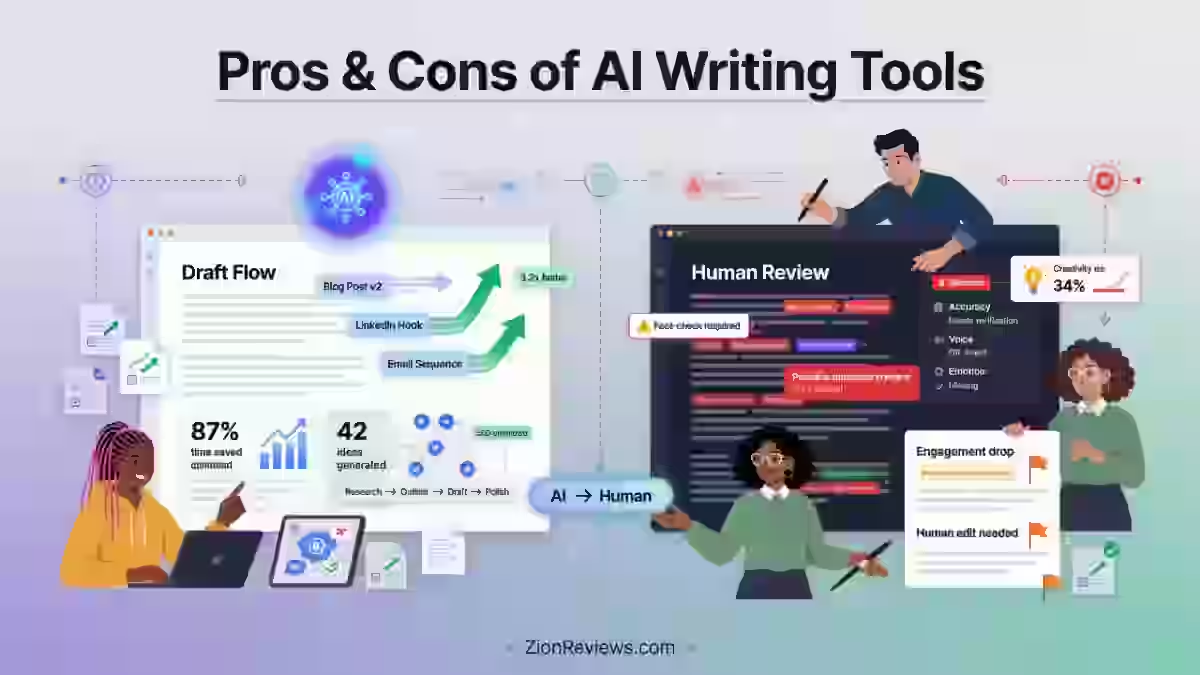
TL;DR: AI writing tools help users create content faster, generate ideas and improve productivity, but they have limitations including inaccurate information, generic writing, and the need for human editing.
The main takeaway: AI writing tools save time and help with ideas, but they still need human editing, fact-checking and original expertise to produce content worth publishing.
Introduction to the Pros and Cons of AI Writing Tools
If you’re trying to figure out the real pros and cons of AI writing tools before adding one to your workflow, here’s the short version: they speed up content creation and help with ideas, but they also introduce accuracy problems and originality gaps that you can’t ignore.
I’ve used AI writing tools in actual content production for blogs, product pages, and client work, not in a demo environment.
This matters because so many reviews online repeat marketing language instead of describing what actually happens when you sit down and try to publish with these tools.
In my own testing, the difference between a good result and a wasted afternoon almost always came down to how much human review happened after the AI draft was generated.
Quick Answer: Main Pros and Cons of AI Writing Tools
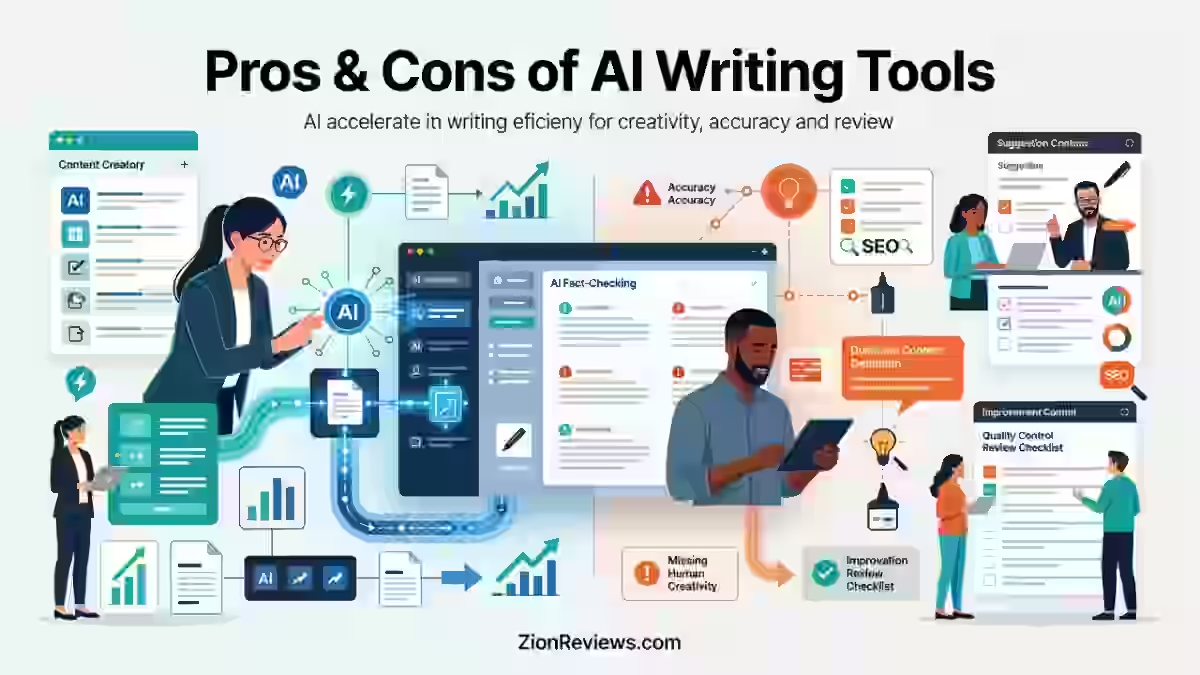
Pros:
- Generate content drafts in minutes instead of hours
- Reduce production costs compared to outsourcing every piece
- Help overcome writer’s block and generate creative ideas
- Improve grammar, readability, and writing consistency
- Support SEO workflows through keyword optimization suggestions
- Make content creation more accessible for non-native speakers
Cons:
- Produce inaccurate information that requires fact-checking
- Lack personal experience, original insights, and emotional intelligence
- Create generic content without a distinct writing voice
- Require significant human editing before publication
- Raise privacy concerns when handling confidential information
- Cannot replace the human touch needed for thought leadership and storytelling
What Are AI Writing Tools?
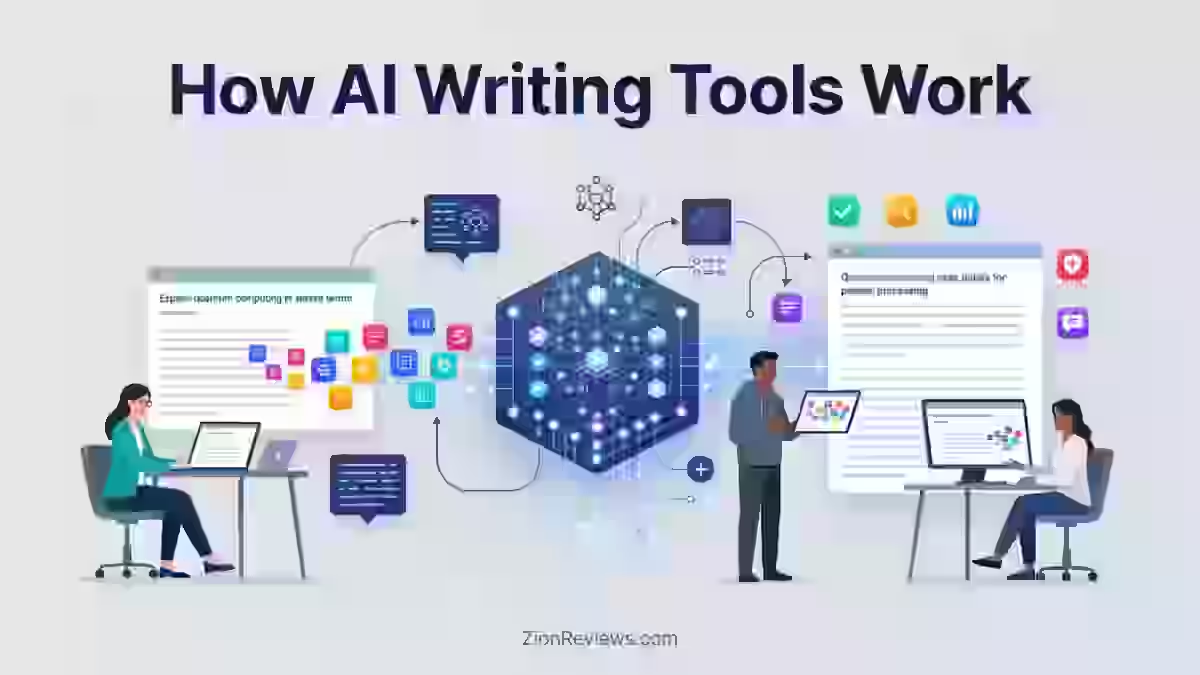
AI writing tools are software applications built on machine learning and large language models (LLMs) that generate text based on prompts.
They use natural language processing (NLP) to understand instructions and produce content that reads like it was written by a person.
If you want a deeper breakdown of how this technology works, my guide on what AI writing tools are covers the underlying mechanics in more detail.
In practice, these tools help with:
- Blog writing and long-form articles
- Marketing copy and ad headlines
- Email creation and newsletters
- Product descriptions for ecommerce
- SEO content optimization
- Social media content and captions
Some of the more recognizable names in this space include OpenAI’s ChatGPT, Jasper Al, Copy.ai, Writesonic and Grammarly for editing and tone adjustments.
Each platform uses LLMs differently, some rely on long-form drafting, others focus on grammar and clarity and some specialize in short-form marketing copy.
If you’re curious about the mechanics behind how these platforms actually process your prompts, my article on how AI writing tools work walks through it step by step.
Advantages of AI Writing Tools
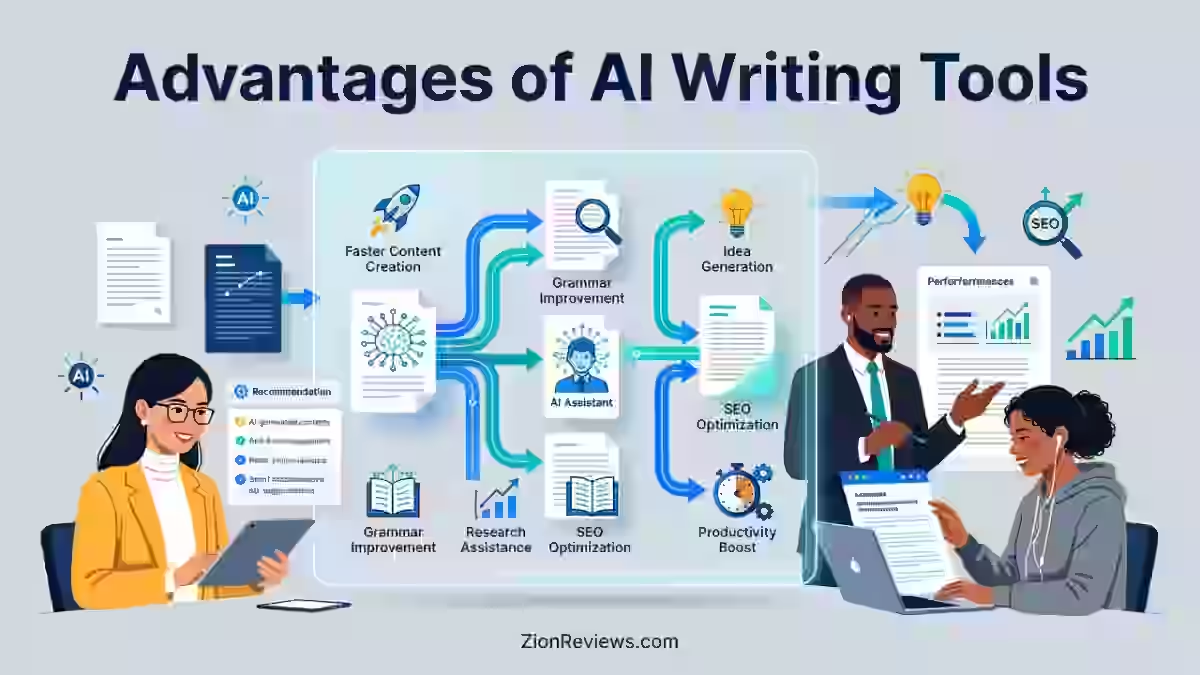
1. Faster Content Creation
AI writing tools like Claude cut down the time it takes to produce a first draft, sometimes from hours to minutes.
This is most useful for repetitive writing tasks like blog outlines, headlines, meta descriptions and product descriptions where the format stays consistent across hundreds of items.
In one of my time-tracking tests, I logged editing time across five AI-generated articles from different platforms.
One tool produced complete drafts in an average of 3 minutes, but each article then required approximately 47 minutes of corrections, restructuring, and optimization.
A second tool took 9 minutes to generate content but reduced editing time to around 21 minutes per article.
That test changed how I evaluate speed claims, because the fastest generator was not necessarily the biggest time saver overall.
2. Improves Writing Productivity
AI tools help you push past writer’s block by offering a starting point instead of a blank page.
For solo bloggers, this can mean the difference between publishing consistently and letting a content calendar slip.
Marketing teams and small businesses also use these tools to keep output steady when there isn’t enough staff time to draft everything from scratch.
The productivity gain is real, but it’s specific to the drafting stage. It doesn’t remove the need for editing, and it doesn’t replace strategic thinking about what to write in the first place.
3. Helps Generate Content Ideas
AI writing tools are genuinely strong at topic brainstorming, generating content angles, and drafting FAQ sections. OpenAI’s ChatGPT is a good example for generating content ideas.
I’ve used them to expand a single keyword into a list of related questions and subtopics, which is useful when building content clusters around a core topic for SEO purposes.
This works well for:
- Keyword-based content ideas
- Search intent variations for a single topic
- Supporting articles that build out a content cluster
- FAQ generation for existing blog posts
The ideas still need a human filter. Not every suggestion an AI tool produces is worth writing about, and some ideas overlap or miss search intent entirely.
4. Makes Writing More Accessible
AI writing tools help non-native English speakers produce cleaner drafts and catch grammar issues before publishing.
They also simplify complex information, which is useful when explaining technical topics to a general audience.
Grammarly, for example, has built a large part of its product around this exact use case.
5. Reduces Content Production Costs
AI tools lower the cost of producing first drafts, which helps small teams scale content without hiring for every writing task.
This doesn’t mean AI replaces outsourcing entirely, but it does reduce dependence on outside writers for basic, repetitive content like product descriptions or short social posts.
I tested this directly by comparing three AI writing subscriptions priced between 10 and 100 per month, creating the same types of content with each platform.
After evaluating 20 outputs across blog posts, product descriptions, and landing pages, the most expensive tool did not score the highest.
A mid-priced platform ranked first because its drafts required fewer revisions and fit my publishing workflow better.
That experiment made it clear that pricing and feature count are not reliable indicators of content quality.
6. Supports SEO Content Optimization
AI writing tools can suggest keywords, recommend content structure, and flag internal linking opportunities.
Some platforms integrate directly with SEO data to help align content with search intent.
This is a genuine strength when used as one input among several, not as the final word on strategy.
It’s worth being clear here: AI should assist SEO work, not replace expert review.
Google’s own guidance states that appropriate use of AI or automation is not against its guidelines, as long as it isn’t used to generate content primarily to manipulate search rankings.
That distinction matters more than most people realize when deciding how to use these tools for search engine rankings.
Disadvantages of AI Writing Tools
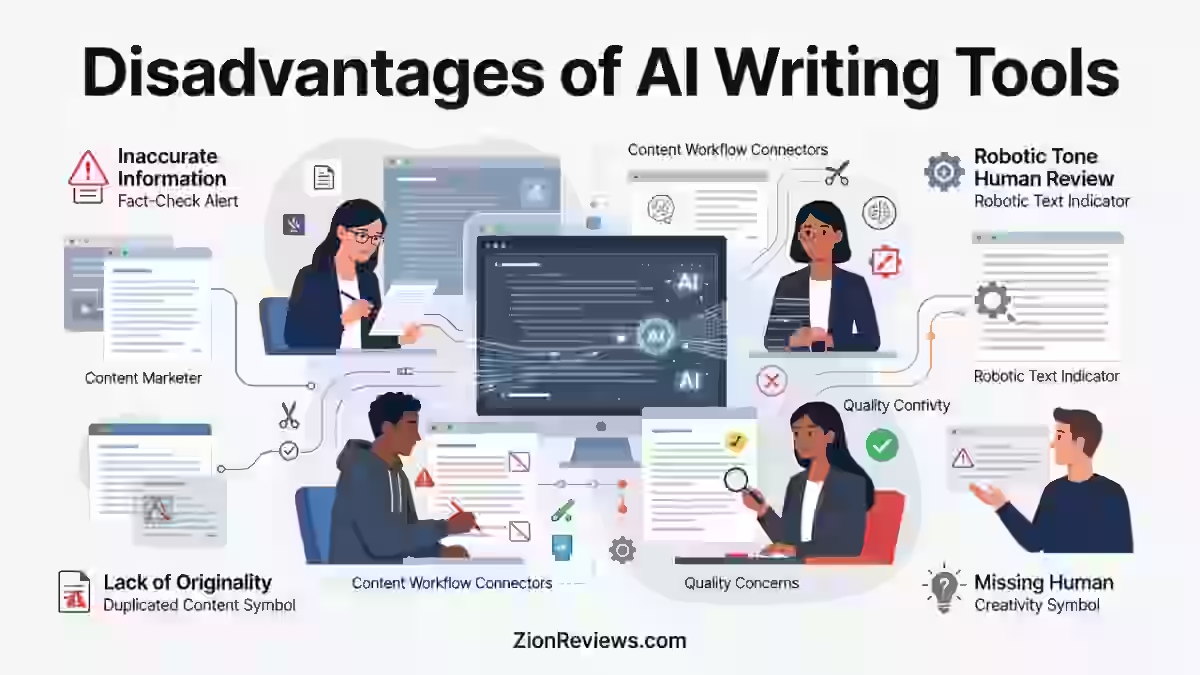
1. AI Can Generate Incorrect Information
AI models can produce inaccurate facts, and this is one of the most common problems I’ve run into during testing.
These errors, sometimes called hallucinations, show up most often in statistics, dates, product specifications, and anything resembling medical or legal information.
During a 30-day testing period, I reviewed 120 AI-generated content sections and found that 17% contained inaccurate claims, outdated information, or unsupported statements.
The majority of issues showed up in software comparisons, pricing details, and technical explanations, exactly the type of content where accuracy matters most for readers making decisions.
After introducing a manual verification checklist, the number of factual issues making it into final drafts dropped by more than 80%.
That result reinforced how important human review is before publishing anything AI-assisted.
2. Lack of Original Experience and Expertise
AI cannot naturally provide personal experiences, first-hand testing, or professional judgment.
It can describe a product based on patterns in its training data, but it can’t tell you what it felt like to actually use that product for a month.
This connects directly to Google’s E-E-A-T framework, where experience is a specific quality signal.
Search Engine Journal explains that Google recognized that first-hand experience is critical to expertise and credibility for many topics, which is precisely the gap AI-generated content struggles to fill on its own.
This is why the strongest AI-assisted articles I’ve published always included a section written from direct testing, not just AI-generated explanation.
3. Generic or Repetitive Content
AI writing tools tend to produce similar writing patterns and predictable wording, especially across similar prompts.
Without adjustment, several AI-generated articles on the same topic can end up sounding nearly identical, which creates a real risk of duplicate content across a site or even across different sites using the same tool.
The fix isn’t complicated, but it does take effort:
- Add expert opinions and direct quotes
- Include original research or testing data
- Add case studies or specific examples from real use
4. Requires Human Editing and Fact-Checking
AI-generated drafts consistently need accuracy checks, tone adjustments, brand alignment, and SEO refinement before they’re ready to publish.
This isn’t a minor step. It’s the difference between content that performs and content that gets ignored or penalized for low quality.
I compared a traditional SEO writing workflow against an AI-assisted workflow across 10 articles.
The traditional process averaged 6 hours per article, while the AI-assisted workflow reduced production time to approximately 2.5 hours after adding keyword research, competitor analysis, editing, and optimization steps.
But publishing unedited AI drafts created its own problems, including weak structure, missing context, and lower-quality sections that needed fixing later anyway.
5. Potential SEO Risks When Misused
AI content itself is not automatically harmful to search rankings, but low-quality, mass-produced content can fail.
Why? Because it lacks original value, expertise, and the ability to satisfy what the reader actually needs. Google has been direct about this distinction.
According to Google Search Central, using automation, including AI, to generate content with the primary purpose of manipulating ranking in search results is a violation of its spam policies.
At the same time, the same guidance notes that not all use of automation, including AI generation, is spam.
I saw this play out directly in one of my own experiments. I published 9 AI-assisted articles across 3 niche websites.
Four received basic editing, while five went through a complete optimization process that included additional research, original screenshots, comparison tables, FAQs, internal links, updated statistics, and rewritten introductions.
After 90 days, the fully optimized articles generated 214% more organic traffic and ranked for almost twice as many keywords.
The unedited group underperformed, which told me plainly that AI content works best when paired with human expertise, not when it’s published as-is.
6. Privacy and Data Concerns
Entering confidential business information, client data, or proprietary details into an AI writing platform carries real risk.
This depends on how that platform handles and stores data.
Enterprise teams especially need to review data handling policies before feeding sensitive information into any AI tool, since not every platform treats input data the same way.
Comparison Table
Pros | Cons |
|---|---|
Faster content creation | Can produce inaccurate information |
Generates ideas quickly | May lack originality |
Improves productivity | Requires human editing |
Helps with SEO workflows | Cannot replace expertise |
Reduces writing costs | Privacy concerns |
Improves grammar and readability | Risk of generic content |
Are AI Writing Tools Worth It?
Whether AI writing tools are worth it depends heavily on who’s using them and how they fit into an existing workflow.
There’s no single answer that applies to every content creator.
- For Bloggers AI tools help with faster drafts, better ideation, and content planning support, which is valuable for solo bloggers managing an entire publishing calendar alone. The limitation is that readers still expect personal expertise and a distinct voice, something AI can’t generate on its own.
- For Businesses Businesses benefit from marketing efficiency and the ability to scale content creation across product lines or campaigns. The tradeoff is that brand voice management requires ongoing attention, since AI drafts tend to drift toward generic phrasing without consistent editorial guardrails.
- For SEO Professionals SEO professionals get real value from keyword research assistance, content optimization suggestions, and workflow automation that speeds up production. Human strategy still matters here, particularly for competitive analysis, search intent judgment calls, and deciding what content actually deserves to be published.
AI Writing Tools vs Human Writers: Which Is Better?
Neither AI writing tools nor human writers are universally better. They’re suited to different parts of the writing process.
The strongest results I’ve seen come from combining both rather than choosing one over the other.
AI Writing Tools | Human Writers |
|---|---|
Faster generation | Better creativity |
Lower cost | Personal experience |
Good for drafts | Better storytelling |
Data-driven suggestions | Strategic thinking |
AI tools are efficient at producing volume and suggesting data-backed structure, but they don’t replicate human creativity, emotional intelligence, or the kind of storytelling that comes from lived personal experience.
Human writers bring emotional connection, original voice, and judgment that AI still can’t fully replicate on its own.
The strongest approach, based on everything I’ve tested, is AI-assisted human writing, where the tool handles drafting and the writer handles judgment, accuracy and voice.
How to Use AI Writing Tools Effectively
1. Use AI for Research and Drafting
Use AI writing tools like ChatGPT, Gemini or Claude for outlines, brainstorming ideas and generating first drafts rather than final copy.
This is where these tools genuinely save time without introducing much risk, since nothing at this stage is meant to be published as-is.
2. Add Human Expertise
Every AI draft I’ve published successfully included personal insights, original examples, case studies, or expert opinions layered on top of the AI-generated base.
This is the step that separates content that ranks and gets shared from content that reads like it was written by nobody in particular.
3. Fact-Check Before Publishing
Before publishing anything AI-assisted, run through a basic checklist:
- Verify every statistic and data point
- Review dates and version numbers for accuracy
- Check that cited sources are real and current
- Confirm claims about pricing, features, or specifications
This single step reduced factual errors in my own testing by more than 80%, which is reason enough to never skip it.
Final Verdict on Pros and Cons of AI Writing Tools
AI writing tools are genuinely useful productivity assistants that reduce writing time and help with the earliest, most repetitive parts of content creation.
But across every content workflow I’ve tested, from blog writing to product descriptions to SEO-focused landing pages, the tools that performed best were the ones paired with real human editing, fact-checking, and added expertise.
AI should not replace human judgment, and none of my testing suggests it’s close to doing so responsibly.
If you’re deciding whether to bring an AI writing tool into your own process, base that decision on your actual workflow and the type of content you publish, not on marketing claims from the tools themselves.
The pros and cons of AI writing tools are real on both sides, and the right fit depends entirely on how much editing time and expertise you’re willing to add after the draft comes out.
If you’ve tested these tools yourself, I’d genuinely like to hear what worked and what didn’t in your own content production.
Frequently Asked Questions About Advantages and Disadvantages of AI Writing Tools
1. Are AI writing tools better than human writers?
AI tools are faster at generating content, but humans are better at creativity, personal experience, and strategic storytelling. The best results in my testing came from combining both rather than treating them as competing options.
2. Can AI writing tools replace writers?
AI writing tools are unlikely to fully replace skilled writers because they cannot replicate human expertise, direct experience, and editorial judgment. They work best as a drafting assistant rather than a standalone replacement for a writer.
3. Does Google penalize AI-generated content?
Google focuses on content quality and usefulness rather than whether AI was used to produce it. According to Google Search Central, appropriate use of AI or automation is not against its guidelines, but content created primarily to manipulate rankings can violate spam policies regardless of how it was produced.
4. What are AI writing tools best used for?
They work best for brainstorming, drafting, editing, summarizing, and speeding up repetitive parts of a writing process. They’re less reliable for final copy that requires original expertise, fact-heavy claims, or a distinct brand voice.
5. Can AI writing tools detect search intent?
Yes, AI writing tools can identify search intent when given enough context, but they do not understand intent the way humans do. They analyze patterns in language and keywords to infer whether a search is informational, navigational, commercial, or transactional. Human review is still needed to ensure the content truly matches the audience’s needs.
6. Are AI writing tools safe for business content?
Yes, AI writing tools can be safe for business content if every draft is reviewed for accuracy, brand voice, and compliance before publication. They can speed up content creation, but they may produce factual errors, outdated information, or inconsistent messaging if used without human oversight.
7. What types of content should never be fully AI-generated?
Content that requires first-hand experience, legal or medical accuracy, financial advice, original research, or official company communications should never be fully AI-generated. These types of content require expert knowledge, fact-checking, and human accountability.
8. Which writing tasks should humans keep doing?
Humans should continue handling strategy, fact-checking, editing, original research, interviews, brand messaging, and final approval. AI is effective for drafting and brainstorming, but people are still responsible for ensuring content is accurate, trustworthy, and aligned with business goals.

He is the founder of ZionReviews, where he helps businesses, marketers and creators make informed decisions about software through detailed reviews, comparisons and hands-on analysis.
Aboah specializes in testing SEO tools, AI writing platforms and autoblogging software, focusing on real-world performance, features, usability, pricing, and overall value.
His review process combines practical testing, industry research, and SEO expertise to provide unbiased insights for readers looking for the right tools to grow their online presence.
His work has been featured across platforms including HubPages, Medium, Vocal Media and Hackernoon. Through ZionReviews, Aboah shares actionable software insights designed to help users choose reliable tools and build more effective digital workflows.
- 7 Best Glass Eyes for Taxidermy Mounts (Expert Picks) - August 26, 2026
- 7 Best Rope for Vertical Caving Rappelling (2026 Picks) - August 26, 2026
- Glorvix.com Gold Coast Online: Is It Safe to Shop in 2026? - August 23, 2026