TL;DR: AI writing tools work by using machine learning and large language models (LLMs) to analyze your prompt, process it into tokens and generate text by predicting the most likely next token based on learned language patterns.
The main takeaway: AI writing tools are powerful assistants, but they still require human oversight for accuracy and quality.
Introduction to How AI Writing Tools Work
If you’ve ever typed a prompt into an AI writer and watched a full blog post appear in seconds, you’ve probably wondered what’s actually happening behind that screen.
Understanding how AI writing tools work matters because it changes how you use them, what you trust them with and where you still need to step in as an editor.
I’ve tested AI writing tools across dozens of articles for client sites and my own projects. The biggest shift in my workflow happened once I stopped treating these tools like search engines.
If you’re brand new to this space, my guide on what AI writing tools are is a good starting point before going into the mechanics below.
AI writing is not traditional software automation. It doesn’t pull answers from a database the way a search engine retrieves indexed pages.
Instead, it generates new text by recognizing statistical patterns learned during training rather than retrieving information from a database.
Quick Answer: How Do AI Writing Tools Work?
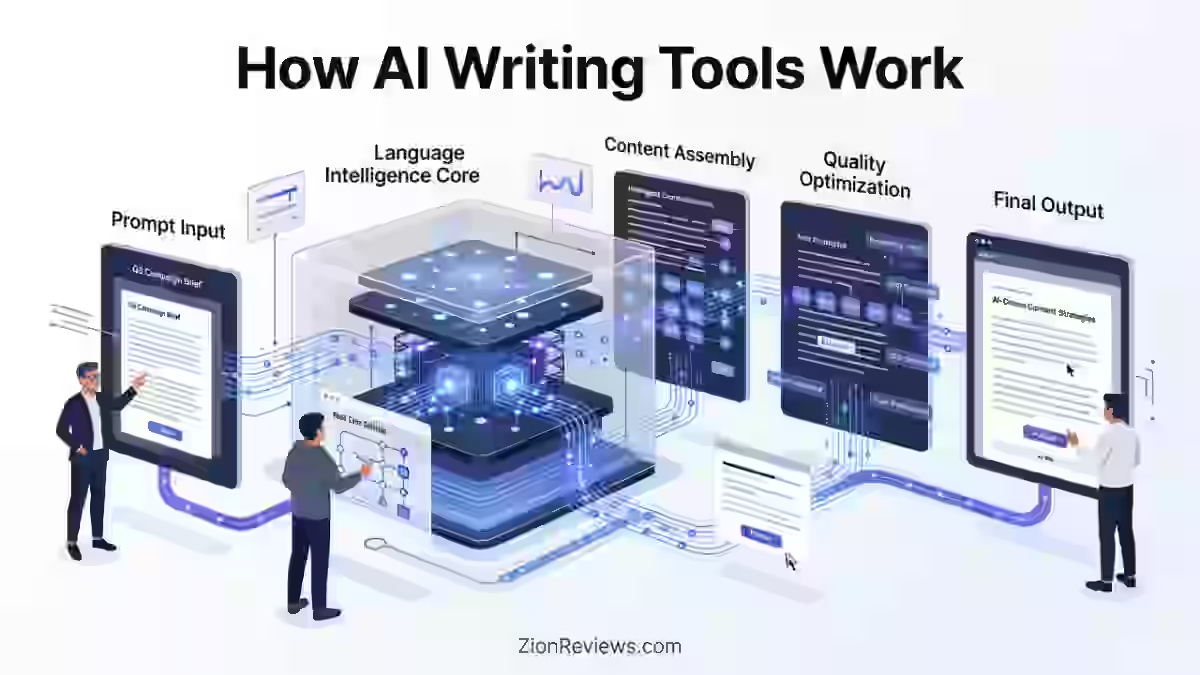
Here’s the short version, in plain terms:
- You give the tool a prompt: This includes your instructions, tone, format, and any examples you provide.
- The tool breaks your text into tokens: Words and parts of words get converted into numerical units the model can process.
- The model analyzes context: It looks at the relationships between tokens to understand meaning, not just individual words.
- The model predicts the next token: It calculates probabilities for what should come next, one token at a time.
- The tool assembles the output: Predicted tokens are strung together into sentences, paragraphs and formatted content.
- A human should review it: Since the model is recognizing language patterns, review the output for accuracy, context and tone before publishing.
That’s the entire mechanical process. Everything else, including large language models, transformers, and fine-tuning, exists to make that process more accurate and more useful for real writing tasks.
How AI Writing Tools Generate Text Step by Step
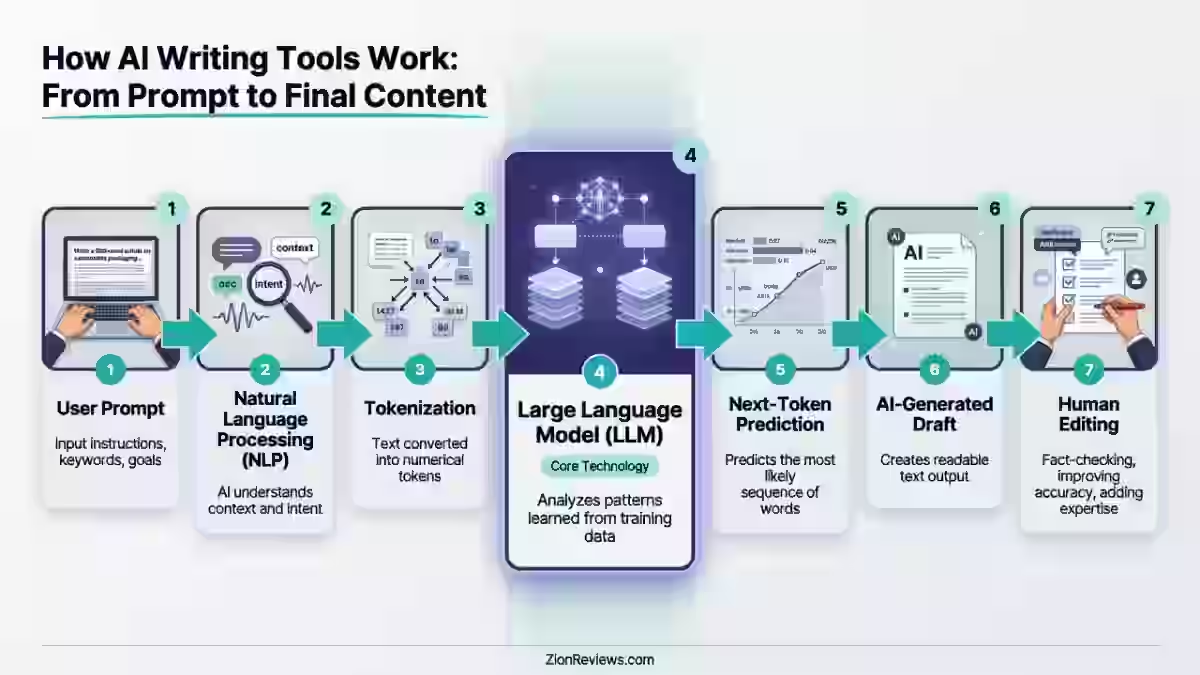
AI writing tools generate text through a sequence of five technical steps: prompt input, tokenization, context analysis, token prediction, and output assembly.
Each step depends on the one before it. Skipping or misunderstanding any of these stages is usually where AI writing mistakes come from.
Step 1: User Provides a Prompt
The process starts with your prompt, which is the instruction you give the AI writer.
A good prompt usually includes context, tone, format requirements, and sometimes examples of the style you want.
This is where prompt engineering comes in. Most AI writing tools separate instructions into two layers:
- System instructions, which are built into the tool by the developer (things like “always write in a professional tone” or “avoid harmful content”)
- User instructions, which are the specific prompts you type in, like “write a 500-word product description for a running shoe in a casual tone”
In my testing, vague prompts almost always produce vague output. When I gave one AI writer a one-line prompt for a landing page, the draft was generic and needed a full rewrite.
However, when I added a target audience, three key benefits, and a competitor example, the same tool produced a draft that needed only minor edits.
Step 2: The AI Converts Text Into Tokens
Once you submit a prompt, the model doesn’t read it as words. It converts everything into tokens, which are smaller units of text that the model can process mathematically.
Text generation and embeddings models process text in chunks called tokens, and tokens represent commonly occurring sequences of characters.
So, a word like “tokenization” might be split into “token” and “ization” while a short common word is represented as a single token.
As a general rule, 1 token is approximately 4 characters or 0.75 words for English text.
This is why AI models process tokens instead of full words. Common tokenization methods include word tokenization, character tokenization and subword tokenization.
Also, GPT models developed by OpenAI use a type of subword tokenization known as Byte-Pair Encoding (BPE).
Once tokenized, each unit gets converted into a numerical embedding, a vector representation that captures meaning and relationships to other tokens.
Step 3: The AI Model Analyzes Context
After tokenization, the model has to figure out how those tokens relate to each other. This is where context windows and attention mechanisms come in.
The attention mechanism enables the model to assign different attention weights or scores to different tokens in a sequence.
This lets the model decide which words in a sentence matter most to understanding the meaning of any given word.
A classic example is the word “apple.” In the sentence “Apple released a new phone,” the model uses surrounding tokens (released, phone) to weight the meaning toward the company.
In “I ate an apple for lunch,” tokens like “ate” and “lunch” shift the weighting toward the fruit. This contextual weighting is why modern AI writing tools handle ambiguous words far better than older rule-based software.
Step 4: The AI Predicts the Next Token
This step is the actual “writing” part of AI writing. The model doesn’t select words based on meaning in the human sense.
It calculates a probability distribution over its entire vocabulary and picks (or samples) the next token based on that distribution.
During output generation, the model predicts a vector value for the next token in the sequence, then selects the next token from its vocabulary based on this vector value.
This process repeats token by token, with output generation being an iterative operation where the model appends the predicted token to the sequence.
And uses that as input for the next iteration, building the final output one token at a time. This is also why AI writing tools produce different answers to the same prompt.
Settings like “temperature” control how much randomness gets introduced into token selection.
Lower temperature produces safer, more predictable text, while higher temperature produces more varied, sometimes more creative, output.
Step 5: The AI Generates the Final Output
After generation, the AI writing tool prepares the response for the user by applying formatting like bullet points or headers, templates and platform-specific instructions.
Some tools add SEO recommendations, brand voice adjustments, or workflow features before displaying the final draft.
This is the point where most AI writing tools also apply post-processing rules, like maintaining consistent tone or following a template structure you selected.
It’s also where quality varies the most between tools, since some platforms add extra formatting and structure logic on top of the base model.
The Technologies That Power AI Writing Tools
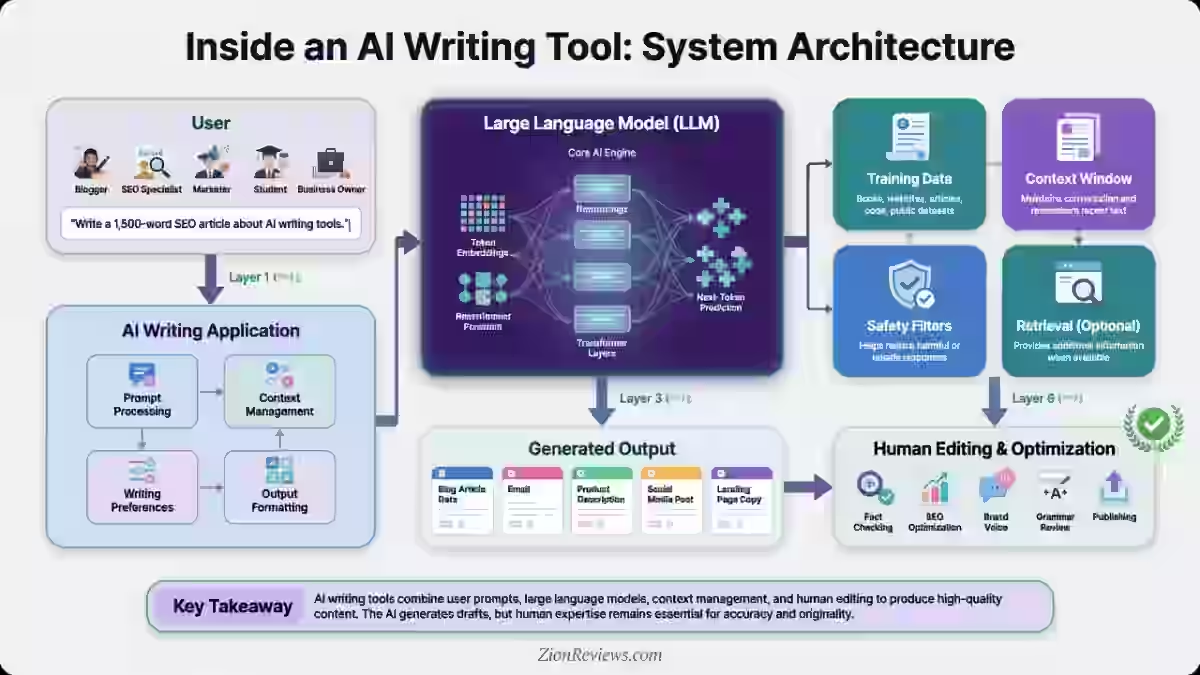
AI writing tools run on a stack of technologies working together, not a single piece of software.
The core pieces are large language models, transformer architecture, natural language processing and the machine learning process that trains all of it.
1. Large Language Models (LLMs)
Large language models are the engine behind almost every AI writer on the market.
Large language models are the foundation of modern AI models, including generative and agentic AI, and they work by learning statistical patterns across massive amounts of text.
Most consumer and business AI writing tools are built on top of models like GPT (OpenAI), Claude (Anthropic), Gemini (Google), or Llama (Meta), often accessed through the OpenAI API or similar provider APIs rather than being built from scratch.
This is why so many different AI writing tools can feel similar in output quality; they’re frequently using the same or similar underlying models with different prompting layers, templates and interfaces on top.
2. Transformer Architecture
Transformers are the neural network design that made modern AI writing possible.
The transformer architecture consists of two parts: the encoder, which processes the tokens of the input sequence, and the decoder, which produces new tokens as output based on the input tokens and previously produced output tokens.
Before transformers, older models processed text sequentially, which made it hard to capture relationships between words that were far apart in a sentence.
Transformer architecture addresses the limitations of recurrent neural networks (RNNs), which are expected to process a sequence of input, using the same network architecture repeatedly to process each element of the sequence.
The attention mechanism inside transformers solved this by letting the model weigh relationships between all tokens in a sequence at once, which is a big part of why AI writing quality improved so sharply after 2017.
3. Natural Language Processing (NLP)
Natural language processing is the broader field that covers how machines understand and produce human language, and it powers more than just text generation.
It’s also behind features like grammar checking, sentiment analysis, tone detection, and translation inside AI writing tools.
Most AI writers combine generative capability with NLP-based features like a built-in grammar checker, a paraphrasing tool, or style adaptation settings.
This is why a single AI writing platform can draft a blog post, adjust tone of voice, and flag grammar issues all in the same interface.
4. Machine Learning and Deep Learning
Machine learning algorithms are what allow these models to improve through training rather than through manually written rules.
During training, a neural network processes huge datasets, adjusts internal weights based on prediction errors, and gradually gets better at predicting the next token in a sequence.
Deep learning refers to the use of many-layered neural networks to do this at the scale required for large language models.
How AI Writing Tools Learn to Write Like Humans
AI writing tools learn to write like humans by training on massive text datasets, adjusting internal weights through repeated exposure to patterns.
They then get further refinement through fine-tuning and human feedback. None of this involves the model memorizing and copying specific articles.
1. Training Data
Base models are trained on a mix of books, websites, articles, code repositories, and licensed datasets.
This training data teaches the model grammar, sentence structure, common phrasing, and factual patterns, but it’s important to be clear about what this does and doesn’t mean.
AI does not store a database of copied articles that it searches through when you type a prompt.
Instead, it learns statistical patterns, like which words and phrases tend to follow others, and generates new text based on those patterns rather than retrieving stored content.
2. Model Training
During training, the model processes text data, tries to predict missing or next words, and gets adjusted based on how wrong or right those predictions were.
This happens across billions of examples, gradually tuning the model’s internal parameters (often called weights) toward better predictions.
3. Fine-Tuning
Once a base model is trained, companies often fine-tune it for specific use cases.
This is how AI writing tools built for marketing copy, customer support, or specific industries get tailored behavior on top of a general-purpose model.
Fine-tuning is also how some AI writing platforms build brand voice training features.
This allows a business to feed in existing content so the tool’s suggestions better match established brand consistency requirements.
4. Reinforcement Learning From Human Feedback (RLHF)
RLHF is one of the reasons modern AI writing tools feel more natural and more instruction-following than early text generators.
Reinforcement Learning from Human Feedback is a training approach where human evaluators compare multiple model responses and indicate which one better satisfies a given prompt.
These human preferences are then used to train a reward model that guides further optimization of the language model.
This is how models like Claude get refined after initial training. Claude models are generative pre-trained transformers that have been trained to predict the next word in large amounts of text.
Then, fine-tuned using reinforcement learning from human feedback (RLHF) and constitutional AI in an attempt to enforce ethical guidelines.
RLHF is a big part of why AI chatbots and AI writers follow instructions more reliably and refuse certain requests, compared to raw, untuned models.
What Happens Inside an AI Writing Tool When You Click Generate?
When you click “generate,” the tool runs through a fast but multi-stage pipeline before showing you text.
Here’s the simplified workflow I use when explaining this to clients who are new to AI writing software:
User Prompt
    ↓
Prompt Processing (system + user instructions combined)
    ↓
Tokenization (text converted into tokens)
    ↓
AI Model Analysis (context and attention applied)
    ↓
Prediction Engine (next-token probabilities calculated)
    ↓
Text Generation (tokens assembled into output)
    ↓
Output Refinement (formatting, template rules applied)
    ↓
Human Editing (fact-checking, tone adjustment, optimization)
That last step, human editing, isn’t optional in any workflow I’d recommend.
During a 30-day testing period, I reviewed 120 AI-generated content sections and found that 17% contained inaccurate claims, outdated information or unsupported statements, with most issues showing up in software comparisons, pricing details, and technical explanations.
After introducing a manual verification checklist, the number of factual issues making it into final drafts dropped by more than 80%.
How AI Writing Tools Improve Accuracy
AI writing tools improve accuracy mainly through retrieval-augmented generation, connected knowledge bases, and manual fact-checking workflows layered on top of the base model.
None of these methods make the output automatically correct, they reduce the odds of outdated or fabricated information.
1. Retrieval-Augmented Generation (RAG)
RAG connects a language model to external sources instead of relying only on what it learned during training.
RAG is a method where the AI doesn’t hallucinate answers but instead retrieves relevant, indexed web pages and then synthesizes a response from them.
This is the same underlying approach behind AI overviews and many AI search engines, which is part of why Google Search Central frames its generative AI features as built on the same ranking and quality systems as regular search.
Research assistants, SEO writing platforms and enterprise AI tools increasingly use RAG to pull in current information.
This include things like recent statistics or product data, rather than relying solely on static training data that might be outdated by the time you use the tool.
2. Knowledge Bases
Beyond RAG, many business-focused AI writing tools let companies upload their own knowledge bases, including brand guidelines, product information, and internal documents.
This helps the tool generate more accurate, on-brand output for things like product descriptions or customer-facing content, since it’s pulling from company-specific data rather than general training data.
3. Fact Checking Systems
Even with external sources, these systems can still require validation because retrieved information may be incomplete, outdated or incorrectly interpreted.
I’ve found that pairing AI drafts with a manual verification step, checking statistics, pricing, and claims against original sources, catches errors that neither RAG nor the base model reliably catches on its own.
Why AI Writing Tools Sometimes Make Mistakes
AI writing tools make mistakes mainly because of hallucinations and a lack of real-world experience, both of which stem from how these models are built.
Understanding why helps set realistic expectations for what an AI writer can and can’t do reliably.
1. AI Hallucinations
Hallucinations happen when a model generates text that sounds confident and fluent but is factually wrong.
This happens because the model is optimized to predict plausible-sounding language, not to verify truth.
Common examples I’ve run into during testing include fake citations, incorrect statistics, and wrong product details, like a tool inventing a pricing tier that doesn’t exist for a software product.
2. Lack of Real-World Experience
AI models don’t use products, conduct interviews, have opinions, or experience events the way a human writer or reviewer does.
This connects directly to Google’s E-E-A-T framework (experience, expertise, authoritativeness, trustworthiness).
This is why those seeking success in Google Search should be looking to produce original, high-quality, people-first content demonstrating qualities of E-E-A-T regardless of how content is drafted.
This is exactly why review sites like Zion Reviews combine AI drafting with actual hands-on testing rather than publishing raw AI output.
The model can describe a feature, but it can’t tell you how a tool actually felt to use during a real content production run.
How AI Writing Tools Understand Writing Style
AI writing tools understand writing style through tone detection settings, brand voice training on sample content, and context memory that carries instructions across a session.
None of this is “understanding” in the human sense, it’s pattern matching applied consistently.
1. Tone Detection
Most AI writers let you select a tone, like professional, friendly, technical, or persuasive, and the model adjusts word choice and sentence structure to match.
In my testing, tone selection works reasonably well for broad categories but can drift on longer pieces, especially past 1,000 words.
This is why re-reading long-form content for consistent tone of voice still matters.
2. Brand Voice Training
Businesses can train some AI writing tools using previous content, a style guide, or specific examples to keep marketing copy consistent across a team.
This is one of the more genuinely useful features I’ve tested, since it cuts down on the “generic AI voice” problem that shows up when multiple writers use the same tool without any brand voice setup.
3. Context Memory
Context memory lets a tool remember earlier parts of a conversation, saved preferences, or custom instructions within a session or project.
This is what allows you to say “make it shorter” or “match the tone from my last draft” without re-explaining your entire brief each time.
AI Writing Tools vs Traditional Software
Traditional writing software (think basic grammar checkers or templated document tools) and AI writing tools solve different problems, even though they can look similar on the surface.
Feature | Traditional Writing Software | AI Writing Tools |
|---|---|---|
Grammar checking | Yes | Yes |
Generates content from a prompt | No | Yes |
Understands natural language prompts | No | Yes |
Suggests ideas or outlines | Limited | Advanced |
Adapts tone of voice | Limited | Yes |
Learns brand voice from samples | No | Yes, on supported platforms |
Requires human fact-checking | Lower risk, rule-based | Higher risk, prediction-based |
The key distinction: traditional software follows fixed rules, while AI writing tools generate new text based on probability and learned patterns, which is more flexible but also introduces the accuracy risks covered earlier.
How AI Writing Technology Is Changing Content Creation
AI writing technology is changing content creation by shifting workflows from fully manual drafting toward AI-assisted production, from keyword-matching toward intent understanding, and from single outputs toward connected content workflows.
1. Manual Writing to AI-Assisted Writing
I compared a traditional SEO writing workflow against an AI-assisted workflow for 10 articles.
The traditional process averaged 6 hours per article.
However, the AI-assisted workflow reduced production time to approximately 2.5 hours after adding keyword research, competitor analysis, editing, and optimization steps.
Publishing unedited AI drafts, though, created its own problems, including weak structure, missing context, and lower-quality sections that required fixes later.
2. Keywords to Intent Understanding
Search and AI systems have moved from matching exact keywords toward understanding what a searcher actually wants.
This is part of why generative engine optimization, sometimes shortened to GEO, has become a bigger part of content strategy.
This focuses on making content clearly answerable and quotable rather than just keyword-dense.
3. Single Outputs to AI Agents
Newer AI writing tools are starting to chain tasks together, like researching a topic, drafting an outline, generating a draft, and checking it against a style guide, closer to an agent workflow than a single prompt-response interaction.
4. Drafting Tools to Content Workflows
Platforms are increasingly building full content workflow features around the core AI writer, including content briefs, plagiarism checker integration, SEO tools, and team collaboration.
Tools like RivalFlow position themselves around this workflow angle, combining content generation with brief creation and optimization steps rather than offering a bare text generator.
A Look at How Different AI Writing Tools Apply This Technology
Seeing the technology in the abstract only gets you so far. Here’s how it plays out across a few tools I’ve tested for different use cases.
- Rytr is built for short-form content and budget-conscious users. It offers a free plan with a limited monthly character allowance and paid plans generally in the $9 to $29/month range depending on usage tier. In my testing, Rytr handled short-form content like product descriptions and social captions reasonably well but needed heavier editing on long-form blog posts. It suits freelancers and small businesses who mostly need short-form content and don’t want to pay for a full-featured platform.
- Anyword leans into marketing copy and performance prediction, using an engagement score to estimate how well a given piece of copy might perform before you publish it. Pricing typically starts in the $39/month range for entry plans and scales up for team and enterprise tiers. It’s a stronger fit for performance marketers running ad copy and landing pages than for long-form SEO content, based on what I’ve tested.
- Writer is positioned more toward enterprise content teams that need strict brand consistency and ai compliance controls across large content workflows. It supports brand voice training, style guide enforcement, and team-level governance features, with pricing generally handled through custom enterprise quotes rather than flat public tiers. It’s overkill for a solo blogger but makes more sense for larger marketing teams managing multiple writers.
- RivalFlow focuses more on the content workflow side, pairing AI drafting with content briefs and optimization steps aimed at SEO optimization rather than acting as a standalone chat-style AI writer. It fits teams who want the generation step connected directly to a broader content strategy process rather than a disconnected drafting tool.
What My Testing Has Shown About AI Writing Tools in Practice
Beyond understanding the technology, actual production testing tells a more useful story about where these tools help and where they don’t.
I tested three AI writing subscriptions priced between 10 and 100 per month by creating the same types of content with each platform.
After evaluating 20 outputs across blog posts, product descriptions, and landing pages, the most expensive tool did not achieve the highest score, a mid-priced platform ranked first because its drafts required fewer revisions and matched my publishing workflow better.
That test showed me pricing and feature count aren’t reliable indicators of better content quality.
Speed tells a similar story. I tracked editing time across five AI-generated articles from different writing platforms.
One tool produced complete drafts in an average of 3 minutes but each article required approximately 47 minutes of corrections, restructuring, and optimization.
But another tool took 9 minutes to generate content but reduced editing time to around 21 minutes per article. The fastest generator wasn’t the biggest time saver once editing time was factored in.
The clearest result came from a publishing experiment.
During one test, I published 9 AI-assisted articles across 3 niche websites, four received basic editing while five went through a full optimization process including additional research, original screenshots, comparison tables, FAQs, internal links, updated statistics, and rewritten introductions.
After 90 days, the fully optimized articles generated 214% more organic traffic and ranked for almost twice as many keywords, which reinforced that AI content performs best when combined with human expertise, not published without review.
Final Thoughts on How AI Writing Tools Work
Understanding how AI writing tools work doesn’t make the output perfect, but it does make you a better editor of that output.
The core mechanics, tokenization, context analysis, and probability-based prediction, explain both why these tools are genuinely useful for speeding up content creation and why they still need a human checking facts, tone, and structure before anything gets published.
There’s no universal “best” AI writing tool, only the one that fits your workflow, budget, and content type, whether that’s short-form marketing copy, long-form SEO content, or fiction writing.
Choose based on how a tool performs in your actual production process, not based on marketing claims about what it can do.
If you’ve tested AI writing tools in your own content workflow, I’d genuinely like to hear what worked and what didn’t, since that’s exactly the kind of real-world data that helps other writers and marketers make better decisions.
Frequently Asked Questions About How AI Writing Tools Work
1. How do AI writing tools create content?
AI writing tools create content by processing your instructions, using a language model to generate a response, and applying formatting or workflow features before showing the final output. The output is then formatted into sentences, paragraphs, or templates based on your instructions.
2. Do AI writing tools understand language?
Not in the human sense. They recognize statistical patterns in language learned from training data, which lets them produce grammatically correct and contextually relevant text without actually “understanding” meaning the way a person does.
3. Are AI writing tools copying information from the internet?
No, AI models don’t store or retrieve copied articles when generating text. They learn general language patterns from training data and generate new text based on probability, though some tools add retrieval-augmented generation to pull in current external information.
4. What technology powers AI writing tools?
AI writing tools run on large language models built with transformer architecture, supported by natural language processing techniques and trained using machine learning algorithms. Many are further refined using reinforcement learning from human feedback to improve instruction-following and reduce harmful or off-topic output.
5. Do AI writing tools think like humans?
No. AI writing tools don’t think or reason like humans. They generate responses by identifying patterns in language rather than forming opinions or drawing on personal experience. This is why AI writing tools can produce fluent, confident-sounding text that’s still factually wrong.
6. Why does AI sometimes produce incorrect information?
AI models are optimized to generate plausible, fluent language, not to verify facts, which leads to hallucinations where confident-sounding text contains fabricated details, wrong statistics, or fake citations. This is why manual fact-checking remains an important step in any AI-assisted content workflow.
7. How do AI writing tools improve over time?
AI writing tools improve through updated training data, fine-tuning for specific use cases, and reinforcement learning from human feedback that adjusts model behavior based on rated responses. Providers also add features like retrieval-augmented generation and knowledge base connections to reduce outdated or inaccurate output.

He is the founder of ZionReviews, where he helps businesses, marketers and creators make informed decisions about software through detailed reviews, comparisons and hands-on analysis.
Aboah specializes in testing SEO tools, AI writing platforms and autoblogging software, focusing on real-world performance, features, usability, pricing, and overall value.
His review process combines practical testing, industry research, and SEO expertise to provide unbiased insights for readers looking for the right tools to grow their online presence.
His work has been featured across platforms including HubPages, Medium, Vocal Media and Hackernoon. Through ZionReviews, Aboah shares actionable software insights designed to help users choose reliable tools and build more effective digital workflows.
- 7 Best Glass Eyes for Taxidermy Mounts (Expert Picks) - August 26, 2026
- 7 Best Rope for Vertical Caving Rappelling (2026 Picks) - August 26, 2026
- Glorvix.com Gold Coast Online: Is It Safe to Shop in 2026? - August 23, 2026