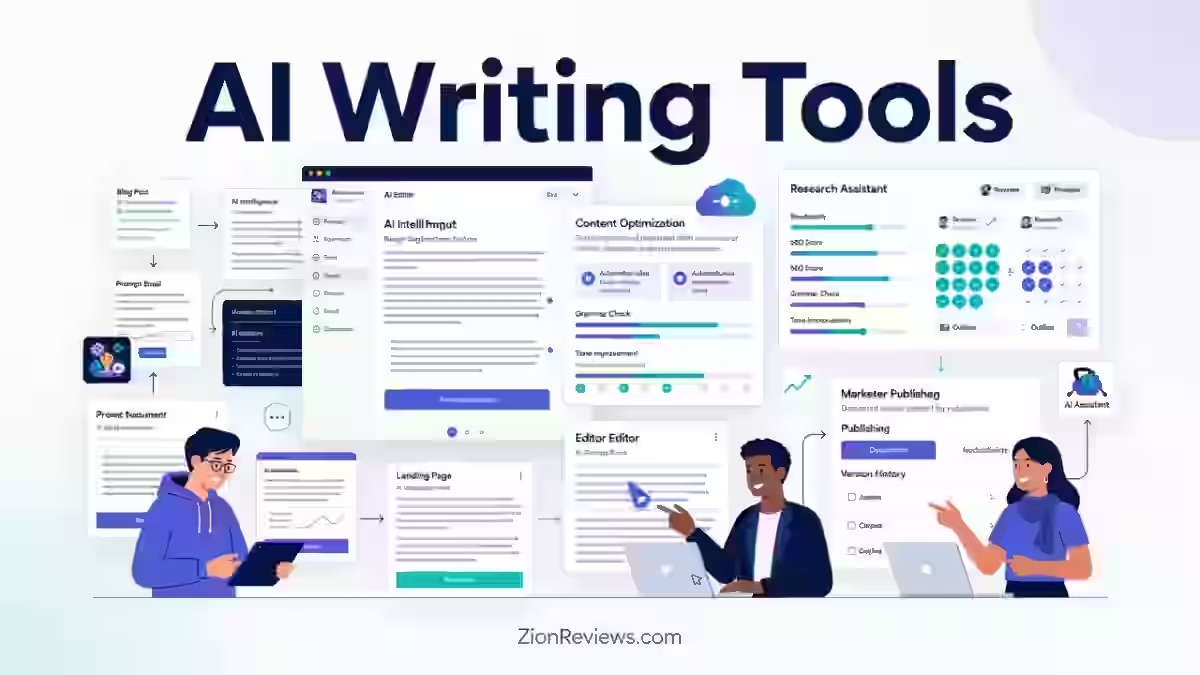
TL;DR: AI writing tools are software applications that use large language models and natural language processing to help you create, edit, optimize and scale written content.
Whether you write blog posts, marketing copy or product descriptions, the main takeaway is this: AI writing tools work best when paired with human editing.
Introduction
I started testing AI writing tools back when most of them produced awkward, repetitive paragraphs that needed more fixing than writing from scratch.
A lot has changed.
Today, the same category of tools can research a topic, draft a full article, rewrite a section in a different tone, flag grammar issues, check for plagiarism and even suggest internal links.
The global AI-powered content creation market was valued at approximately $2.2 billion in 2024 and is expected to grow to around $3.0 billion by 2026, reaching $10.6 billion by 2033.
That growth is not happening in a vacuum. It reflects how many content teams, agencies, freelancers and solo bloggers now rely on these tools as a core part of their production workflow.
AI adoption in content marketing has reached near-saturation, with 97% of content marketers planning to use AI to support their efforts in 2026, up from 90% in 2025.
That statistic tells me the question is no longer “should I use AI writing tools?” It is “which one fits my workflow and how do I use it without sacrificing quality?”
What Are AI Writing Tools? (Definition Based on Real-World Testing)
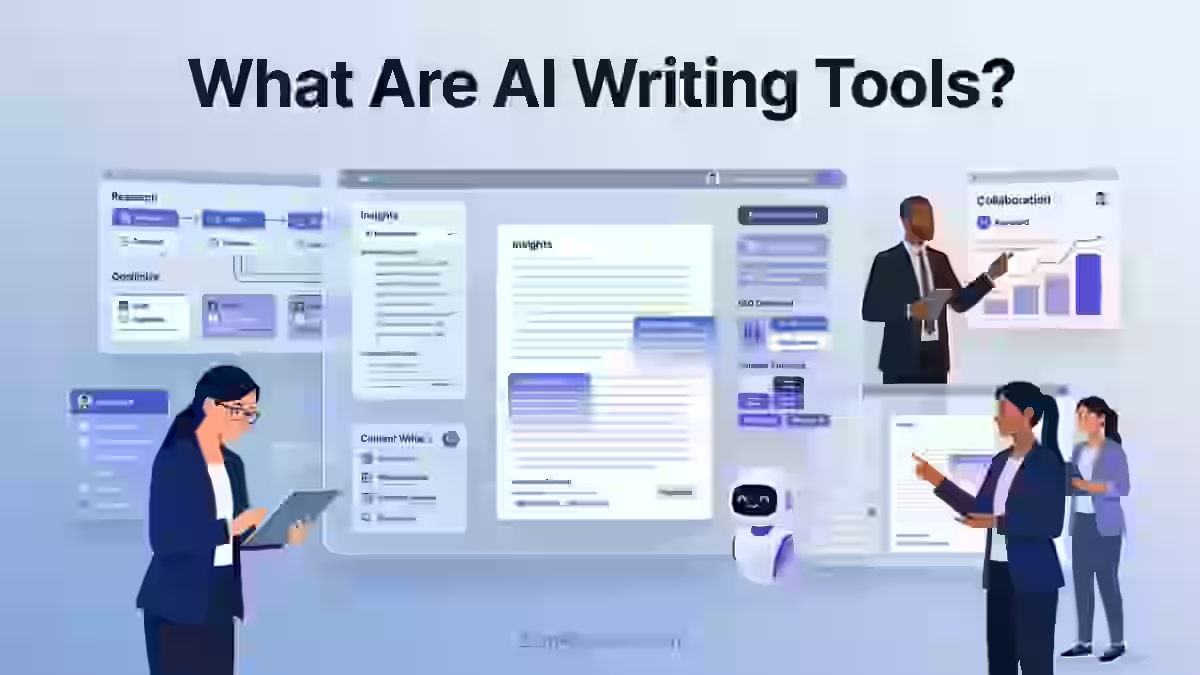
AI writing tools are software applications powered by large language models (LLMs) and natural language processing (NLP) that help users create, edit, rewrite, summarize and optimize written content across different formats and use cases.
They function as AI writing assistants that generate text based on prompts, learn from patterns in training data and apply machine learning algorithms to produce human-like text for blogs, marketing copy, product descriptions, emails, social media posts and more.
Unlike basic autocomplete features, modern AI writing software can follow instructions, maintain a writing style, incorporate SEO optimization signals and adapt output to different brand voices.
They are sometimes called AI content generators, AI text generators or AI writing generators depending on the platform.
AI Writing Tools I’ve Tested (By Category & Best Use Cases)
Before going deeper into how these tools work, it helps to see what the category actually looks like in practice.
The market includes hundreds of options, but they fall into a few clear groups.
1. General-Purpose AI Tools
These are tools built around large chat-based AI models. They handle a wide range of writing tasks without being purpose-built for any one use case.
- ChatGPT (OpenAI): The most widely used AI writing platform. ChatGPT processes 2.5 billion daily requests and serves 900 million weekly active users as of 2026. It handles everything from blog drafts to email writing, but requires careful prompting and heavy editing for SEO-focused content. Free plan available; ChatGPT Plus starts at $20/month.
- Claude (Anthropic): Known for longer context windows, nuanced writing, and following detailed instructions. Among AI writing tools, ChatGPT dominates at selection rate as the most trusted option, while Claude follows. Claude Pro starts at $20/month.
- Gemini (Google): Google’s AI model, integrated directly into Google Workspace. Strong for research-adjacent tasks and works well for teams already inside Google’s ecosystem. Gemini Advanced is included in Google One AI Premium at $19.99/month.
2. SEO-Focused AI Writing Tools
These tools are built specifically for content that needs to rank on search engines. They combine AI content generation with keyword research, competitor analysis and SEO optimization.
- Surfer SEO: Uses real-time SERP data to score your content as you write. Pricing starts at $199/month. Excellent for on-page SEO optimization. Best for SEO professionals who need data-driven guidance during the drafting process.
- Writesonic: Covers AI content generation and SEO writing workflows. Plans start at $19/month. Includes over 100 templates. Good for teams producing large content volumes.
- Frase: Focuses on content briefs, SERP research and AI drafting. Starting at $45/month. Best for content strategists who want research and writing inside one tool.
3. Marketing-Focused AI Writing Tools
- Jasper AI: One of the most established AI writing platforms for marketing teams. Includes brand voice settings, templates for ads, landing pages, and social media. Creator plan starts at $49/month.
- Copy.ai: Primarily built for short-form marketing copy. Free plan allows limited usage; Pro plan starts at $49/month. Good for generating variations of ad copy, headlines and CTAs quickly.
- Anyword: Stands out for its engagement score feature, which predicts how well your copy will perform with a specific audience before you publish. Starter plan at $49/month. Best for performance marketers who want data-driven copywriting.
- Rytr: A budget-friendly option for individuals and small teams. Plans start at $9/month with access to over 40 use cases. Not as powerful for long-form content, but solid for short-form content and quick drafts.
4. Editing and Grammar Tools
- Grammarly: The most widely used grammar checker and writing assistant. Free plan covers basic grammar; Premium at $30/month adds clarity, tone, and style suggestions. Integrates with browsers, Google Docs, and Microsoft Word.
- ProWritingAid: Deeper style analysis than Grammarly, with detailed writing reports. Annual plan works out to around $10/month. Better suited for long-form writers and authors.
- Quillbot: A paraphrasing tool that rewrites sentences and paragraphs in different modes. Free plan available; Premium at $9.95/month. Useful as an AI humanizer to improve the natural flow of AI-generated text.
5. Long-Form Content Tools
- RightBlogger: Built for bloggers, with over 90 AI writing tools inside one dashboard. Plans start at $59/month. Covers blog posts, meta descriptions, FAQs, outlines etc.
- Koala AI: Generates long-form SEO articles using real-time web data. Plans start at $9/month. Good for affiliate and niche site owners who need volume with reasonable quality.
- WordRocket AI: Newer long-form content generation tool focused on producing complete blog posts using competitor and SERP analysis with minimal prompting. Free plan available. Pricing starts at $10/month.
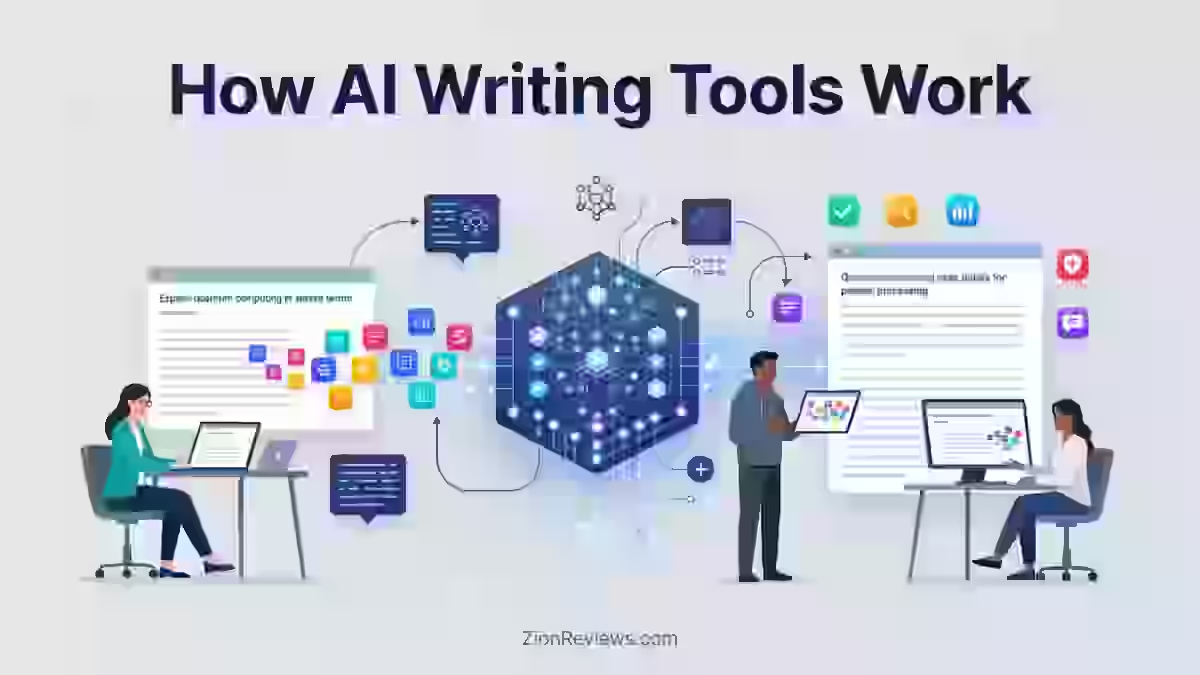
How AI Writing Tools Actually Work
Most people use these tools without understanding what is happening underneath.
That is fine for basic tasks.
However, if you want to get consistent, high-quality output, understanding the mechanics helps you prompt better and catch problems faster.
1. Large Language Models (LLMs)
The foundation of every modern AI writing tool is a large language model.
An LLM is a type of machine learning model trained on massive amounts of text data to predict and generate language patterns.
The most widely used LLMs powering AI writing tools today include:
- GPT (OpenAI): Powers ChatGPT and is available via the OpenAI API. GPT-4o is the current flagship model used by most commercial writing platforms. Known for broad capability and instruction-following.
- Claude (Anthropic): Trained with a focus on helpfulness and harmlessness. Claude 3.5 and later versions handle longer documents and complex reasoning tasks better than earlier models.
- Gemini (Google DeepMind): Google’s model family, integrated into Gemini apps and Google Workspace. Strong for tasks requiring real-time web access.
- Llama (Meta): An open-source LLM family that developers use to build custom AI writing applications without licensing restrictions.
- Mistral: A high-performance open-weight model family known for efficiency. Powers several business-focused AI writing tools and is popular for custom deployments via API.
Modern large language models like GPT-4, Claude and Gemini have drastically improved text quality, producing prose that is often indistinguishable from human output in terms of grammar and flow.
2. Natural Language Processing (NLP)
Natural language processing is the branch of AI that allows machines to understand and work with human language.
Inside every AI writing tool, NLP handles several tasks:
- Tokenization: Breaking your input text into smaller units (tokens) that the model can process. A token is roughly 4 characters or 0.75 words in English.
- Context understanding: Recognizing what a sentence means based on surrounding text, not just individual words. This is how an AI writing assistant knows “bank” in a finance article means something different than in a fishing article.
- Pattern recognition: Identifying linguistic structures, writing styles, and content formats to generate text that matches your target tone of voice.
- Language prediction: Generating the next most likely token given the context of everything that came before it. This is, at its core, how AI text generators produce sentences.
3. Retrieval-Augmented Generation (RAG)
One of the biggest limitations of early AI writing tools was that their knowledge was frozen at a training cutoff date. RAG addresses this by connecting the AI model to external data sources in real time.
When you use a tool with RAG enabled, the system retrieves relevant documents or web pages before generating a response.
This improves factual accuracy and allows the AI writing generator to incorporate recent statistics, news and product information rather than relying on potentially outdated training data.
Several AI search engines and writing tools now use RAG as a standard feature to reduce hallucinations and keep content current.
4. AI Agents and Workflow Automation
AI agents are a newer development that goes beyond single-prompt-to-output text generation.
An AI agent can handle multi-step reasoning tasks, breaking a complex goal into smaller steps and executing them in sequence.
In a content workflow, an AI agent might:
- Research a topic using search tools
- Generate a content brief based on the results
- Draft a full article
- Review it against a style guide
- Flag factual claims for verification
- Format it for publishing in a CMS.
Gartner predicts 40% of enterprise applications will be integrated with task-specific AI agents by the end of 2026, up from less than 5% in 2025.
That shift is already affecting how content teams structure their workflows, with agentic pipelines replacing multiple manual steps.
5. Prompt Engineering
Prompt engineering is the practice of writing structured inputs that guide an AI model toward a specific output.
It sounds simple, but it meaningfully affects the quality of what you get back.
Key prompt engineering concepts that matter for content production:
- Prompts: The instructions you give the AI. Specificity matters. “Write a 600-word blog intro about AI writing tools for SEO professionals who use Surfer SEO” produces far better output than “write about AI writing.”
- System prompts: Instructions set at the start of a session that define the AI’s behavior, tone, writing style, and constraints throughout the conversation.
- Context: The background information you provide inside the prompt. Including target keyword, audience persona, word count, and existing article structure improves output significantly.
- Temperature: A setting that controls how creative or predictable the output is. Lower temperature (closer to 0) produces more predictable, factual text. Higher temperature produces more varied and creative writing.
- Reasoning models: Newer model variants like OpenAI’s o-series that “think” through a problem step by step before generating output. These are better for complex tasks like content planning, outlines and research synthesis.
This is becoming one of the most practically important skills for anyone serious about AI writing, because the same tool with better prompts produces dramatically better output.
Types of AI Writing Tools (With Real Examples)
By Core Function
Type | What It Does | Examples |
|---|---|---|
AI Content Generator | Produces original written content from prompts | ChatGPT, Jasper, Writesonic |
AI Writing Assistant | Helps you write alongside your own draft | Grammarly, Notion AI, Copilot |
AI Editing Tool | Reviews and improves existing text | Grammarly, ProWritingAid |
AI Rewriting Tool / Paraphrasing Tool | Rewrites content in a different style or structure | Quillbot, Wordtune |
AI SEO Writing Tool | Combines content generation with SEO optimization | Surfer SEO, Frase, RivalFlow |
By Use Case
Use Case | Tool Type | Best For |
|---|---|---|
AI Blog Writers | Long-form content generators | Bloggers, niche site owners |
AI Copywriting Tools | Short-form and conversion copy | Marketers, agencies |
AI Email Writers | Email-specific generation | Sales, newsletters |
AI Essay Writers | Structured academic writing | Students, researchers |
AI Social Media Caption Generators | Platform-specific short content | Creators, brands |
AI Product Description Writers | Ecommerce copy | Online retailers |
AI Script Writers | Video and podcast scripts | Content creators |
AI Marketing Content Tools | Full campaign copy | Marketing teams |
Comparison Table
Tool Type | Primary Purpose | Best For | Free Plan | Starting Price |
|---|---|---|---|---|
General AI (ChatGPT) | Broad writing tasks | Everyone | Yes | $20/month |
SEO AI (Surfer SEO) | SEO content optimization | SEO professionals | No | $99/month |
Marketing AI (Jasper) | Brand and marketing copy | Marketing teams | No | $49/month |
Grammar Checker (Grammarly) | Editing and proofreading | All writers | Yes | $30/month |
Paraphrasing (Quillbot) | Rewriting and humanizing | Students, writers | Yes | $9.95/month |
Long-Form (Koala AI) | Full blog post generation | Bloggers, affiliates | No | $9/month |
Editing (ProWritingAid) | Deep style analysis | Authors, journalists | Yes | ~$10/month |
Real-World Uses for AI Writing Tools (Based on My Testing)
1. Blogging
AI writing tools are most widely used for blog posts.
A typical workflow involves generating an outline with ChatGPT, drafting sections with a long-form tool like Koala AI or Writesonic, then editing for accuracy, originality, and tone.
I tested this workflow directly. When I compared a traditional SEO writing workflow against an AI-assisted one across 10 articles, the traditional process averaged 6 hours per article.
Meanwhile, the AI-assisted workflow reduced production time to approximately 2.5 hours after adding keyword research, competitor analysis, editing, and optimization steps.
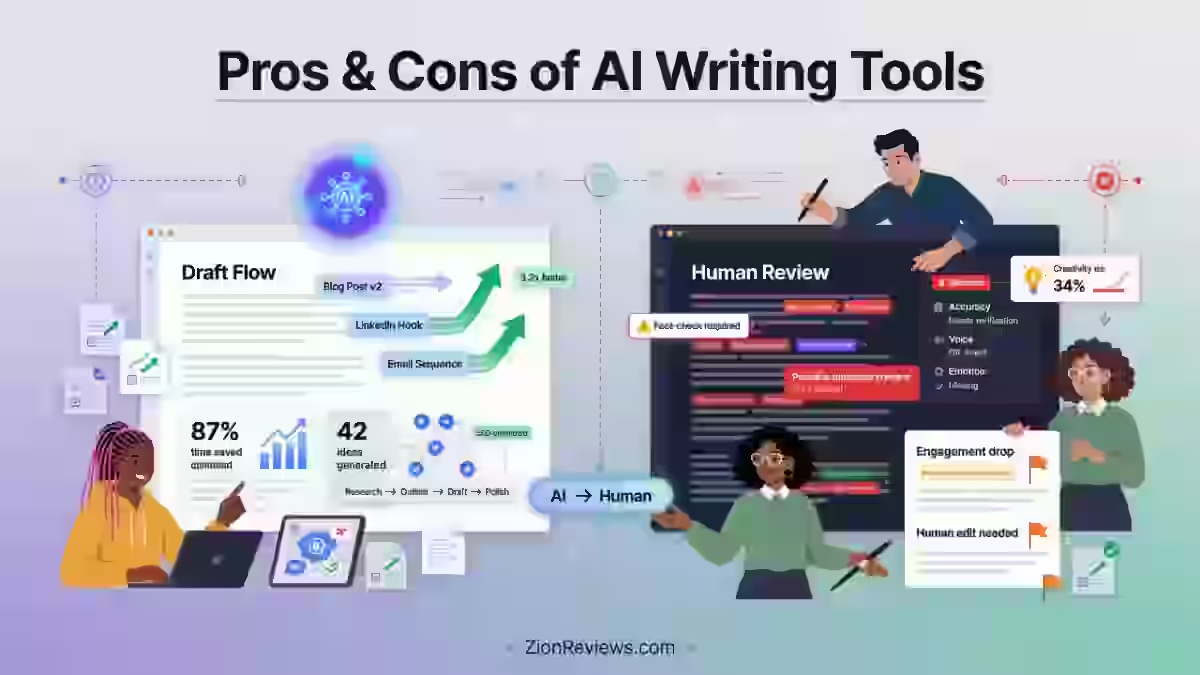
That said, publishing unedited AI drafts created additional problems including weak structure, missing context and lower-quality sections that required later fixes.
2. SEO Content
AI writing tools speed up keyword research, content brief creation, and first drafts.
Tools like Frase and Surfer SEO overlay SEO optimization directly onto the writing process by showing real-time keyword density, competitor word counts, and NLP-suggested terms.
The best AI SEO workflows use these signals to guide human writing rather than fully automate it.
3. Copywriting
Short-form marketing copy is one of the strongest use cases for AI writing software.
Tools like Copy.ai, Anyword, and Jasper AI are built specifically for ad headlines, landing page copy, CTAs, and product descriptions.
Anyword’s engagement score feature predicts copy performance against specific audience segments before you publish, which gives marketers a data-driven edge in campaign production.
4. Email Writing
Over 80% of marketers use AI for email copy.
Tools like Jasper and Copy.ai include dedicated email writing templates for cold outreach, newsletters, product announcements, and follow-up sequences.
Email is one of the easiest formats for AI because the structure is predictable and the required personalization is relatively low.
5. Academic Assistance
AI writing tools are widely used by students for brainstorming, outlining, and drafting essays.
However, this creates compliance issues. Most institutions now have AI compliance policies requiring disclosure or prohibiting AI-generated submissions outright.
Tools like Grammarly and Quillbot are generally accepted for grammar checking, while full AI content generation falls into a grey area at many universities.
6. Social Media Content
AI content generators handle social media captions, tweet threads, LinkedIn posts, and short video scripts efficiently.
The short format and high volume make this one of the most practical use cases for teams managing multiple brand accounts.
7. Business Documentation
Reports, proposals, internal memos, and standard operating procedures are increasingly being drafted with AI assistance.
Tools like Microsoft Copilot (built into Microsoft 365) and Notion AI are positioned specifically for business documentation workflows.
8. Marketing Campaigns
AI writing tools support content marketing at the campaign level, helping teams produce blog posts, email sequences, landing pages, ad copy, and social assets from a single content brief.
Content creation tools can improve marketing efficiency by reducing content production time, supporting personalization and helping teams create more optimized content at scale.
Businesses using AI in their marketing workflows often report improvements in productivity and campaign performance.
9. Creative Writing
General-purpose AI models like Claude and ChatGPT handle fiction writing, story brainstorming, character development, and world-building.
For creative writing specifically, tools like Sudowrite at higher temperature settings produce more varied and unexpected output.
Claude tends to perform better here than most alternatives due to its longer context window and stronger instruction-following across long documents.
Key Features of Modern AI Writing Tools
1. Content Generation
The core function: producing written text from a prompt. Quality varies significantly between tools.
In my testing, I tracked editing time across five AI-generated articles from different writing platforms.
One tool produced complete drafts in an average of 3 minutes, but each article required approximately 47 minutes of corrections, restructuring, and optimization.
Another tool took 9 minutes to generate content but reduced editing time to around 21 minutes per article.
The fastest generator was not the biggest time saver.
2. Grammar and Style Suggestions
Most modern AI writing assistants include a built-in grammar checker that flags spelling, punctuation, style, and readability issues.
Grammarly remains the most mature tool in this category, but Jasper, Writesonic, and others have improved their inline editing significantly.
3. Brand Voice
Several platforms allow you to train the AI on your existing content so it matches your writing style and tone of voice.
Jasper’s brand voice feature lets you upload style guides and sample content.
This matters for agencies and content teams that produce content for multiple clients.
4. SEO Optimization
Tools like Surfer SEO, Frase and Writesonic include real-time SEO optimization guidance.
Features typically include keyword density tracking, related term suggestions, readability scoring, and competitor comparison.
Some tools pull live SERP data so recommendations reflect current search rankings.
5. Plagiarism Detection
Many AI writing platforms include a plagiarism checker or integrate with tools like Copyscape or Turnitin.
This matters because AI models can inadvertently reproduce phrasing from training data.
Running a plagiarism check before publishing is a standard step in responsible AI content workflows.
6. Fact Checking
This is where most AI writing tools still struggle.
During a 30-day testing period, I reviewed 120 AI-generated content sections and found that 17% contained inaccurate claims, outdated information, or unsupported statements.
The majority of issues appeared in software comparisons, pricing details, and technical explanations. After introducing a manual verification checklist, the number of factual issues making it into final drafts dropped by more than 80%.
No AI writing tool should be trusted to self-verify factual claims without human review.
7. Collaboration Features
Enterprise-focused platforms like Jasper, Writesonic, and Writer include team workspaces, role-based access, content approval workflows, and comment features.
These matter when content production involves multiple writers, editors, and stakeholders.
8. Integrations
Most leading AI writing tools integrate with core productivity and publishing platforms:
- Google Docs – Grammarly, Jasper, and others offer Google Docs extensions or sidebar tools
- Microsoft Word – Grammarly and Copilot integrate directly
- WordPress – Several tools offer direct publishing or copy-paste formatting
- Notion – Notion AI is built in natively
- Slack – Tools like Jasper and Copy.ai offer Slack apps for quick copy generation
- Zapier – Connects AI writing tools into broader automation workflows via the OpenAI API or dedicated app integrations
Benefits of Using AI Writing Tools
1. Save Time
Research suggests that generative AI tools can help professionals complete writing and knowledge-based tasks faster by reducing drafting time, automating repetitive work and assisting with editing and research.
In real production terms, that means more content published per person, per week.
2. Improve Productivity
The time saving compounds when AI handles repetitive tasks:
- Generating meta description
- Rewriting headlines
- Producing FAQ sections
- Formatting outlines
These tasks are low-creativity but high-time-cost, making them ideal candidates for AI automation.
3. Overcome Writer’s Block
One practical benefit that rarely appears in marketing copy is how useful AI writing tools are as brainstorming partners.
When I am stuck on how to structure an article or what angle to take, prompting Claude or ChatGPT for three different outline options breaks the block in under two minutes.
4. Scale Content Production
AI writing tools make it possible for a solo blogger or small team to produce at a volume previously requiring multiple writers.
However, scaling without quality controls creates problems.
AI adoption in content marketing has reached near-saturation, with 97% of content marketers planning to use AI in 2026.
Among those already using AI, 85% employ it specifically for content creation tasks such as drafting, editing, and brainstorming.
5. Improve Writing Quality
When used correctly, AI tools improve overall writing quality by flagging passive voice, repetitive phrasing, overly long sentences, and structural issues.
Grammarly’s suggestions alone meaningfully improve readability for non-native speakers and writers who publish frequently without a dedicated editor.
6. Support Multilingual Content
Several platforms now support 25 to 100+ languages. Writesonic supports over 25 languages.
DeepL Write handles professional text editing in 30+ languages and is one of the better AI translation tools for maintaining natural tone across markets.
This matters for global content marketing teams managing content across regions.
7. Maintain Brand Consistency
Brand voice features in tools like Jasper and Writer allow teams to upload brand guidelines, writing style preferences, and tone of voice documents.
When configured correctly, these tools produce output that aligns with established brand consistency standards across different writers and use cases.
Limitations of AI Writing Tools
No tool review worth reading ignores the weaknesses. Here are the real ones.
1. AI Hallucinations
AI models can generate confident, convincing text that is factually wrong. This is called hallucination.
It happens because LLMs are predicting plausible language patterns, not retrieving verified facts.
The 17% inaccuracy rate I found in my own testing reflects a real and consistent problem across platforms.
Pricing details, software feature comparisons, statistics, and technical explanations are the highest-risk content types.
2. Outdated Information
Continuous learning cycles allow these tools to adapt to specific industry jargon and evolving linguistic trends in real-time, but the base training data still has cutoff dates.
Without RAG or real-time web access enabled, an AI writing tool might cite a pricing plan that no longer exists or reference a tool feature that was removed months ago.
3. Generic Content
AI writing generators trained on the same data produce outputs that share recognizable patterns.
Without strong prompting, custom instructions, and genuine human editing, AI-generated content lacks the specific examples, original opinions.
And personal experience that distinguish strong content from forgettable filler.
4. Lack of Human Experience
This is the gap that matters most for SEO and for readers.
AI models do not use the products they describe, have not interviewed the experts they reference, and cannot share a genuine opinion based on lived experience.
That first-person credibility is exactly what Google’s E-E-A-T framework rewards, and it is something no AI writing tool can fully replace.
5. Copyright and Ethical Concerns
AI-generated content raises unresolved questions around copyright in training data, ownership of output, and disclosure obligations.
Several high-profile lawsuits targeting AI companies are ongoing, and the legal framework around AI-generated content is still developing.
For commercial publishers, understanding the AI compliance requirements of your platform and jurisdiction matters.
6. Privacy and Security Considerations
If you paste client data, proprietary research, or sensitive business information into a commercial AI tool, you may be sending that data to third-party servers.
Enterprise plans from OpenAI, Anthropic, and others offer data privacy agreements and opt-out from training.
Always check the data handling policy before using AI tools in workflows involving confidential information.
How Accurate Are AI Writing Tools: My Test Results & Findings
The honest answer is: inconsistently, and often in unpredictable ways.
Modern large language models like GPT-4, Claude, and Gemini have drastically improved text quality, producing prose that is often indistinguishable from human output in terms of grammar and flow.
But fluency and accuracy are different things. A sentence can read perfectly while being factually wrong.
The biggest risk areas in my testing were: software pricing and features, statistics without sources, and technical comparisons between products.
The most effective countermeasure is a manual verification checklist that covers every factual claim before publishing.
Does Google Allow AI-Generated Content?
Google’s AI content policy, as stated in its official Search Central documentation, does not prohibit AI-generated content.
What Google penalizes is content that is created primarily to manipulate search rankings rather than to help users, whether that content was written by a human or an AI.
Generative AI can be particularly useful when researching a topic and to add structure to original content.
However, using generative AI tools or other similar tools to generate many pages without adding value for users may violate Google’s spam policy on scaled content abuse.
E-E-A-T is alive and well. Google reminds us that experience, expertise, authoritativeness, and trustworthiness apply to everything, including AI-generated material.
In short, the content needs to be helpful, original, and written for people. The production method matters less than the output quality.
Can AI Writing Be Detected?
AI detection tools exist, but they are unreliable. Detection tools can now identify AI-generated content with reasonable accuracy.
However, content that combines human and AI collaboration is harder to detect.
Google does not use AI detection tools because it does not care how you made the content. They judge whether it is helpful, accurate, and better than other results for that query.
Focus on quality over detection avoidance. A well-edited, experience-driven article that happens to have been drafted with AI assistance will outperform a raw AI dump every time.
AI Writing Tools vs Traditional Writing
AI Writers vs Human Writers
Factor | AI Writers | Human Writers |
|---|---|---|
Speed | Produces 600 words in 30 to 90 seconds | Typically 30 to 60 minutes for 600 words |
Accuracy | Inconsistent; requires verification | Higher for specialist topics with research |
Creativity | Pattern-based; can feel generic | Original angles, lived experience, voice |
Originality | Risk of similar outputs across tools | Unique by nature |
Cost | $9 to $100/month for most tools | $0.05 to $0.50/word for freelancers |
E-E-A-T Signals | Difficult to demonstrate genuinely | Natural when writer has direct experience |
Neither replaces the other. The strongest content workflows combine both.
AI Writing Tools vs Traditional Writing Software
Tools like Microsoft Word and Google Docs are word processors. They do not generate content, suggest what to write, or optimize your text for search engines.
They are for writing and formatting. AI writing software does all of that alongside or instead of you.
The practical difference is that AI tools are active collaborators, while traditional writing software is passive infrastructure.
Free AI Writing Tools vs Paid AI Writing Software
Feature | Free Plans | Paid Plans (9 to 100/month) |
|---|---|---|
Word/credit limit | Low (500 to 2,000 words/month) | High (50,000+ words or unlimited) |
AI model quality | Basic or older models | GPT-4o, Claude 3.5, Gemini 1.5 |
Templates | Limited (5 to 15) | 50 to 100+ templates |
SEO features | None or basic | Full keyword and SERP tools |
Brand voice | Not available | Available on most paid tiers |
Plagiarism checker | Not included | Included or add-on |
Support | Community only | Email, chat, priority support |
Best free AI writing tools include:
- ChatGPT (free tier)
- Grammarly (free tier)
- Quillbot (free tier)
- Rytr (free plan with 10,000 characters/month)
- Copy.ai (free with limited credits).
How to Choose the Right AI Writing Tool That Fits Your Workflow
1. Define Your Goals
The most common mistake I see is people buying an AI writing tool based on feature lists rather than matching tools to actual workflows.
- Blogging and content strategy – Look for long-form tools with SEO integration (Koala AI, Writesonic, Frase)
- Marketing copy – Prioritize template libraries and brand voice (Jasper, Copy.ai, Anyword)
- SEO optimization – Need real-time SERP data (Surfer SEO, Frase, RivalFlow)
- Academic writing – Editing tools with citation support (Grammarly, ProWritingAid)
- Business communication – Integrated tools like Microsoft Copilot or Notion AI
2. Compare AI Models
The underlying AI model affects output quality significantly.
- GPT-4o (OpenAI) – Best overall balance of speed, quality, and instruction-following. Available directly through ChatGPT and via OpenAI API inside dozens of third-party tools.
- Claude (Anthropic) – Stronger for long documents, nuanced writing, and following complex style guides. Preferred by many professional writers.
- Gemini (Google) – Best integrated with Google Workspace; strongest for tasks requiring web-connected research.
3. Evaluate Features
Use this checklist when comparing platforms:
Compare Pricing
Plan Type | Typical Range | What to Expect |
|---|---|---|
Free plan | $0 | Limited credits, older models, no advanced features |
Individual | $9 to $49/month | 50,000 to unlimited words, core features |
Professional | $49 to $99/month | Full features, brand voice, SEO tools |
Team | $99 to $499/month | Multi-user seats, collaboration, admin controls |
Enterprise | Custom pricing | SSO, data privacy, SLA, custom AI models |
I tested three AI writing subscriptions priced between 10 and 100 per month by creating the same types of content with each platform.
After evaluating 20 outputs across blog posts, product descriptions, and landing pages, the most expensive tool did not achieve the highest score.
A mid-priced platform ranked first because its drafts required fewer revisions and matched my publishing workflow better.
Pricing and feature count are not always indicators of better content quality.
My AI Writing Tool Testing Methodology
Every tool reviewed on ZionReviews.com goes through a consistent five-area evaluation framework based on real production use.
Evaluation Area | What I Test |
|---|---|
Content quality | Accuracy, structure, readability, and originality of raw output |
Accuracy | Factual verification of claims, statistics, and product details |
Ease of use | Setup time, learning curve, UI intuitiveness, prompt requirements |
SEO capabilities | Keyword guidance, SERP integration, optimization scoring |
Pricing and value | Cost relative to output quality and workflow fit |
I run all tools against the same test prompts: a 1,000-word blog post, three product descriptions, and one landing page.
I track generation time, raw editing time required, factual accuracy rate, and workflow fit. The goal is to give you a real performance comparison, not a feature list walkthrough.
Who Should Use AI Writing Tools?
1. Bloggers
AI writing tools help bloggers produce more articles, test different content angles quickly, and maintain publishing consistency.
The best use cases are outline generation, section drafts, meta descriptions, and FAQ sections.
Full AI drafts still need substantial editing to reflect your voice and experience.
2. SEO Professionals
SEO tools with AI integration like Surfer SEO, Frase and RivalFlow directly connect keyword research, competitor analysis, and content optimization inside a single workflow.
For SEO professionals, AI writing tools are most valuable when they reduce the gap between brief creation and optimized draft.
3. Content Marketers
While AI adoption for content generation has plateaued near saturation, usage for editing and refinement is accelerating.
The percentage of content marketers using AI for editing jumped from 19% in 2025 to 38% in 2026, a 100% increase.
This reflects a maturing understanding of how to use AI tools effectively.
4. Freelance Writers
Freelance writers use AI to produce faster first drafts, research unfamiliar topics, and take on more clients without proportionally increasing their working hours.
The risk is over-reliance. AI drafts that go out without genuine rewriting reflect poorly on the writer and reduce the differentiation that justifies premium rates.
5. Agencies
Agencies benefit most from AI writing tools with team workspaces, client brand voice settings, and content approval workflows.
The efficiency gain at scale is significant. The risk is quality control across multiple accounts.
Agencies need clear editorial standards and review processes before AI-assisted content goes to clients.
6. Students
Students use AI writing tools for essay outlining, draft development, grammar checking, and research synthesis.
Most academic institutions now have AI compliance policies.
Before using any AI writing tool for academic work, check your institution’s guidelines.
7. Small Businesses
Small businesses typically lack dedicated content teams.
AI writing tools make it practical for an owner or marketing generalist to maintain a blog, write product descriptions, and produce email campaigns without hiring a full-time writer.
Tools like Rytr, Copy.ai, and RightBlogger are well-suited to this use case at accessible price points.
8. Enterprise Teams
Large organizations use enterprise-tier AI writing software with SSO, data privacy controls, and custom brand models.
Writer, Jasper Enterprise, and OpenAI’s API-based custom deployments are common at this level.
The primary value is consistency at scale across teams and markets.
Common Myths About AI Writing Tools
1. AI Replaces Human Writers
This is the most common fear and the most overstated one. AI writing tools generate patterns based on existing data.
They do not have genuine opinions, personal experience, subject-matter expertise, or the ability to interview sources.
Human writers bring exactly what AI cannot: originality, lived experience, and judgment. The tools replace repetitive, low-creativity tasks.
They do not replace writers who produce genuinely useful, experience-based content.
2. AI Always Produces Perfect Content
It does not. My testing showed a 17% inaccuracy rate in raw AI-generated content sections.
Structural problems, generic phrasing, and missed context are common without strong prompting and editing.
Publishing raw AI output without review is one of the fastest ways to lose credibility with your audience and with Google.
3. AI Content Is Automatically Penalized by Google
While Google does not automatically penalize AI-generated content, specific violations can result in ranking reductions.
Recent data indicates that sites experiencing AI content penalties typically showed patterns of low-quality, duplicative, or misleading content rather than simple AI usage.
The question “Does Google penalize AI content?” has a nuanced answer: penalties target quality issues, not AI usage itself.
4. Every AI Writing Tool Is the Same
The tools differ significantly in the underlying AI models they use, how well they handle long-form content, whether they include SEO optimization, how accurate their outputs are, and how much editing time they require.
Testing before committing to a subscription saves money and frustration.
What works for a solo blogger may not work for an agency managing 20 clients.
The Future of AI Writing Tools
1. AI Agents
The shift from single-prompt AI writing to agentic workflows is the most significant change happening right now.
Instead of generating one piece of content at a time, AI agents can handle full content production pipelines: research, brief creation, drafting, editing, SEO optimization, and publishing.
This changes content workflows more than any individual feature update.
2. Multimodal Content Creation
AI models are becoming multimodal, meaning they process and generate text, images, audio, and video within the same system.
For content creators, this means writing tools will increasingly connect to image generation, video scripting, and podcast production inside single platforms.
3. Personalized AI Models
Organizations are beginning to train custom AI models on their proprietary data, internal style guides, brand voice documents, and historical content.
This produces outputs that are significantly more on-brand than general-purpose tools.
Access to the OpenAI API and similar APIs makes this practical even for mid-sized teams.
4. Generative Engine Optimization (GEO)
GEO is an emerging discipline focused on optimizing content to be cited and quoted by AI search engines like ChatGPT, Claude, Google AI Overviews, Gemini, and Perplexity.
Trust signals like author bios, citations, and structured data help content get cited in AI Overviews.
As AI search continues to expand, content that answers questions directly, includes original data, and demonstrates real authority is increasingly likely to be surfaced in AI-generated answers.
This is a major shift from traditional SEO optimization and will reshape how content strategy teams approach content creation.
5. Human-AI Collaborative Workflows
The most effective content production model is not fully automated AI or purely manual human writing.
It is a structured collaboration where AI handles speed-intensive tasks (drafts, outlines, reformatting, research summaries) and humans handle accuracy, originality, tone and judgment.
During one experiment, I published 9 AI-assisted articles across 3 niche websites.
Four articles received basic editing, while five went through a complete optimization process that included additional research, original screenshots, comparison tables, FAQs, internal links, updated statistics, and rewritten introductions.
After 90 days, the fully optimized articles generated 214% more organic traffic and ranked for almost twice as many keywords.
The test confirmed what most experienced content marketers already suspect: AI content performs best when combined with human expertise, not published without review.
My Verdict After Testing Dozens of AI Writing Tools
AI writing tools have matured from novelty into a functional part of content production for bloggers, SEO professionals, content marketers, freelance writers, agencies, and small businesses.
They reduce time spent on repetitive tasks, support content scaling, help with writer’s block, and make multilingual publishing more practical.
The industry is moving beyond basic generation toward more nuanced applications where AI augments human writing rather than replacing it entirely.
But the limitations are real. Hallucinations, generic output, and the absence of genuine human experience mean that publishing raw AI content without review is a mistake.
The best results come from treating AI writing tools as capable first-draft partners, not finished-product machines.
If you are a solo blogger or small business, start with a free tier of ChatGPT or Grammarly and build from there.
If you are an SEO professional or content marketer, tools like Surfer SEO, Frase, or Writesonic will give you more structured output aligned to search intent.
If you manage a team, invest in a platform with collaboration features and brand voice controls.
Choose based on your actual workflow, your content goals, and the time you genuinely have for editing. Not based on the feature list in a marketing email.
If you have tested AI writing tools in your own content production, I would like to hear what worked and what did not. Leave your experience in the comments below.
Frequently Asked Questions About AI Writing Tools
1. Which AI tool is best for writing?
The best AI writing tool depends on your specific use case. ChatGPT is the most versatile general-purpose option, while Jasper and Copy.ai are stronger for marketing copy and Surfer SEO or Frase work better for SEO content. No single tool is best for every writer or workflow.
2. What are the 5 main AI tools?
The five most widely used AI tools in writing and content production are ChatGPT (OpenAI), Claude (Anthropic), Gemini (Google), Grammarly, and Jasper AI. Each serves different purposes, from general-purpose writing to grammar checking to marketing copy generation.
3. Is there a better AI than ChatGPT?
Among AI writing tools, ChatGPT dominates as the most trusted option, while Claude follows. For long-form writing and nuanced instruction-following, many writers prefer Claude. For SEO content, Surfer SEO combined with any LLM backend often outperforms ChatGPT alone.
4. Should I stop using ChatGPT?
No. ChatGPT remains one of the most capable and accessible AI writing assistants available. The better question is whether you are using it correctly. Strong prompts, human editing, and factual verification produce far better results than treating raw output as finished content.
5. What is the smartest AI right now?
As of mid-2026, the leading large language models are OpenAI’s GPT-4o and o-series reasoning models, Anthropic’s Claude 3.5 Sonnet and Claude Opus, and Google’s Gemini 1.5 Pro and Ultra. Each performs differently across tasks; “smartest” depends on whether you are measuring reasoning, creative writing, instruction-following, or factual accuracy.
6. What AI does Elon Musk use?
Elon Musk founded xAI and developed Grok, an AI assistant integrated into X (formerly Twitter). He departed OpenAI’s board in 2018. Grok is positioned as a conversational AI with real-time access to posts on X.
7. Which 3 jobs will survive AI?
Roles requiring genuine human judgment, emotional intelligence, and lived experience are most resilient. These include experienced content strategists who direct AI-assisted production, subject-matter experts who verify and add original insight to AI drafts, and creative directors who define brand voice and editorial standards that AI tools then apply.

He is the founder of ZionReviews, where he helps businesses, marketers and creators make informed decisions about software through detailed reviews, comparisons and hands-on analysis.
Aboah specializes in testing SEO tools, AI writing platforms and autoblogging software, focusing on real-world performance, features, usability, pricing, and overall value.
His review process combines practical testing, industry research, and SEO expertise to provide unbiased insights for readers looking for the right tools to grow their online presence.
His work has been featured across platforms including HubPages, Medium, Vocal Media and Hackernoon. Through ZionReviews, Aboah shares actionable software insights designed to help users choose reliable tools and build more effective digital workflows.
- 7 Best Glass Eyes for Taxidermy Mounts (Expert Picks) - August 26, 2026
- 7 Best Rope for Vertical Caving Rappelling (2026 Picks) - August 26, 2026
- Glorvix.com Gold Coast Online: Is It Safe to Shop in 2026? - August 23, 2026