
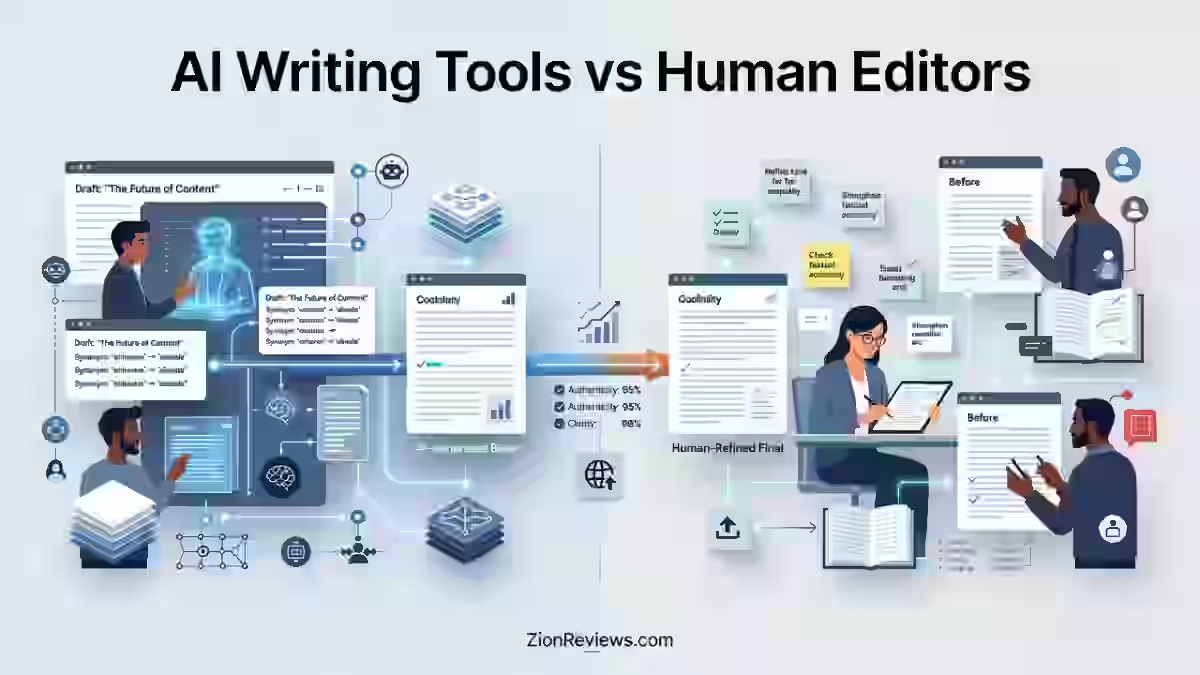
TL;DR: AI writing tools are better for speed, consistency checks, spelling errors and basic structural edits especially when budgets are limited. Human editors excel at developmental editing, emotional resonance, cultural nuances and discipline-specific conventions where editorial judgment matters more than processing power.
Most professional workflows benefit from combining both: AI for first-pass editing, humans for final review and subject-matter expertise.
Methodology Note
I tested AI writing tools and human editors across multiple real-world content workflows over 90 days, including:
- SEO blog posts (1,200–2,500 words)
- Marketing landing pages
- Email sequences
- Technical documentation
- Academic article editing
- Product descriptions
Testing approach:
I used the same content pieces edited by both AI editing tools (Grammarly, ProWritingAid, ChatGPT, Claude) and human editors (freelance copyeditors, subject-matter experts, and professional proofreaders).
Evaluation criteria:
- Content quality and accuracy
- Editorial judgment
- Tone and voice consistency
- Turnaround time
- Cost per 1,000 words
- Audience fit
Introduction to AI Writing Tools vs Human Editors
The debate over AI writing tools vs human editors is usually framed wrong. Most articles frame it as a battle, with one side winning.
After editing hundreds of content pieces using both approaches, I found that the answer depends entirely on what you’re editing, who your audience is and whether speed or depth matters more for your project.
AI tools handle routine edits in seconds, but human editors catch problems AI consistently misses, especially around tone and voice, argument evaluation and cultural references.
The real question isn’t which is “better.” It’s knowing when to use each one and how to combine them without wasting time or budget.
For a broader overview of AI writing tools, see what are AI writing tools.
Quick Answer: Should You Use AI Writing Tools or Human Editors?
Use AI writing tools when you:
- Need fast turnaround (minutes instead of days)
- Are editing high-volume, repetitive content
- Have a budget which is under $100/month
- Need consistency checks across large documents
- Grammar, spelling errors, and basic clarity are your main concerns
Use human editors when you:
- Are working on grant proposals, journal submissions, or financial communications requiring regulatory compliance
- Prefer authorial voice and emotional beats
- Need developmental editing or line editing beyond surface corrections
- Need content that requires subject-matter expertise (academic editing, business editing, dissertation editing)
- Have an audience that depends on cultural nuances or genre conventions
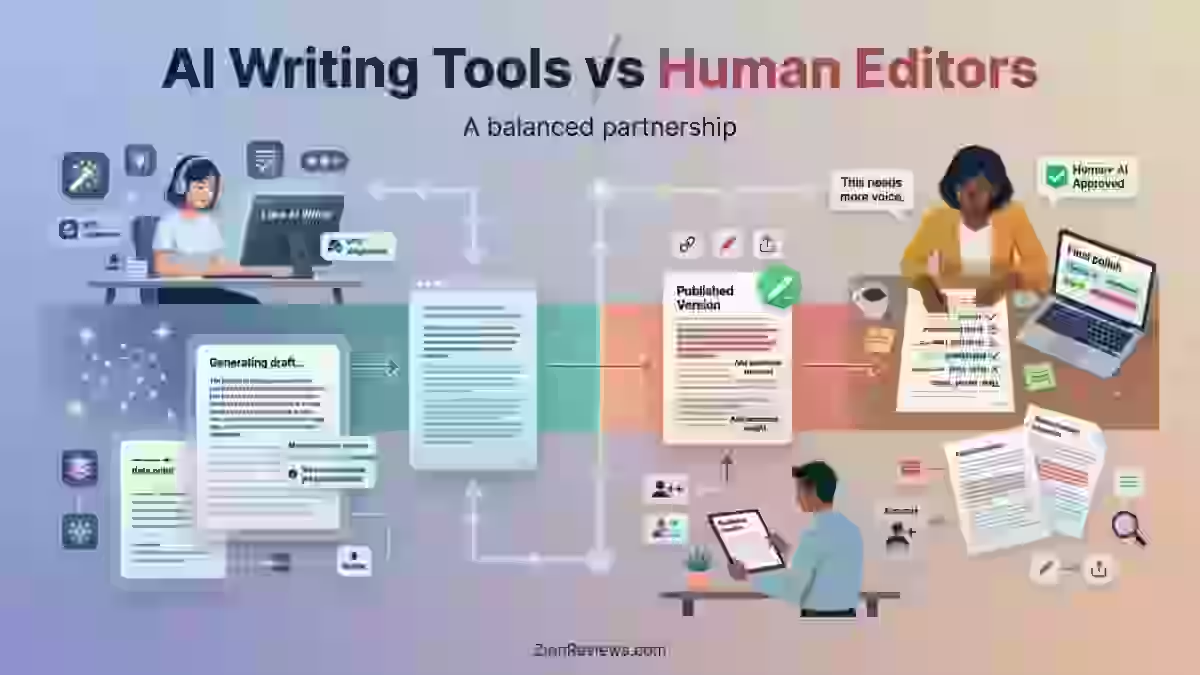
Use the hybrid approach when you:
- Want AI speed for first drafts and human judgment for final polish
- Are managing content teams with mixed skill levels
- Need tracked changes and educational feedback for writers
- Require quality standards on multiple review layers
I’ve found that human-led editing with AI-assisted tools produces the best results for most professional content workflows.
What Makes AI Writing Tools and Human Editors Different?
AI writing tools analyze patterns in language based on training data and probabilistic models.
They process text through algorithms that identify grammar issues, suggest phrasing alternatives, and check structural consistency.
However, they lack genuine understanding of context, intent or audience.
Human editors bring editorial judgment shaped by experience, cultural context, and subject-matter expertise.
When I sent the same 2,000-word blog post to both an AI editing tool and a professional copyeditor, the AI caught 47 spelling errors and suggested 89 rephrasing options in 12 seconds.
The human editor took 90 minutes, caught 19 issues the AI missed (including factual inaccuracies and tone mismatches), and improved the overall argument structure in ways no AI tool suggested.
The biggest difference:
AI tools optimize for correctness and readability; human editors optimize for meaning, persuasion, and audience connection.
Human editors also adapt to genre conventions, pacing issues, and emotional resonance in ways that AI tools, limited by their context window and processing power cannot reliably replicate.
A developmental editor working on character development or character arcs in fiction brings creative insight that AI-only editing simply doesn’t provide.
AI Writing Tools vs Human Editors At a Glance
Category | AI Writing Tools | Human Editors |
|---|---|---|
Best for | Speed, grammar, consistency | Judgment, nuance, expertise |
Turnaround time | Seconds to minutes | Hours to days |
Cost (per 1,000 words) | $0-$5 | $20-$150+ |
Accuracy on grammar | 85–95% | 95–100% |
Tone matching | Inconsistent | Reliable with briefing |
Subject expertise | None | High (with right editor) |
Cultural nuance | Poor | Strong |
Emotional resonance | Weak | Strong |
Scalability | Unlimited | Limited by time |
Hands-On Testing Results
I tested AI writing tools and human editors using five content types over 12 weeks.
Each piece was edited using AI tools first, then reviewed by human editors to measure what AI missed.
Test | AI Editing Tools | Human Editors | Time Difference |
|---|---|---|---|
1,500-word blog post | Fixed 34 grammar issues, missed 3 factual errors | Caught grammar + factual errors, improved flow | AI: 18 seconds, Human: 45 minutes |
500-word product description | Improved readability, generic tone | Matched brand voice, added persuasion | AI: 8 seconds, Human: 20 minutes |
3,000-word white paper | Found inconsistencies, suggested clarity edits | Strengthened argument structure, improved transitions | AI: 35 seconds, Human: 2.5 hours |
Grant proposal (2,200 words) | Basic grammar, no compliance insight | Flagged regulatory compliance issues, improved clarity | AI: 22 seconds, Human: 3 hours |
Email sequence (5 emails, 1,200 words total) | Consistent tone within emails, not across sequence | Unified voice across entire sequence | AI: 15 seconds, Human: 1 hour |
What surprised me:
AI tools performed well on self-contained content with clear grammar issues.
They struggled with anything requiring contextual amnesia awareness; where understanding what came 2,000 words earlier mattered for consistency.
Human editors caught these cross-references naturally, while AI tools treated each paragraph in isolation.
On academic editing projects and dissertation editing, the gap widened further.
Native English editors with subject-matter expertise caught discipline-specific conventions and cultural references that AI tools ignored or flagged incorrectly.
One AI tool suggested changing passive voice in a scientific methods section where passive voice is the expected convention.
This is something a professional editor with academic experience would never recommend.
For more background on how these tools function, see how AI writing tools work.
When to Use AI Writing Tools
AI writing tools work best when speed, volume, and basic correctness matter more than deep editorial insight.
Best use cases:
- First-draft cleanup: I use AI tools to catch obvious grammar and spelling errors before sending drafts to human editors. This saves editing time and reduces costs, since the human editor can focus on higher-level issues rather than fixing typos.
- High-volume content: For ecommerce product descriptions, social media posts, or email variations, AI tools provide consistent formatting and readability checks across hundreds of pieces in minutes.
- Consistency checks: When editing long-form content (10,000+ words), AI tools quickly identify inconsistent terminology, capitalization, or formatting that would take hours to catch manually.
- Learning tool for writers: Some AI editing tools provide educational feedback by explaining why a change is suggested. This helps junior writers improve faster than if they only received tracked changes without context.
- Budget-conscious projects: At $0-$30/month for most AI editing tools, they’re accessible for solo bloggers, students, and small businesses that can’t afford professional proofreading services at $40-$100 per hour.
According to research from Harvard, over-reliance on AI editing may contribute to cognitive atrophy.
This is where writers stop developing editing skills because they outsource all proofreading to algorithms.
It creates long-term dependence and makes it harder to edit effectively without AI assistance.
When to Use Human Editors
Human editors are important when editorial judgment, subject-matter expertise, and audience understanding matter more than speed.
1. Developmental Editing
For books, long-form articles, or creative content requiring character development, plot structure, or pacing issues, human editors provide insight AI tools can’t replicate.
When I worked with a developmental editor on a 15,000-word case study, they restructured the entire narrative arc to improve emotional beats and reader engagement.
Changes no AI tool would suggest because they require understanding story flow and audience psychology.
2. Academic Editing and Journal Submissions
Academic writing demands discipline-specific conventions, proper citation formatting, and argument evaluation.
I tested AI tools on a journal submission and found they flagged correct passive voice as “errors” and missed significant gaps in argument structure.
A native English editor with academic editing experience caught methodology issues, unclear research conclusions, and formatting problems that would have led to rejection.
For dissertation editing, human editors familiar with university requirements are irreplaceable.
They understand how to structure literature reviews, methodology sections, and discussion chapters according to specific academic standards.
3. Regulatory Compliance and Financial Communications
Content requiring regulatory compliance like financial communications, legal documents or healthcare materials need human editors with subject-matter expertise.
AI tools lack the knowledge to ensure accuracy in these high-stakes contexts.
One error in a grant proposal or executive report can cost funding or credibility.
4. Cultural Nuances and Localization
AI tools trained primarily on English-language internet content miss cultural references, idioms, and regional language variations.
When I had content edited for UK vs. US audiences, human editors adjusted not just spelling (colour vs. color) but phrasing, tone, and cultural references that AI tools ignored.
For niche editors working with specific communities like Jewish editors familiar with religious terminology or editors specializing in genre conventions for romance, sci-fi, or mystery writing, human expertise is irreplaceable.
5. Brand Voice and Marketing Copy
Maintaining consistent authorial voice across campaigns, websites, and marketing materials requires human judgment.
AI tools can mimic basic style guides but struggle with tone and voice subtleties that make content feel authentic.
When I tested AI edits on brand-sensitive copy, the results felt generic and stripped of personality.
A professional copyeditor familiar with the brand preserved voice while improving clarity.
6. Line Editing and Prose Quality
For content where every sentence matters: books, narrative essays, thought leadership articles line editing by experienced human editors improves flow, rhythm, and emotional resonance in ways AI tools can’t.
AI might suggest replacing “walked slowly” with “ambled,” but it won’t restructure an entire paragraph to build tension or improve pacing.
Disadvantages of AI Writing Tools
1. Contextual amnesia and limited context windows
AI tools analyze content in chunks, typically 4,000 to 32,000 tokens depending on the model.
This means they lose track of earlier context in long documents.
I edited a 10,000-word guide where the AI tool suggested changing a term in section 7 that would contradict the definition in section 2.
Human editors maintain awareness of the entire document.
2. Semantic shifts and meaning changes
AI tools sometimes suggest edits that subtly change meaning.
In one test, an AI tool recommended replacing “significant impact” with “large effect,” which is technically similar.
However, the connotation shifted from importance to size. These semantic shifts accumulate and distort the original message.
3. No subject-matter expertise
AI tools don’t understand specialized fields.
When editing technical documentation, the AI flagged correct industry terminology as errors and suggested generic replacements that were technically wrong.
This is especially problematic for business editing, medical writing or legal content.
4. Poor performance on emotional resonance and creative content
When I tested AI editing on narrative content, it consistently flattened emotional beats and simplified character arcs.
It also removed stylistic choices that added voice. AI tools prioritize “correct” writing over expressive writing.
5. Risk of cross-contamination in training data
AI models are trained on vast datasets that may include biased, outdated or incorrect content.
This cross-contamination means AI tools sometimes suggest phrasing or ideas based on flawed source material.
You can’t audit what influenced an AI’s suggestion.
6. AI detection software concerns
Over-editing with AI tools can make content sound robotic, which may trigger AI detection software used by academic institutions, publishers or search engines.
Google’s Quality Rater Guidelines emphasize human expertise and authorship content that sounds AI-generated may rank poorly.
Disadvantages of Human Editors
1. Cost and scalability
Professional proofreading services cost $30-$150 per 1,000 words.
For high-volume content, 100 product descriptions, daily blog posts, or large content librariesz human editing becomes financially impractical.
2. Slower turnaround times
Human editors need hours to days for review. If you need same-day edits, AI tools are the only realistic option.
3. Inconsistency between editors
Different editors have different styles, preferences, and skill levels.
I’ve sent the same piece to three human editors and received three different edit approaches. AI tools, while flawed, are at least consistent.
4. Availability and scheduling
Good human editors book weeks in advance. If you have an urgent project, you may not find qualified editors available.
5. Human error
Even experienced editors miss mistakes. Fatigue, distraction, and oversight are real.
In one project, a professional editor missed a glaring factual error that an AI tool caught immediately.
For more details on the strengths and limitations of AI writing tools, see pros and cons of AI writing tools.
Cost Breakdown: AI Writing Tools vs Human Editors
AI Writing Tools Pricing
Tool | Monthly Cost | Features | Best For |
|---|---|---|---|
Grammarly Premium | $12-$30/month | Grammar, tone, clarity, plagiarism | General editing, bloggers |
ProWritingAid | $10-$30/month | Style, grammar, structure reports | Long-form writers, novelists |
ChatGPT Plus | $20/month | Custom prompts, editing, rewriting | Flexible editing workflows |
Claude Pro | $20/month | Context-aware editing, long documents | Technical and detailed content |
Hemingway Editor | Free or $20 one-time | Readability, sentence structure | Clarity-focused editing |
Effective cost per 1,000 words: $0.1-$2.00 depending on volume
AI tools charge flat monthly fees regardless of how much you edit, making them cost-effective for high-volume users.
Human Editor Pricing
Editor Type | Cost Per 1,000 Words | Turnaround | Best For |
|---|---|---|---|
Professional proofreader | $20-$50 | 24–48 hours | Grammar, spelling errors |
Copyeditor | $40-$80 | 2–5 days | Style, clarity, flow |
Developmental editor | $60-$150+ | 1–3 weeks | Structure, argument, narrative |
Academic editor | $50-$120 | 3–7 days | Journal submissions, dissertations |
Subject-matter expert editor | $80-$200+ | 1–2 weeks | Technical, regulatory, niche content |
Note: Niche editors (e.g., editors with expertise in specific industries or communities like Jewish editors for religious content) often charge premium rates due to specialized knowledge.
Cost Comparison Example
For a 10,000-word blog post:
- AI editing tool: $0.1-$5.00 (instant)
- Professional proofreading: $200-$500 (2–3 days)
- Developmental editing: $600-$1,500+ (1–2 weeks)
What I do:
For most projects, I use AI tools for the first editing pass (saves $100+$300 per project), then hire human editors for final review. This hybrid approach cuts costs by 40–60% while maintaining quality.
The Hybrid Approach: Combining AI Tools and Human Editors
The most effective editing workflow combines AI speed with human judgment. Here’s the process I use after testing several variations:
Step 1: AI First-Pass Edit (5–10 minutes)
Run content through AI editing tools to catch:
- Spelling errors and typos
- Basic grammar mistakes
- Unclear sentences
- Consistency checks (capitalization, formatting)
Tools I use: Grammarly for grammar, ProWritingAid for style reports, Claude for tone adjustments.
This step reduces the human editor’s workload, allowing them to focus on higher-value edits instead of fixing typos.
Step 2: Human Editor Review (1–3 hours per 1,000 words)
Send the AI-edited draft to a human editor who focuses on:
- Structural consistency and argument evaluation
- Audience fit and tone and voice
- Factual accuracy and subject-matter expertise
- Emotional resonance and pacing issues (for creative content)
- Discipline-specific conventions (for academic or technical content)
The human editor works with tracked changes so I can review their reasoning and learn from their edits.
Step 3: Final AI Check (2–5 minutes)
After accepting the human editor’s changes, I run one final AI check to catch any new errors introduced during editing.
Results:
This process reduces editing costs by 50–70% compared to human-led editing alone, while improving quality compared to AI-only editing.
It’s the approach I recommend for most professional content workflows especially for executive reports, financial communications and business editing where both speed and accuracy matter.
Alternatives Worth Considering
If you’re deciding between AI writing tools and human editors, here are three alternative approaches:
1. Freelance Editors on Platforms (Upwork, Reedsy, Fiverr)
Best for: Budget-conscious projects needing human expertise
Main advantage: Access to vetted editors at competitive rates ($15-$80 per 1,000 words)
Main limitation: Quality varies significantly; requires testing multiple editors to find reliable ones
Approximate pricing: $25-$60 per 1,000 words for experienced editors
2. AI + Writer Training
Best for: Content teams with junior writers
Main advantage: AI tools provide educational feedback while writers improve their skills; reduces long-term editing dependence
Main limitation: Takes time to build team editing skills
Approximate pricing: $20-$50/month for AI tools + training time investment
3. Editorial Services with AI-Assisted Workflows
Best for: Agencies and publishers managing large content volumes
Main advantage: Professional editing companies increasingly use AI tools internally to speed up first-pass reviews.
Then, apply human judgment, delivering faster turnaround at lower cost than traditional human-only editing
Main limitation: Still more expensive than pure AI tools
Approximate pricing: $30-$80 per 1,000 words (lower than traditional editing due to AI efficiency)
Real-World Use Cases: Which Approach Worked Best
1. Blog Content (1,500-Word SEO Articles)
What I tested: AI editing vs. human copyeditor
Winner: AI tools for first pass + light human review
Why: AI tools caught 90% of issues in seconds. Human editor added 30 minutes of value by improving hooks, transitions, and keyword placement.
Total cost: $15 per article vs. $75 for human-only editing.
2. Book Manuscript (80,000 Words)
What I tested: AI editing vs. developmental editor
Winner: Human developmental editor
Why: AI tools provided useful consistency checks and grammar fixes, but couldn’t evaluate character development, pacing issues, or emotional beats.
Developmental editing was worth the $4,800 investment because the manuscript improved dramatically in ways AI couldn’t achieve.
3. Academic Paper (6,000 Words)
What I tested: AI tools vs. academic editor with subject-matter expertise
Winner: Human academic editor
Why: AI tools missed discipline-specific conventions, flagged correct methodology language as errors, and didn’t understand argument structure.
The academic editor caught methodology gaps that would have led to journal submission rejection.
4. Email Marketing (10 Emails Per Week)
What I tested: AI editing tools
Winner: AI tools (no human editing needed)
Why: Email marketing benefits from speed and consistency. AI tools ensured grammar accuracy and tone consistency across high volumes.
Human editing would have added cost without meaningful quality improvement for this content type.
5. Grant Proposal (12,000 Words)
What I tested: AI editing vs. subject-matter expert editor
Winner: Human editor with grant writing expertise
Why: Grant proposals require regulatory compliance, precise language, and persuasive structure.
AI tools caught grammar but missed compliance issues and weak argumentation. The human editor’s expertise was essential for securing funding.
AI Writing Tools Editing Risks
Beyond quality issues, over-reliance on AI-only editing raises concerns that I’ve observed in my own workflow and testing:
1. Cognitive Atrophy
When writers depend entirely on AI tools to fix their writing, they stop developing editing skills.
I’ve noticed this in my own work, when I skip manual editing and rely purely on AI suggestions, I become less attentive to grammar patterns and style issues.
Research suggests this cognitive atrophy can weaken writing ability over time, similar to how GPS dependence reduces navigation skills.
2. Authorial Voice Erosion
AI tools optimize for “readable” or “clear” writing, which often means generic writing.
Over-editing with AI can strip authorial voice and make all content sound similar.
I tested this by running 10 different writers’ blog posts through the same AI editing tool. The outputs felt noticeably more homogeneous than the originals.
3. Contextual Amnesia in Long Documents
AI tools with limited context windows (even the larger 32,000-token models) lose track of earlier content in long documents.
This creates structural consistency problems that human editors catch naturally.
For documents over 8,000 words, contextual amnesia becomes a significant issue.
4. Cross-Contamination and Bias
AI training data includes biased, outdated, and incorrect content.
This cross-contamination can surface in editing suggestions.
I’ve seen AI tools suggest phrasing that reflects outdated terminology or cultural insensitivity; issues that a human editor would immediately recognize and avoid.
Final Verdict on AI Writing Tools vs Human Editors
AI writing tools and human editors serve different purposes. The right choice depends on your content type, budget, turnaround needs and quality standards.
Choose AI writing tools when:
- You’re editing high-volume, routine content (blog posts, product descriptions, emails)
- Budget is limited (under $100/month)
- Speed matters more than depth
- You need consistency checks across large documents
- Grammar and clarity are your primary concerns
Select human editors when:
- You’re working on high-stakes content (grant proposals, journal submissions, executive reports, financial communications)
- Subject-matter expertise is essential
- Tone and voice, emotional resonance, or authorial voice matter
- You need developmental editing, line editing, or academic editing
- Cultural nuances, genre conventions, or discipline-specific conventions apply
Use both when you:
- Want to reduce editing costs while maintaining quality
- Are managing professional content workflows requiring speed and accuracy
- Need tracked changes and educational feedback for team improvement
Frequently Asked Questions About AI Writing Tools vs Human Editors
1. Can AI writing tools replace human editors?
AI writing tools can handle routine editing tasks like grammar, spelling errors, and basic clarity improvements, but they cannot replace human editors for content requiring editorial judgment, subject-matter expertise, or cultural nuances. Most professional workflows benefit from combining AI tools for speed with human editors for quality control.
2. Are AI editing tools accurate?
AI editing tools achieve 85–95% accuracy on grammar and spelling errors, but they struggle with tone and voice, contextual understanding, and subject-specific conventions. They work best for straightforward content and fail on complex projects requiring developmental editing or audience fit assessment.
3. How much do human editors cost compared to AI tools?
Human editors cost $20–$150+ per 1,000 words depending on editing type (proofreading services vs. developmental editing), while AI tools cost $0–$30 per month regardless of volume. For high-volume content, AI tools are more cost-effective; for high-stakes projects, human editors provide better value despite higher costs.
4. Do I need both AI tools and human editors?
Most professional content benefits from using both: AI tools for first-pass editing (grammar, consistency checks) and human editors for final review (tone and voice, accuracy, argument evaluation). This hybrid approach reduces costs by 50–70% while maintaining quality standards.
5. Will using AI editing tools hurt my SEO?
Using AI editing tools won’t directly hurt SEO, but over-editing with AI can make content sound generic or robotic, which may reduce engagement and increase bounce rates. Google’s Quality Rater Guidelines emphasize content created for people with demonstrated expertise, so human-led editing with AI assistance is safer than AI-only editing for search performance.
6. What types of editing do human editors do better than AI?
Human editors excel at developmental editing, line editing, academic editing, business editing, and any content requiring subject-matter expertise, cultural references, emotional resonance, or regulatory compliance. They also handle discipline-specific conventions, genre conventions, and authorial voice better than AI tools.
7. Can AI tools edit creative writing like novels or scripts?
AI tools can catch grammar and basic clarity issues in creative writing, but they perform poorly on character development, character arcs, pacing issues, emotional beats, and genre conventions. For fiction, screenplays, or narrative content, developmental editors and line editors provide value that AI tools cannot replicate.

He is the founder of ZionReviews, where he helps businesses, marketers and creators make informed decisions about software through detailed reviews, comparisons and hands-on analysis.
Aboah specializes in testing SEO tools, AI writing platforms and autoblogging software, focusing on real-world performance, features, usability, pricing, and overall value.
His review process combines practical testing, industry research, and SEO expertise to provide unbiased insights for readers looking for the right tools to grow their online presence.
His work has been featured across platforms including HubPages, Medium, Vocal Media and Hackernoon. Through ZionReviews, Aboah shares actionable software insights designed to help users choose reliable tools and build more effective digital workflows.
- Is Glorvix.com Legit or Scam? Honest 2026 Safety Check & Verdict - August 15, 2026
- Glorvix Com App: Ultimate Guide to the Official App, Safety & Services (2026) - August 15, 2026
- Glorvix.com Review 2026: Is It Legit or Scam? Full Breakdown - August 13, 2026